College life hit Ethan like a discordant chord. After twelve years of familiar faces in public school, the University of Wisconsin-Milwaukee was a lonely symphony. The first semester, he mostly kept to himself, a silent observer in a bustling hall. His refuge was the practice room, where he wrestled with private violin lessons and a beginner keyboard class. The rest of his schedule was filled with the mandatory core classes: Freshman English, College Algebra, Intro to Mass Communication, and even Folk Dancing – subjects he just wanted to get through.
A harsh truth soon emerged: Ethan wasn’t the violin virtuoso he’d imagined. The college music department was a different league, filled with talent that humbled him. He had a lot to learn and even more to practice.
Home, meanwhile, offered no respite. Though legally an adult in Wisconsin, Ethan was still treated like a child, his efforts at college met with a barrage of negativity. His father, in particular, dismissed his studies as “a waste of time and money.” UWM, a commuter school, meant Ethan drove to campus and back daily, his life resembling a joyless 9-to-5 grind. The crushing weight of loneliness and the constant barrage of disapproval at home began to take a severe toll on his mental health. Ethan was ready to quit.
One afternoon after Ethan’s classes, he was sitting on a couch in the student union trying to figure out what he could do. Staying at home was already a nightmare, and dropping out would only intensify the negative atmosphere. He had nowhere to go. An apartment was out of the question financially, and he didn’t know anyone well enough to find roommates. The stress mounted, anxiety twisting his thoughts and emotions into a suffocating knot. Tears welled up, blurring his vision.
Just then, a young woman walking by noticed his distress. She sat down beside him, a kind smile on her face. “Hi, I’m Peggy,” she offered, her voice soft and reassuring. “I’ve seen you with your violin and heard you pounding away on the piano in the practice rooms.”
Ethan, still teary, mumbled his name. Peggy asked if there was anything she could do to help. He almost said no, but something in her eyes, a genuine warmth, made him pause. He looked at her, feeling an unexpected ease, and then, the words tumbled out. He told her everything, the loneliness, the pressure, the suffocating expectations. Peggy listened, her attention unwavering, making him feel truly heard for the first time in a long time. When he finally finished, a wave of relief swept over him.
Peggy looked at him, a gentle smile returning to her face. “Are you hungry?” she asked. “I make a great mac and cheese. I’ve got some tea and a little wine if you’re interested.” She paused, her gaze steady. “You can’t do this alone, Ethan. You need some friends.” She stood up, extending her hand.
Ethan took it, and they began to walk. Then, he stopped. “Bessie,” he blurted out.
Peggy looked at him, confused. “Who’s Bessie?”
“My car,” Ethan explained, feeling a blush creep up his neck. “I know it sounds silly, but I named my car Bessie.”
Peggy stopped dead in her tracks, her eyes wide with amazement. “You have a car!?”
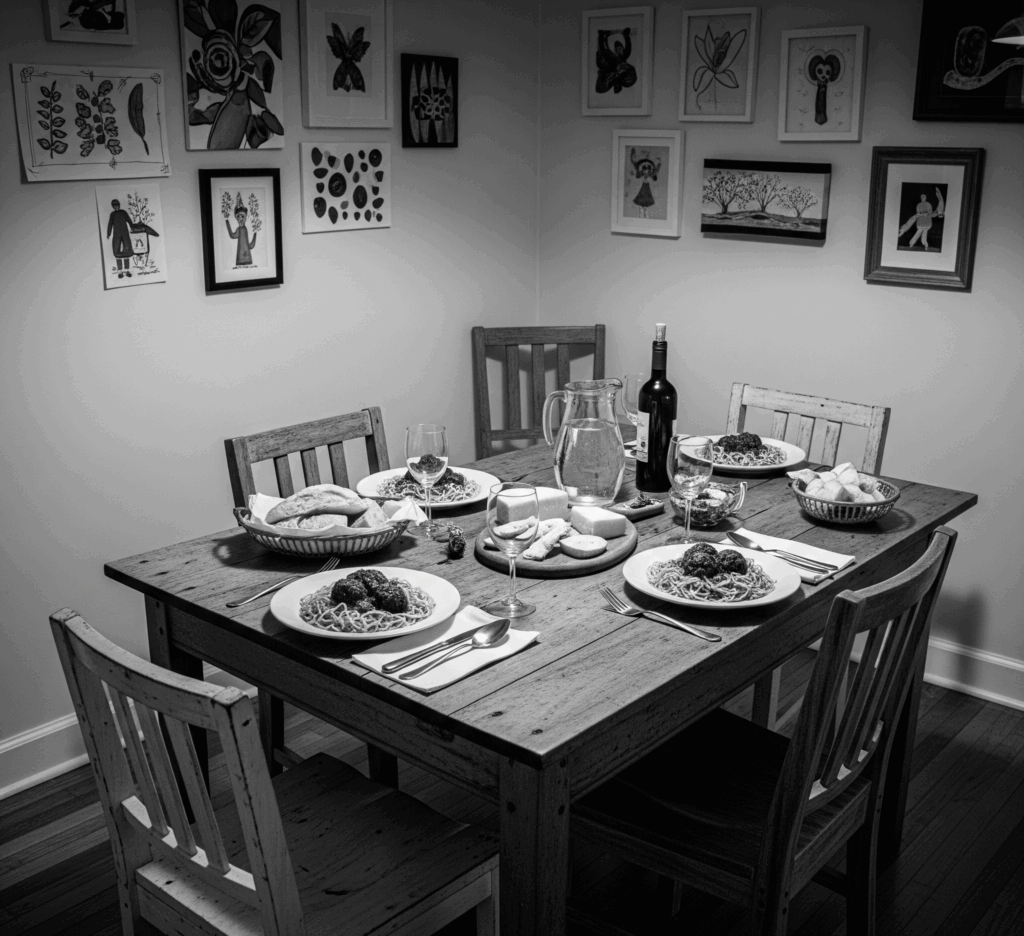
Minutes later, they were at a small, family-owned grocery store. Pooling their meager funds, they debated dinner options. “We should have something special,” Peggy declared. “I know let’s do spaghetti and meatballs…and get a loaf of Italian bread and some cheese.”
“Sounds perfect!” said Ethan.
“Maybe some gelato for dessert,” Peggy added. “I think we have enough money.”
“Gelato?” Ethan’s eyes widened. “I’ve never tried it.”
“Everyone in the house loves gelato!” Peggy exclaimed.
“Everyone?” Ethan inquired.
“My roommates,” Peggy clarified. “You’ll really like them, and they’ll definitely like you.”
“Roommates, hmmm?” Ethan murmured to himself, a flicker of something new – anticipation? – stirring within him.
Ethan pulled Bessie in front of a grand, old Victorian house, subdivided into a duplex. Peggy directed him to drive around to the alley and park behind the house. “Don’t worry,” she assured him, “this is our parking space, and now we have a reason to use it.” Peggy was in a remarkably good mood, humming a cheerful tune. Ethan watched her, captivated by her unburdened happiness, a feeling he yearned to experience.
They ascended the back steps to the upper duplex, laden with groceries, backpacks, and Ethan’s violin. At the door, they were greeted by Amy, a self-proclaimed “hippie wannabe” who dressed the part but possessed the suburban directness Ethan was accustomed to. She was polite, expressed her happiness to meet Ethan, and was visibly thrilled about Peggy bringing home dinner.
The third roommate, Russel, entered the living room. Ethan braced himself, expecting the typical jock persona he’d encountered throughout high school. But Russel, to Ethan’s surprise, was an artist. He enthusiastically showed Ethan sketches for a stage play, asking for his opinion on stage designs. Peggy, however, intervened, suggesting they give Ethan a chance to settle in first.
Amy led Ethan to the living room couch. He gazed around, marveling at the abundance of framed and unframed artwork adorning the walls – truly amazing pieces. Amy then asked about his musical preferences. When Ethan replied “most anything,” she seemed a little annoyed. “Everyone has their particular type of music that fits their personality,” she stated, “everyone is unique.” Amy stood up, studying Ethan intently. “You seem to be in pain,” she observed. She walked to a shelf filled with record albums, selected one, and placed it on the stereo. The melancholic strains of Samuel Barber’s “Adagio for Strings” filled the room. She sat back down beside him. “This is how I see you now,” she said, her voice soft but firm, “but this isn’t the real you. The real you is buried under a whole mess of unnecessary bullshit. You need to toss the bullshit.”
Peggy, stepping in from the kitchen, gently chided Amy. “Cut him some slack, Amy, don’t scare him off. He’s a nice guy.” She smiled reassuringly at Ethan before returning to her cooking.
Russel joined them in the living room, settling into a chair opposite the couch. He began asking Ethan questions, seemingly genuinely interested in his answers. Amy, too, listened intently, clearly trying to piece together who Ethan truly was.
Dinner was fantastic, the spaghetti and meatballs surprisingly delicious. Russel opened a bottle of wine, and they shared it, a sense of camaraderie blooming around the table. After the meal, Ethan helped Peggy with the dishes. He thanked her for the wonderful dinner and the great time but said he should probably head home.
Peggy turned to him, her expression firm. “Nonsense, you’re not going anywhere. Why go home? Why go back to all that stress and negativity? You can stay here.”
“But my parents will wonder where I am,” Ethan protested weakly.
Peggy looked him directly in the eyes. “Do you really want to go home, Ethan? Think before you answer.”
Ethan closed his eyes, his thoughts a chaotic whirlwind. The stress he’d tried to suppress surged back, and he felt tears beginning to fall again. Peggy gripped his arms. “Ethan!” she exclaimed.
He opened his eyes. Everyone was in the kitchen now, all eyes on him. Ethan looked at Amy and Russel, then his gaze settled on Peggy. His voice, barely a whisper, was laced with raw desperation. “I never want to go back home.”