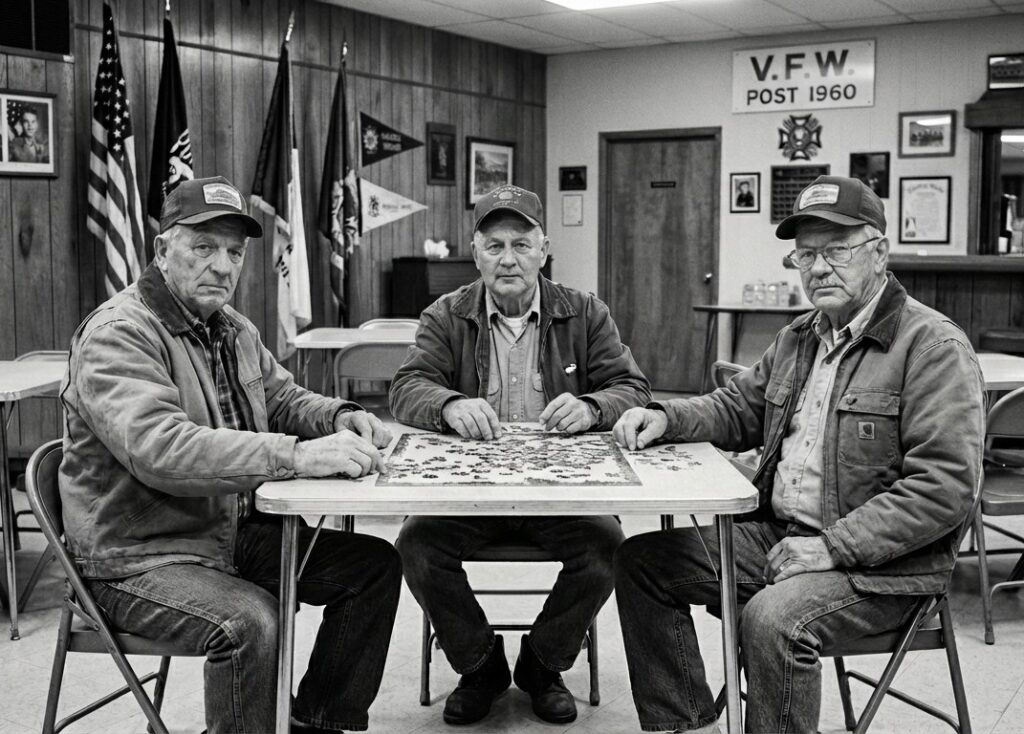
Peggy pulled open the service door and stepped into a dimly lit hallway. The air was thick and heavy with the scent of aged beer, Pine-Sol cleaner, and the sharp, nicotine tang of old tobacco smoke. It was quite warm inside. A stark contrast to the fresh gentle breeze outside.
The hallway led her around a corner and into the main hall – a large, cavernous room where sunlight struggled to penetrate the high, dusty windows. A few folding tables were set up near a makeshift counter, and seated around one table were three elderly men, wearing jackets, baseball caps and the casual, comfortable clothes of retirement. They were arguing good-naturedly over a half-completed jigsaw puzzle, their voices rumbling like distant thunder.
“Look, Fred, that piece is clearly part of the river! You can see the shading!”
“Nonsense, Harold! That’s part of the sky!”
Peggy cleared her throat. The conversation stopped instantly. All three heads snapped towards Peggy – a young woman with a backpack, looking totally out of place.
“Well, hello there,” the man Peggy took to be Harold said, pushing his chair back. He had a friendly but suspicious look in his eye. “Can we help you, miss? The VFW isn’t officially open until five.”
Peggy forced a smile and walked toward them, placing the backpack on the table. She pulled out the folded copy of the 1957 road map and the blurry 1959 newspaper photo from the envelope.
“My name is Peggy. I know this is strange, but I’m looking for some information about an old dance band, Tommy Melk and the Melk Duds, and a town called Royal. I have an old poster for a dance held in this hall.”
The men exchanged glances. The one named Fred grunted, chewing on the end of a wooden toothpick. “Melk Duds? Sure, I remember Melk. They played a mean polka. But that was years ago, kid. Long before you were born.”
Harold picked up the map, his finger tracing the line from Highway 139 until the finger rested on the small dot labeled Royal.
“This here map is old,” he observed. “Royal. That town’s been long gone. What in the blazes do you want with Royal?”
Peggy chose her words carefully, deciding to focus on the people, not the quarantine. “I’m trying to trace the history of a family friend, a musician. His name was Paul, and he played the accordion for the Melk Duds.” Peggy then pointed to the newspaper photo of the roadblock. “Do any of you remember this? The quarantine in 1959?”
The third man, who had been silent, slowly pushed his glasses up his nose. “Quarantine? I remember that. April ’59. Measles outbreak was terrible. County sheriff locked that place down tighter than an oil drum. Never seen anything like it.” He looked at Peggy, his eyes suddenly sharp. “Why’s that important, girl?”
“I have reason to believe this family friend … Paul … lived in Royal. I’m trying to put the pieces of a puzzle together. I need to find out what happened to the town and people of Royal.”
Fred snorted. “What happened? They waited out the quarantine, same as everyone else. Once the all-clear came, people just started leaving. Royal was a small place anyway, mostly a tourist trap. By the mid-sixties, everyone was gone and the county just abandoned the town and roads.”
Harold, however, was still staring at the map. “Wait a minute, Fred. That ain’t exactly right. The quarantine was lifted, sure, but Royal didn’t just empty out. Some folks… they never left right away. And that one woman, Grace. She was….” Harold’s voice trailed off. He stared down and went back to work on the puzzle.
Peggy’s heart hammered against her ribs. Grace. The love of Ethan’s grandfather’s life.
“What about Grace?” Peggy whispered, leaning in.
Harold looked uneasy, casting a glance down the hallway. “Years before the measles outbreak, Grace had a kid. Folks said the measles hit the town hard. I heard… just talk, mind you… that Grace and her child were the last ones in Royal to leave. They stayed there long after the power was cut. She was holding out for someone to come back.”
“Who was she holding out for?” Peggy pressed, her voice sounding urgent.
Before Harold could answer, the front door of the VFW hall swung open.
“Peggy!”
It was Eleanor, the taxi driver, standing framed in the doorway, her face etched with genuine alarm.
“Eleanor, what are you doing here?” Peggy asked, bewildered. The front doors were locked. How did she get in?
“I came back for you!” Eleanor strode into the hall, ignoring the men. “I got halfway back to Black River Falls and realized what I did. Dropping a pretty college girl off alone in Oakhaven with nothing but a backpack. I was worried sick. You get some real rough characters wandering these parts. You’re coming home with me.”
Peggy realized she had misjudged the woman completely; Eleanor wasn’t just a taxi driver, she was a motherly protector. She quickly gathered her materials. The men, their conversation thoroughly disrupted, offered no protest.
Peggy looked down at Harold. “I need to come back tomorrow,” Peggy told Harold firmly. “I need to know more about Grace and that child.”
Harold just nodded, looking resigned. “You ask Eleanor. She’s a local. She’ll know more than us old coots.”
As Peggy was putting the map and newspaper article back in the envelope, she glanced down at the puzzle the three old men were putting together. Peggy’s eyes widened at the almost completed puzzle. It was the gazebo from the cover page of the sheet music “In The Shadow Of Yesterday”.