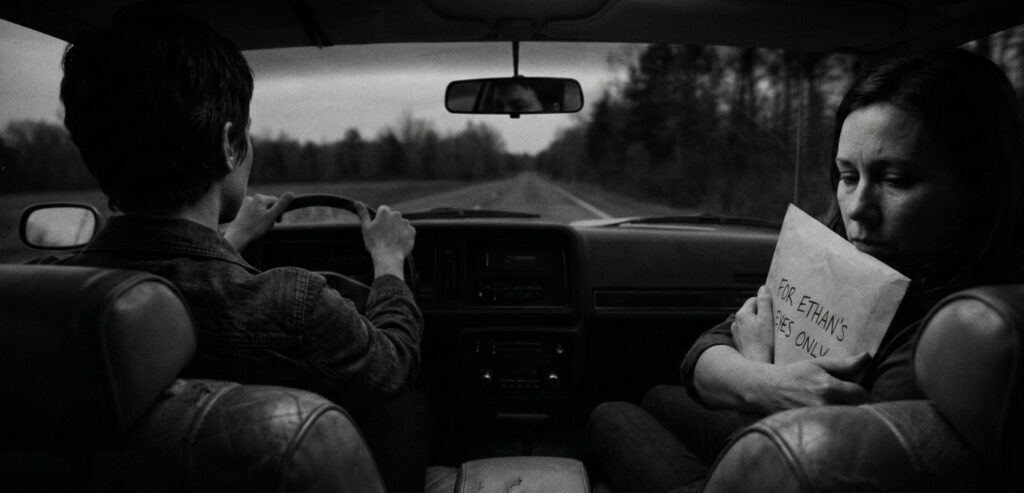
The heavy front door of the VFW groaned shut, sealing out the amber light of the late afternoon. Peggy sat in the passenger seat of Eleanor’s battered Chevy. Her mind spinning faster than the gravel under the tires. Clutched in her arms, the “For Ethan’s Eyes Only” envelope felt heavy, a physical weight of secrets and skipped heartbeats.
“You’re awfully quiet, sugar,” Eleanor said, her eyes fixed on the winding blacktop. “Those old warhorses in there can talk your ear off, but they don’t mean much harm. Mostly just bored.”
Peggy looked at Eleanor’s profile. The woman’s hands were steady on the wheel, her face a map of small-town resilience. “Harold mentioned a woman named Grace. He said she stayed in Royal after everyone else left. After the power was cut.”
Eleanor’s foot hesitated on the gas for a fraction of a second. The engine hummed a lower note. “Harold always did have a soft spot for a ghost story. But Grace… she wasn’t a story. She was real enough.”
“Did you know her?”
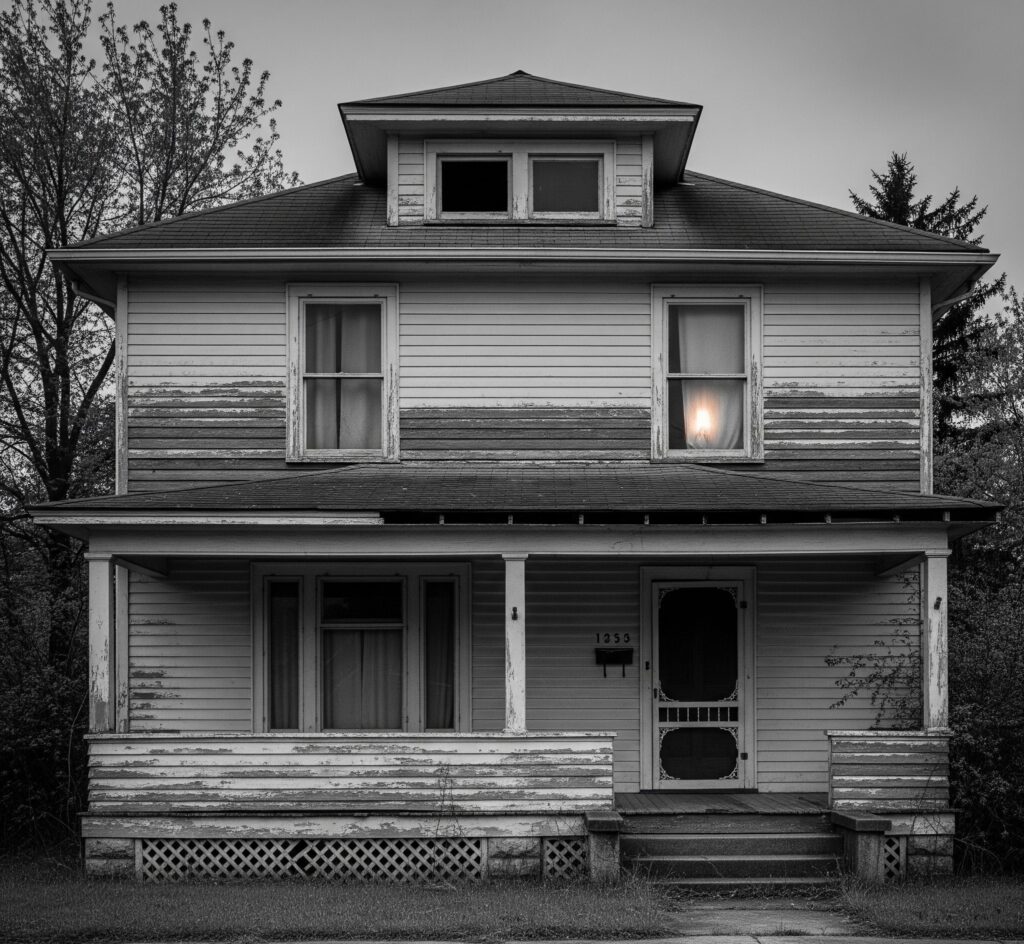
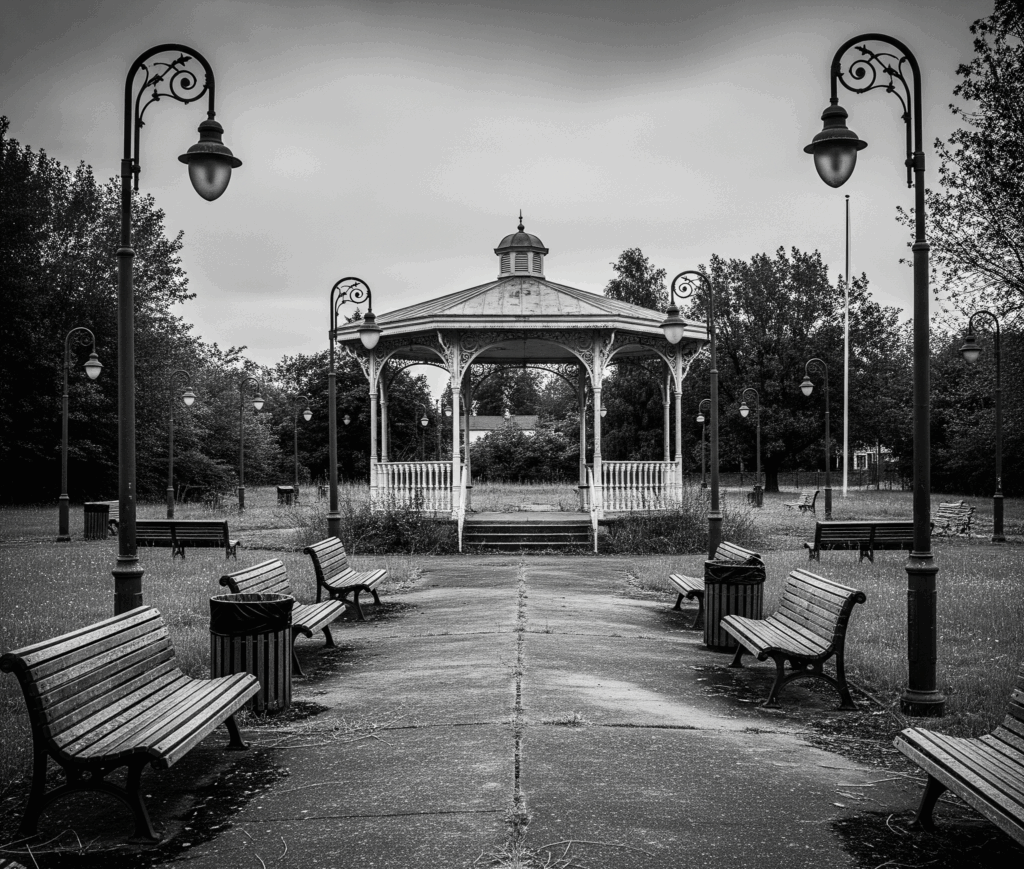
Eleanor sighed, a sound like dry leaves skittering across pavement. “Everyone knew the girl who waited. She lived in that little Victorian house near Royal Park. The park with the gazebo. The house was a beautiful place before the quarantine. After? It was like the world just forgot to keep turning for her.”
Peggy’s breath hitched. The gazebo. The image from the puzzle, the image on the sheet music. It wasn’t just a romantic illustration; it was a landmark of a tragedy.
“She had a child, didn’t she?” Peggy pressed.
“A boy,” Eleanor said. “Born a few years before the ’59 outbreak. Grace was… different after that. Fiercely private. When the sheriff put up the roadblocks for the measles quarantine, she didn’t complain. Some say she liked the silence. But then the quarantine lasted too long. The measles story started to smell funny to folks in Oakhaven. People stopped getting sick, but the guards stayed. And when they finally left? Royal was just a shell.”
“Why didn’t she leave with the others?” Peggy asked.
“She told my mom once that she’d promised someone she’d be there when the music started again. Can you imagine? Waiting in a town with no lights, no mail, just the wind whistling through the abandoned town.” Eleanor shook her head. “She stayed until 1964. By then, the boy was school-age. The county finally sent a social worker in to force them out. They moved her to a state facility over in Chippewa Falls. The boy… well, he went into the system.”
Peggy gripped the envelope. “What was the boy’s name?”
Eleanor turned the blinker on, the rhythmic click-clack filling the tense silence of the car. “I really don’t remember. Maybe after his father. But Grace never would say who the father was. Just that he was a traveling man. Or something like that. Some said the father was a musician. He might have played in the Tommy Melk band”
The realization hit Peggy like a physical blow. Tommy Melk and the Melk Duds? Ethan’s grandfather? The family friend she told the old men about wasn’t just a friend. Could it be…?
As they pulled into the driveway of a small, neat house in Black River Falls, Eleanor turned off the ignition. The silence was absolute.
“Peggy,” Eleanor said softly, “that puzzle those old men were working on? It’s been in that VFW hall for years. No one ever finishes it because one piece is missing. Just like the truth about Royal. Some things are better left lost in the woods.”
Peggy looked at the dark silhouette of the trees against the twilight sky. Somewhere out there, past the highway and the history books, the ghost town of Royal was waiting. And she knew, with a terrifying certainty, that she held the missing piece in her hand.
The needle of Ethan’s life had finally found a groove. After several weeks in Royal, the initial static of terror had smoothed into a steady, mid-century hum. He had a routine now, one that felt more like a ceremony than a schedule.
Each morning, the sun would spill across his floorboards, beckoning him down to a kitchen that would eventually smell of percolating coffee and bacon and eggs. He’d step onto the porch to retrieve the morning paper, often lingering to trade pleasantries with a neighbor. These were simple exchanges—talk of the weather or local gossip—but they anchored him. By the time he sat down with his coffee and breakfast, Ethan’s true reality felt like a half-remembered dream.
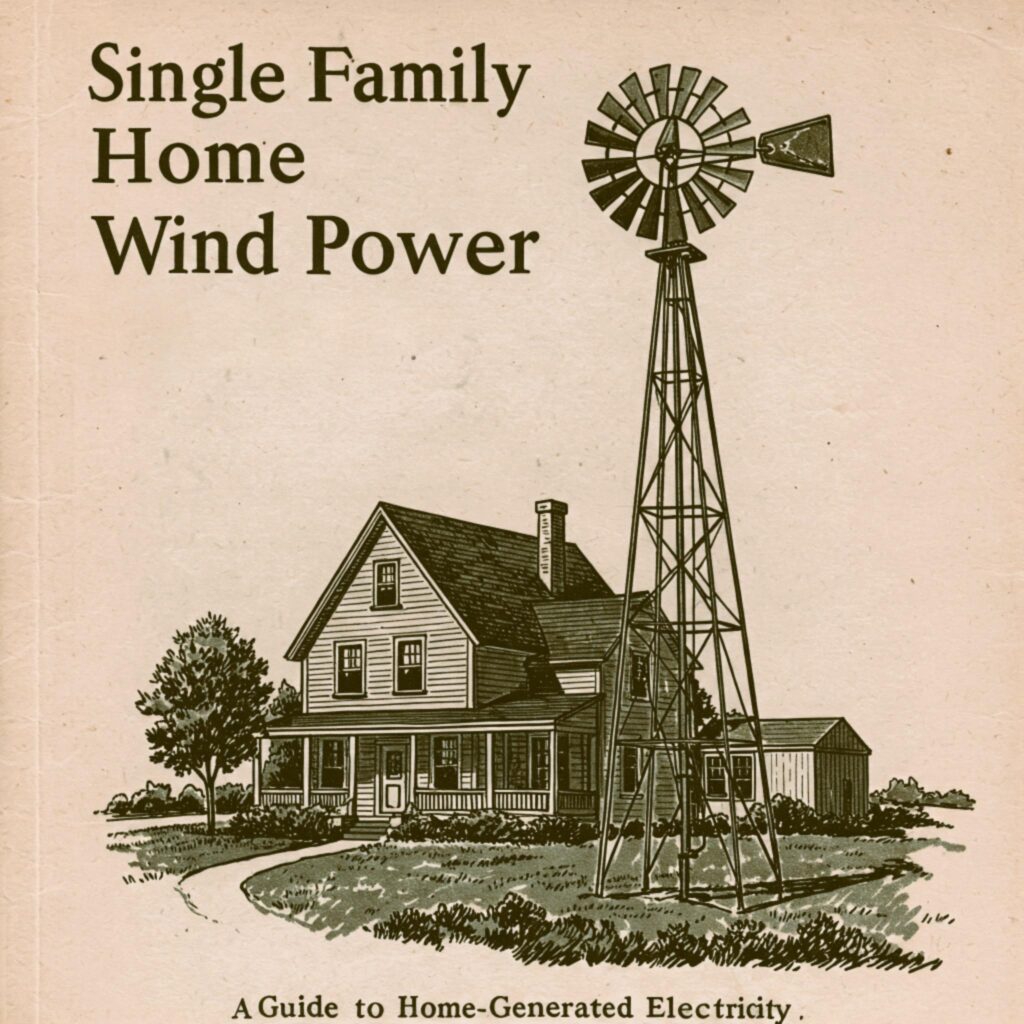
He spent his midday hours in a state of quiet productivity. He mowed the lawn, tended to his vegetable garden, and performed his ritual check on the windmill. He found solace in his backyard shed, tinkering with tools and reading articles from a stack of Popular Science magazines.
Most surprisingly, he had returned to his violin. At first, the music was a struggle. His fingers were stiff, and the bow felt like a lead weight in his hand. The notes he produced were rusty, screeching protests that sounded out of tune with the world around him. But as the days passed, the stiffness in his arm melted away, and the melodies began to flow, smoothing out until they matched the rhythm of the town itself.
By afternoon, Ethan was the charming voice of WRYL. Ethan would walk to the radio studio and back with the easy gait of a man who belonged. He ate at the Lunch Box Cafe, engaged in philosophical bouts with Pastor Dzef, and attended services at Saint Helga’s. He was happy or so he told himself. He felt a sense of control that had eluded him in his “real” life.
But Royal had a way of reminding him he was a guest, not a native.
Every evening, the silence of the house brought the “other” reality back into focus. He would look into the corner of the dining room and see them – the backpack, the cooler, and the suitcase. They sat there like artifacts from a shipwreck. In their presence, Ethan would snap back to his true timeline, and the anxiety would bloom in his chest like a dark flower.
On his hardest days -the days when Ethan was not working, he would walk to the edge of town. He’d stare at the horizon, wondering if he could simply outrun the 1950s. But Royal was a jealous guardian. Every time he strayed too far, a neighbor or a passerby would magically appear, striking up a conversation that gently but firmly steered him back home. He was trapped in a tug-of-war between his memory of Peggy and his family, and the magnetic pull of this perfect, impossible place. At night, he felt a presence watching over him, a phantom guardian that vanished the moment he woke.
One afternoon, the Town of Royal decided it was time for Ethan to move beyond his routine.
As he walked toward the radio studio, he spotted a woman outside the Greyhound bus station, right next to the Lunch Box Cafe. She stood by a lone suitcase, her long brown hair catching the light. She looked familiar – hauntingly so. But the connection slipped through Ethan’s mind. Her face had a radiant, almost angelic glow. When she looked at Ethan and smiled, he felt mesmerized, his feet momentarily rooted to the sidewalk.
A bus pulled up, venting a cloud of diesel smoke. Passengers spilled out, and Ethan quickened his pace, desperate to reach her. But by the time the door hissed shut and the bus pulled away, the sidewalk was empty. She wasn’t on the bus, and she wasn’t on the street. She had simply vanished.
“People stay and people leave. It is all in what you believe,” a voice stated.
Ethan turned to find Pastor Dzef standing there, holding out a chocolate malt. The Pastor’s gaze was heavy with meaning as they both watched the bus disappear down the road. “What do you believe in, Ethan?”
Ethan didn’t have an answer. He offered a small smile, thanked the Pastor for the malt, and continued toward work.
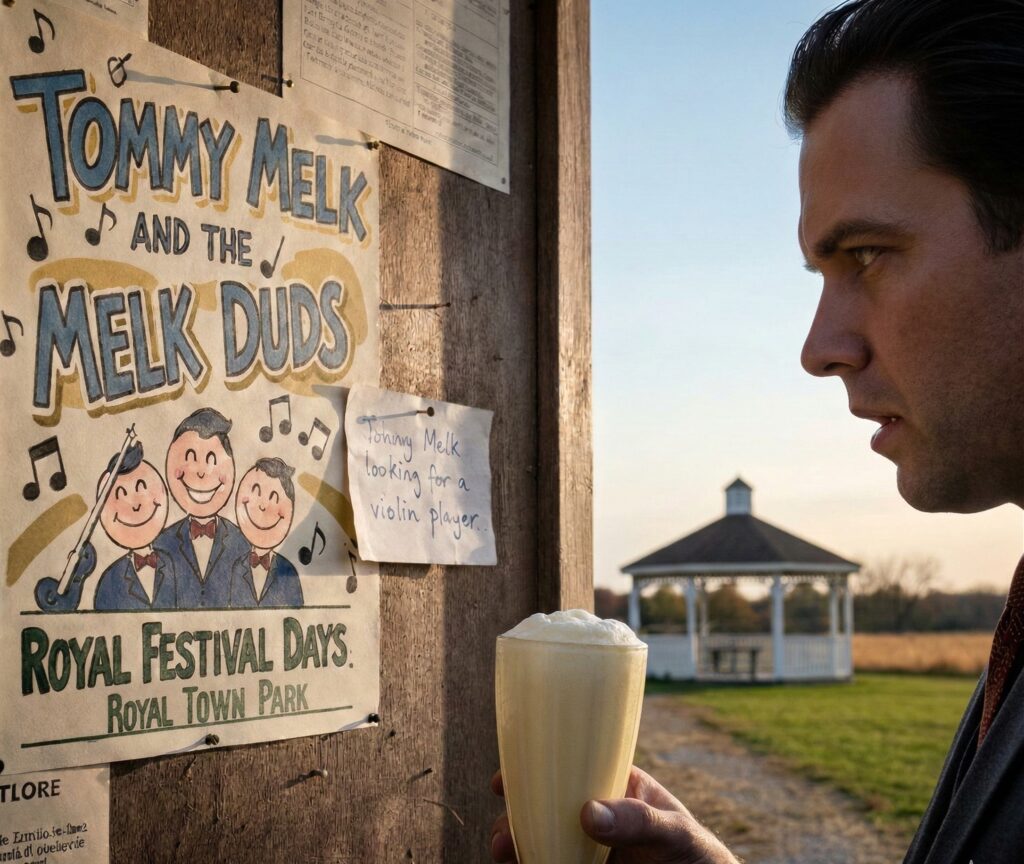
As he passed Royal Park, something new caught his eye on the community bulletin board. A vibrant poster announced that Tommy Melk and the Melk Duds would be performing at the gazebo during the upcoming Royal Festival Days.
Pinned right next to it was a small, hand-written scrap of paper that seemed to vibrate with possibility. Tommy Melk was looking for a violin player.
Ethan felt the weight of the chocolate malt in one hand and the calluses on the fingers of the other. The tug of realities had just entered a new phase.
Peggy pulled open the service door and stepped into a dimly lit hallway. The air was thick and heavy with the scent of aged beer, Pine-Sol cleaner, and the sharp, nicotine tang of old tobacco smoke. It was quite warm inside. A stark contrast to the fresh gentle breeze outside.
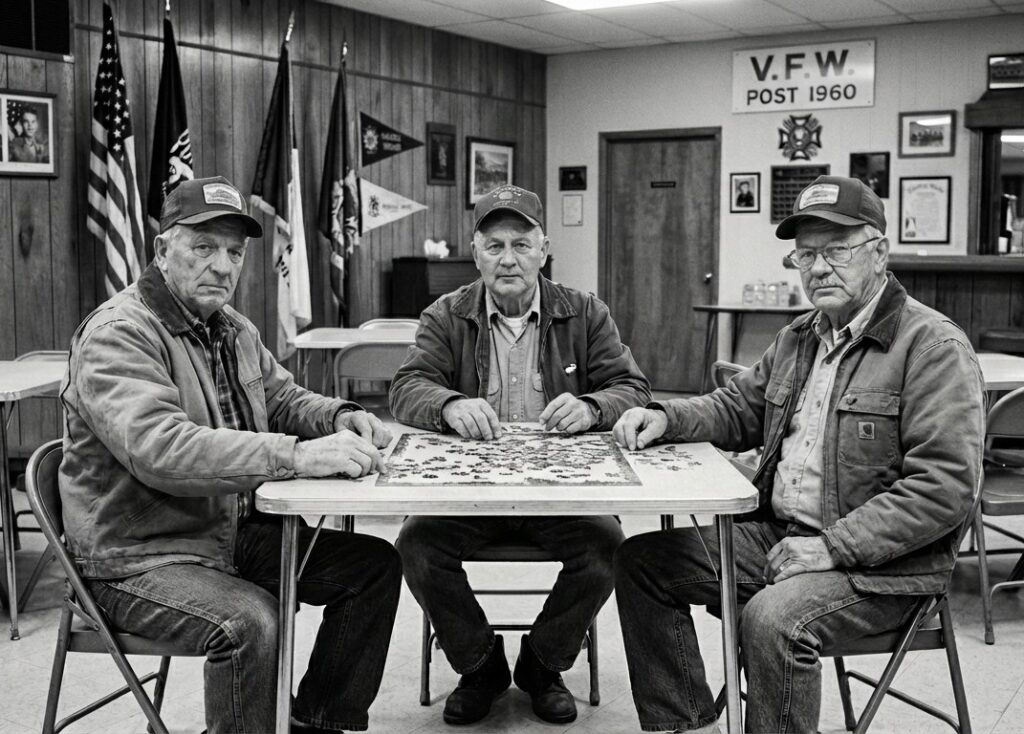
The hallway led her around a corner and into the main hall – a large, cavernous room where sunlight struggled to penetrate the high, dusty windows. A few folding tables were set up near a makeshift counter, and seated around one table were three elderly men, wearing jackets, baseball caps and the casual, comfortable clothes of retirement. They were arguing good-naturedly over a half-completed jigsaw puzzle, their voices rumbling like distant thunder.
“Look, Fred, that piece is clearly part of the river! You can see the shading!”
“Nonsense, Harold! That’s part of the sky!”
Peggy cleared her throat. The conversation stopped instantly. All three heads snapped towards Peggy – a young woman with a backpack, looking totally out of place.
“Well, hello there,” the man Peggy took to be Harold said, pushing his chair back. He had a friendly but suspicious look in his eye. “Can we help you, miss? The VFW isn’t officially open until five.”
Peggy forced a smile and walked toward them, placing the backpack on the table. She pulled out the folded copy of the 1957 road map and the blurry 1959 newspaper photo from the envelope.
“My name is Peggy. I know this is strange, but I’m looking for some information about an old dance band, Tommy Melk and the Melk Duds, and a town called Royal. I have an old poster for a dance held in this hall.”
The men exchanged glances. The one named Fred grunted, chewing on the end of a wooden toothpick. “Melk Duds? Sure, I remember Melk. They played a mean polka. But that was years ago, kid. Long before you were born.”
Harold picked up the map, his finger tracing the line from Highway 139 until the finger rested on the small dot labeled Royal.
“This here map is old,” he observed. “Royal. That town’s been long gone. What in the blazes do you want with Royal?”
Peggy chose her words carefully, deciding to focus on the people, not the quarantine. “I’m trying to trace the history of a family friend, a musician. His name was Paul, and he played the accordion for the Melk Duds.” Peggy then pointed to the newspaper photo of the roadblock. “Do any of you remember this? The quarantine in 1959?”
The third man, who had been silent, slowly pushed his glasses up his nose. “Quarantine? I remember that. April ’59. Measles outbreak was terrible. County sheriff locked that place down tighter than an oil drum. Never seen anything like it.” He looked at Peggy, his eyes suddenly sharp. “Why’s that important, girl?”
“I have reason to believe this family friend … Paul … lived in Royal. I’m trying to put the pieces of a puzzle together. I need to find out what happened to the town and people of Royal.”
Fred snorted. “What happened? They waited out the quarantine, same as everyone else. Once the all-clear came, people just started leaving. Royal was a small place anyway, mostly a tourist trap. By the mid-sixties, everyone was gone and the county just abandoned the town and roads.”
Harold, however, was still staring at the map. “Wait a minute, Fred. That ain’t exactly right. The quarantine was lifted, sure, but Royal didn’t just empty out. Some folks… they never left right away. And that one woman, Grace. She was….” Harold’s voice trailed off. He stared down and went back to work on the puzzle.
Peggy’s heart hammered against her ribs. Grace. The love of Ethan’s grandfather’s life.
“What about Grace?” Peggy whispered, leaning in.
Harold looked uneasy, casting a glance down the hallway. “Years before the measles outbreak, Grace had a kid. Folks said the measles hit the town hard. I heard… just talk, mind you… that Grace and her child were the last ones in Royal to leave. They stayed there long after the power was cut. She was holding out for someone to come back.”
“Who was she holding out for?” Peggy pressed, her voice sounding urgent.
Before Harold could answer, the front door of the VFW hall swung open.
“Peggy!”
It was Eleanor, the taxi driver, standing framed in the doorway, her face etched with genuine alarm.
“Eleanor, what are you doing here?” Peggy asked, bewildered. The front doors were locked. How did she get in?
“I came back for you!” Eleanor strode into the hall, ignoring the men. “I got halfway back to Black River Falls and realized what I did. Dropping a pretty college girl off alone in Oakhaven with nothing but a backpack. I was worried sick. You get some real rough characters wandering these parts. You’re coming home with me.”
Peggy realized she had misjudged the woman completely; Eleanor wasn’t just a taxi driver, she was a motherly protector. She quickly gathered her materials. The men, their conversation thoroughly disrupted, offered no protest.
Peggy looked down at Harold. “I need to come back tomorrow,” Peggy told Harold firmly. “I need to know more about Grace and that child.”
Harold just nodded, looking resigned. “You ask Eleanor. She’s a local. She’ll know more than us old coots.”
As Peggy was putting the map and newspaper article back in the envelope, she glanced down at the puzzle the three old men were putting together. Peggy’s eyes widened at the almost completed puzzle. It was the gazebo from the cover page of the sheet music “In The Shadow Of Yesterday”.
The gentle May air of Milwaukee was bright and fresh, but Peggy barely noticed. She stood outside the intercity bus depot, the worn canvas backpack containing everything for the trip, including Ethan’s envelope, slung over her shoulder. Amy and Russel flanked her, two steadfast pillars of worry in the early morning light. Their support felt like both a lifeline and an anchor of guilt.
“Are you sure you don’t want me to drive you at least to Madison?” Amy pleaded, adjusting the lightweight cardigan she wore. “It would shave two hours off the bus ride.”
“No, Ames. I’m fine,” Peggy insisted, trying to sound more confident than she felt. “You need the gas, and you both need to focus on finals. I’ll be fine. Black River Falls is the key. Once I’m there, I’ll figure the rest out.”
Russel silently pressed a wad of bills into her hand. All their combined cash reserves, tightly folded. “This has to last, Peg. Get a room if you have to, but don’t spend it on anyone trying to fleece a college kid. Promise us you’ll call.”
Peggy’s throat tightened. She looked at their earnest, worried faces, recognizing the enormous sacrifice they were making for her singular, all consuming quest. “I promise. I will call. And I will find him.”
A moment of profound, silent sorrow passed between the three of them. They knew this was reckless, but they also understood the alternative. Watching Peggy slowly dissolve under the weight of her grief and curiosity was worse.
“Be safe. Don’t take any risks you don’t have to,” Russel finally said, giving her a brief, awkward hug.
Amy embraced her tightly. “Bring him home, Peg.”
Peggy watched them drive away, the headlights of Amy’s beat-up Honda Civic disappearing into the Milwaukee sunrise. Then, she turned, clutching the backpack and walked into the sterile, diesel-scented cavern of the depot. She was on her own now.
Peggy’s only real lead was found in the envelope marked “For Ethan’s Eyes Only.” The envelope Ethan’s grandmother opened. Looking through the contents, she found a single, garish flyer: Tommy Melk and the Melk Duds playing at the Oakhaven VFW.
Oakhaven was the clue. Spreading out her map, she located Royal. She then located Oakhaven and felt a jolt of pure adrenaline: it was the closest town to Royal she could find. The flyer was not an invitation, but a cryptic destination. Her path was clear. She would take the bus to Black River Falls, the nearest stop, and from there find transport to Oakhaven.
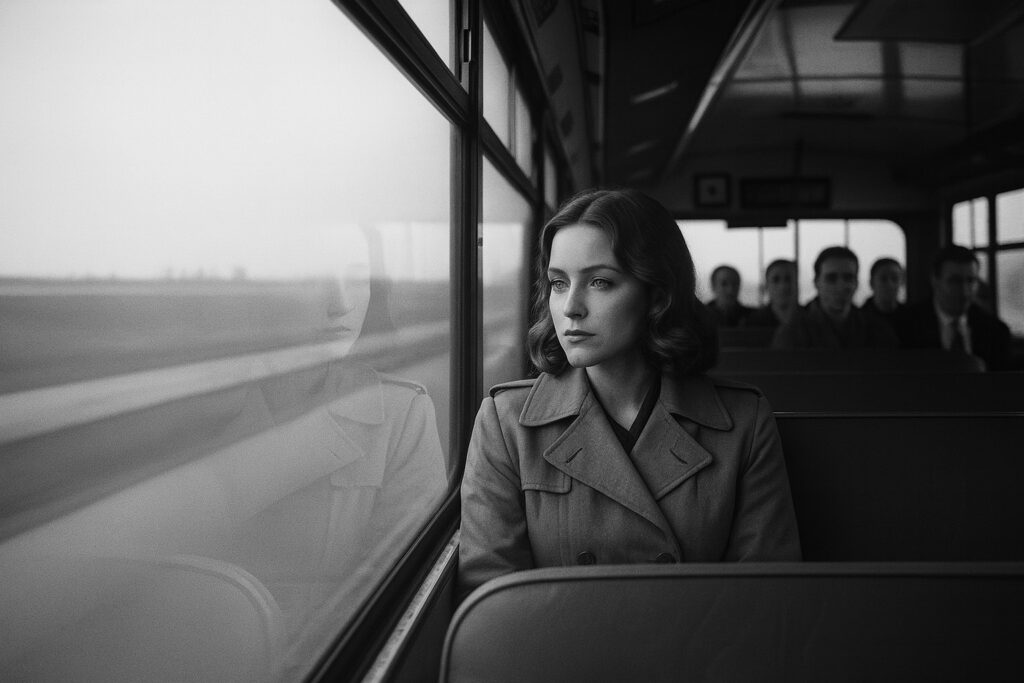
The bus ride was a warm, rattling blur. Peggy sat by the window, letting the bright, green landscape of Wisconsin roll past, her mind replaying the story of Ethan’s grandfather, of Grace, and the secret love the two shared. The town of Royal, the measles quarantine in 1959. It was all coming into focus, but the image was heartbreakingly tragic.
When the bus finally pulled into the Black River Falls depot, it was mid-morning. The small station smelled faintly of cigarettes and coffee. Peggy checked her watch: 10:30 AM. She had made it. But the next hurdle was upon her. How to cover the remaining twenty miles to Oakhaven, the town neighboring Royal.
She walked out to the parking area, her eyes scanning for any sign of opportunity. A couple of battered cars were parked near the entrance, drivers leaning against them, waiting for passengers. She approached the first man, who quoted a price that would take nearly half of Amy and Russel’s cash. Peggy shook her head and moved on. The second driver was equally expensive. She stood for a long minute, feeling the familiar spiral of panic begin to choke her. “Recognize what is in front of your face,” Peggy whispered to herself.
She turned back to the depot entrance and spotted a third car, an ancient, faded station wagon with a hand-painted sign duct-taped to the windshield that read, simply TAXI. The driver, a woman with kind eyes and a sensible, wool coat, was just settling behind the wheel smoking a cigarette.
Peggy walked up and leaned down to the open window. “Ma’am, I need to get to Oakhaven. It’s about twenty miles south on Highway 139. I don’t have much money.” Peggy quickly named a price she could afford, a fraction of the others’ quotes and held up the crumpled bills.
The woman, whose name tag read ‘Eleanor,’ considered her for a moment. “Oakhaven? Nothing much out there but woods and a VFW hall,” she observed. She looked at Peggy’s earnest face. “Well, you look like you’re on a mighty important mission, dear. Hop in. I can’t promise you a ride back, but I’ll take you the twenty miles for that. Just promise me you won’t stand out there alone hitchhiking.”
Peggy’s relief was immediate and overwhelming. “Thank you, Eleanor. Thank you so much.”
The ride was surprisingly pleasant. Eleanor wasn’t one for chitchat, but the silence was a welcome change from the bus ride. As they drove south, Peggy kept her eyes glued to the scenery, looking for any clue, any hint of the landscape she’d seen in the grainy 1959 newspaper photo.
“Whereabouts in Oakhaven you headed?” Eleanor asked, pulling the station wagon onto the quieter, two-lane Highway 139.
“The VFW Hall,” Peggy answered immediately. She pulled out the blurry photo of the roadblock. “Do you know anything about a town called Royal? It was just a few miles from Oakhaven, years ago.”
Eleanor squinted at the photo, then chuckled, a dry, rusty sound. “Royal, huh? That’s a name I haven’t heard in years. My folks used to drive out there for dances when I was a kid. Why, Royal’s been nothing but timberland for ages now. The road’s gone, folks moved out.”
“But it was still there in ’59?” Peggy pressed.
“Oh, sure. Just before that big measles thing,” Eleanor nodded. “Everyone in the whole county was terrified. Whole place was locked up tight as a drum. Folks just kind of… never came back after that. Not much reason to, I suppose.”
Eleanor pulled over onto a narrow, paved road. The sun was fully up now, illuminating a small, sleepy collection of utility poles, a gas station that looked half-dead, and a single, faded sign reading: Welcome to Oakhaven—Established 1898. Just ahead, a squat, concrete block structure stood: the Oakhaven VFW Hall.
“This is it, dear,” Eleanor said, pulling out a cigarette from her purse. “Good luck with your mission.”
Peggy paid her, thanked her and stepped out onto the warm asphalt. She stood for a long moment, watching the station wagon pull away, her solitude absolute. Clutched in her hands were the envelope, the map, and the faint hope that someone inside that concrete hall remembered a dance, a band, a man with an accordion, and a lost town called Royal.
The VFW Hall looked closed, dark, and utterly impenetrable. She walked toward the front door, the heavy brass knob cold beneath her fingers.“Recognize what is in front of your face,” Peggy whispered to herself.
The door was locked.
Peggy walked around the side of the building, her shoes crunching on the gravel. Beside a loading dock, a small, unmarked door was ajar, a faint line of golden light spilling out, along with the distinct aroma of coffee and tobacco.
Taking a deep breath, Peggy pulled the door open and stepped inside.
The air inside WRYL Studios was thick with the scent of dust, old electronics, and coffee. It was the smell of analog broadcasting being done on a shoestring budget. In the small, bustling reception area, a woman with a bouffant hairdo kept her gaze fixed downward, her fingers a blur on the typewriter.
“Good afternoon,” Ethan said, his voice hesitant.
Clack-clack-clack. The woman didn’t pause.
“I’m Ethan,” he tried again, taking a step closer. “I… uh… I just got a call. My show?”
The woman stopped abruptly, snatched the paper from the carriage with a rip, and looked up, her expression a mix of impatience and professionalism. Her eyes were framed by sharp cat-eye glasses.
“About time, Ethan! Mr Stoddard wants to see you right away. He’s in his office.” She pointed to a closed office door. Ethan just stood there confused, unsure of what to do. The receptionist snapped. “Try to keep up, dear.” She punctuated her statement with a shaming glance at his vintage casual wear and a finger pointing to the closed office door..
“R-right,” Ethan stammered, feeling like a high school kid late for detention. He turned and walked towards the designated door. The wall behind Ethan was lined with framed, yellowing photographs of stern-looking men and women in suits—presumably past station managers or local celebrities. The door was marked with a gold-plated sign: E. G. STODDARD, STATION MANAGER.
Ethan knocked.
“It’s open, you insufferable nitwit! Get in here!” roared the same booming voice Ethan heard on the phone.
Taking a fortifying breath, Ethan pushed the door open. Behind a massive, cluttered metal desk sat a man who filled his tweed jacket completely. He had a bristly gray crew cut and a face that looked perpetually annoyed.
“There you are,” Stoddard barked, pointing a stumpy finger at a clock on the wall. “Twenty minutes to air. You’ve been late three times this month, Ethan. Three times! You keep this up, and the sponsors will pull the plug on ‘Ethan’s Afternoon Exchange.’ You want to go back to scrubbing dishes at the Lunch Box Cafe?”
“No, sir, I don’t,” Ethan answered, swallowing the impulse to inform the man he had never scrubbed dishes in his life. Everything he was hearing felt like a line of dialogue from a play he hadn’t rehearsed.
Stoddard ignored him and shoved a typed sheet of paper across the desk. “News first. You need to hit these three headlines hard. The new community pool—it’s the biggest project since the war. Second, the missing Royal High School mascot uniform—it’s a scandal. And third, make sure you mention Mrs. Gable’s prize-winning roses again. She buys ad time. You scratch her back, she scratches ours.”
Ethan picked up the paper, his eyes scanning the impossible, anachronistic news items: “Pool construction ahead of schedule.” “Manhunt for perpetrator of mascot theft.” He was being asked to discuss current events in a town he didn’t even recognize an hour ago.
“And what is the interview?” Ethan asked, trying to sound professional and not completely insane.
Stoddard sighed, rubbing his temples. “The usual routine. Mrs. Percy from the Garden Club is coming in to discuss the annual Lilac Festival. She’s bringing her notorious triple-layered lemon cake. Be nice, nod a lot, and for heaven’s sake, don’t mention her ex-husband. Last time you did, she almost threw a vase at you.”
Ethan blinked. He had a history here. Apparently a clumsy, tactless history with Mrs. Percy.
“Alright, Ethan, listen up,” Stoddard said, leaning forward. “This station is the heartbeat of Royal. It’s a good job, a steady gig, and you’ve got a real knack for it. But you need to be professional. Get it together. Now, go warm up your voice and get into Studio A. I’ll send the engineer in shortly.”
Stoddard gestured toward another door within the office.
“Studio A?” Ethan inquired.
“Yes, Studio A! Where you host your show five days a week! Now move!”
Ethan retreated, stumbling into a small sound-proofed room. It was tiny, dominated by a large microphone and a console covered in sliders and knobs. Through a thick glass window, he could see a second room with a turntable and a reel-to-reel tape machine. The air was colder here, quieter. The world outside felt very far away.
He sat down in the upholstered chair, the smooth vinyl squeaking under his weight. He touched the heavy, chrome microphone grille, feeling a sudden, strange rush of adrenaline. He was about to go on the air as a radio host in a 1950s-era town that had materialized out of thin air.
This is it, Ethan thought, placing his hands on the worn desk.
The door opened, and a middle aged man with thick black glasses and a worried expression slipped in, clutching a stack of 45-rpm records.
“Ethan, you look pale. Did you get any sleep? Stoddard’s furious,” the man said, his eyes magnified through the thick lenses. He smelled faintly of mint and engine oil.
“I… I’m fine, just a little off,” Ethan said, studying the man’s familiar-but-unknown face. “And you are?”
The man stared, flabbergasted. “It’s me! Bobby! Your engineer! Are you still mad about that time I accidentally played the wrong ad and you had to fill four minutes with a story about a goat?”
“Oh! Bobby! Right,” Ethan mumbled, trying to connect the dots. “No, not mad, just… stressed.
Bobby, visibly relieved, flipped a switch on the console in front of Ethan, causing the words “ON AIR” to glow red..
“Theme music is cued up. Five seconds,” Bobby announced, tapping a gauge on the console. “Remember to hit the news first, and for God’s sake, say hi to Mrs. Gable! She’s listening!”
Bobby quickly retreated to the engineer’s room, giving a thumbs-up through the glass.
Ethan felt his heart hammer against his ribs. He was staring at the microphone, an inert piece of metal that was about to connect him to an entire town of strangers who thought they knew him.
The music swelled, a bright, jazzy, slightly tinny melody. A green light on the console flashed.
He cleared his throat, swallowed hard, and leaned into the microphone.
“Good afternoon, Royal! This is…” he paused for a fraction of a second, “…Ethan.”
The jangling repetition of an alarm clock ripped Ethan out of a deep, dreamless sleep. Groaning, he reached across the expanse of the mattress and slapped the alarm off. He turned over, sinking back into the pillow, but something pricked his consciousness. That alarm clock never worked before.
Ethan slowly rolled onto his back and gazed up at the ceiling. Where was the signature patch of mildew? The tell-tale water stains from the leaky roof that had dripped on his first night? Instead, the ceiling was immaculate, the light fixture clean and new.
Ethan heard the first distinct sounds from outside: voices, clear and conversational, followed by the sputtering, ratcheting start of a lawnmower. The noise startled him. He sat up too fast. A wave of dizziness and disorientation washing over him.
Then the room snapped into focus. The walls were freshly painted, the hardwood floors gleaming, cleaned and polished to a rich luster. The furniture, which had been broken relics, was now new, dust-free, and perfectly arranged. Everything was in place. Nothing was lying on the floor.
Ethan stumbled over to the dresser and stared into the mirror. He was wearing pajamas. He definitely hadn’t packed pajamas in his meager luggage. He stared at his reflection. He hadn’t changed. But everything around him had.
Ethan bolted to the window and looked out. The view had been transformed. The houses weren’t dilapidated shells; they were in pristine shape. Freshly painted homes with manicured lawns. This wasn’t a ghost town. The trees were bursting with leaves, flowers bloomed in neat beds, and the distinct, sweet scent of lilacs drifted in the air.
Ethan heard the voices again, closer now. People were outside. Some relaxing on their porches, others walking along the sidewalk. Kids played tag on the grass or rode their bikes. Several cars were parked along the curb, and occasionally, one would drive by.
Ethan stood glued to the glass, his mouth gaping wide. What is going on?
People! The realization hit him with the force of a physical blow. Without stopping to process the bizarre shift, Ethan tore down the stairs and burst out the front door, stopping dead on the porch. The sheer reality of the vibrant, breathing town left him utterly dumbfounded.
“Hey, Ethan! Those are some mighty fine PJs!” a man from the house next door called out, with a friendly, familiar grin on his face. “Don’t you think you should get dressed? You’ll be on the air soon.”
“Yes,” Ethan muttered, still dazed. “On the air.” The phrase meant nothing. He realized the man, and several other people, had stopped what they were doing and were simply staring. Kids pointed and giggled. People across the street paused their conversations to look and gesture.
Feeling a sudden, overwhelming blush, Ethan forced a tight smile, backed awkwardly through the door, and closed it quickly.
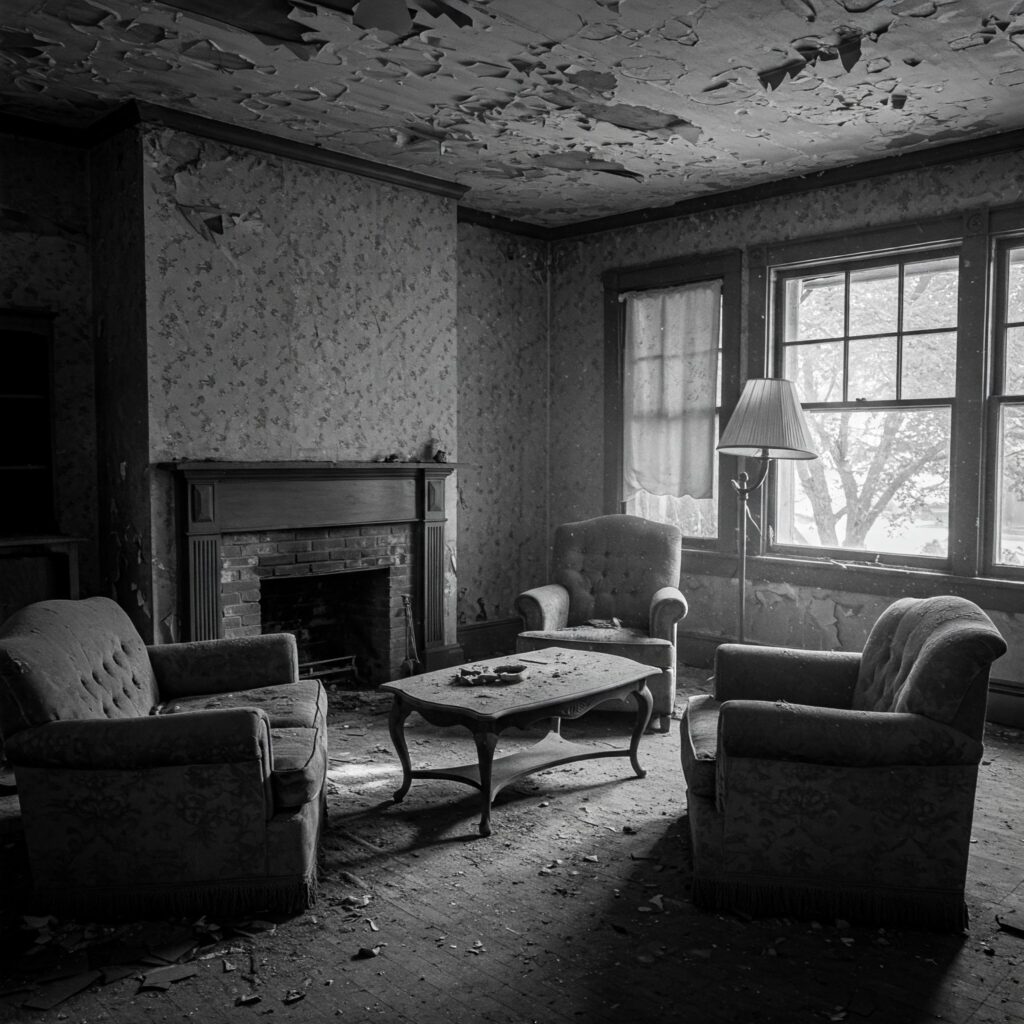
The inside of the house was a revelation. The living room and dining room glowed with perfect restoration. The old, dirty furniture looked new and clean. The floors were spotless. Fresh curtains hung on sparkling windows. The bookshelf near the fireplace was full of books, the coffee table topped with a neat stack of magazines.
The dining room looked like a museum exhibit. Corner hutches were filled with delicate dishes and glasses. The chandelier’s crystals shone brightly. A lace tablecloth adorned the six-chaired table, a candelabra sitting ready in the center. The two rooms, impeccable and welcoming, reminded him instantly of his grandfather’s house.
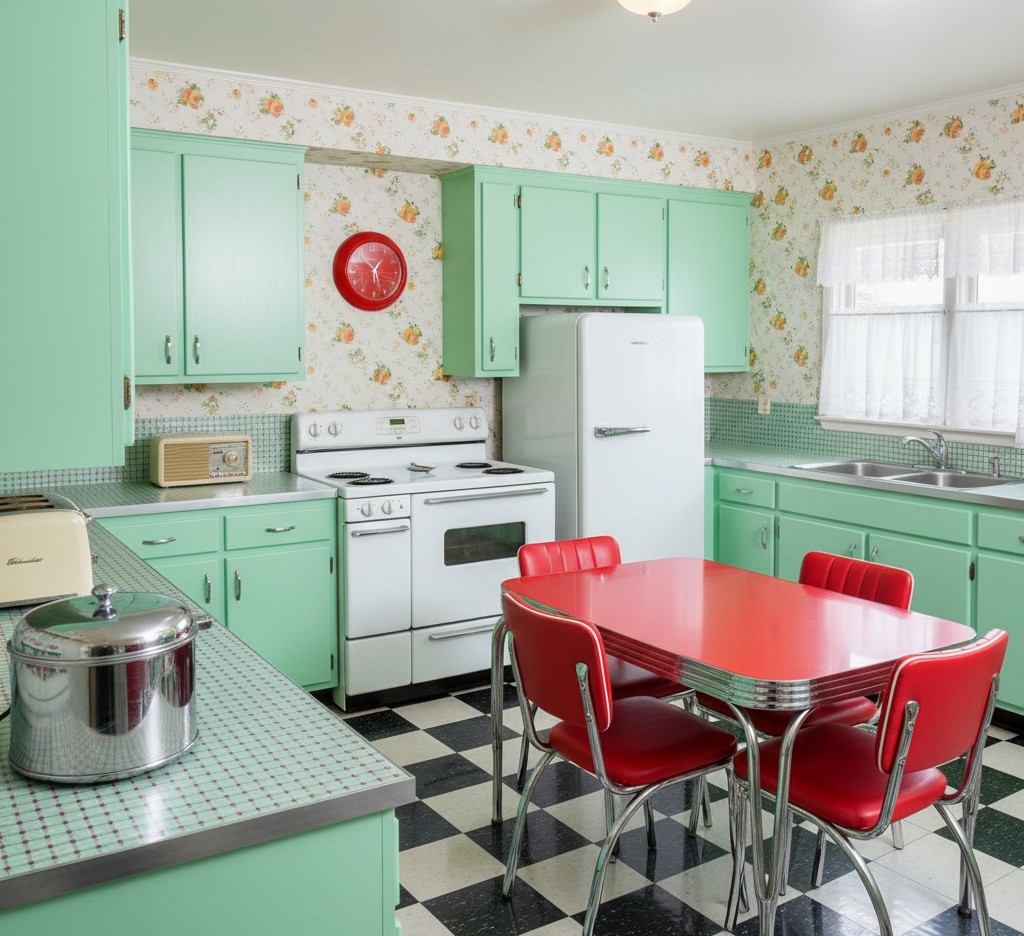
Still reeling, Ethan drifted into the kitchen and stopped dead in his tracks. The linoleum floor was a crisp black and white checkerboard, slippery with a fresh coat of wax under his socks. The wood cabinets were a cheerful mint green, contrasting sharply with the white stove and refrigerator. The countertops were an eye-popping mint green and magenta checkerboard Formica pattern. There was a chrome bread box, a chrome electric coffee pot, a radio, and a chrome toaster. A chrome kitchen table with a bright red Formica top and matching vinyl chairs anchored the room.
He opened the refrigerator; it was fully stocked with food he liked. Drawers and cabinets held new cookware. The pantry was full.
Ethan sank onto one of the kitchen chairs, burying his face in his hands. “What is going on here?” he muttered.
Then a telephone rang.
“This is a dream. I need to wake up,” he repeated, walking toward the annoying ringing.
A large black rotary phone sat in an alcove off the dining room. Ethan stared at it, letting it ring several times before his nerve finally broke through the confusion. He picked up the receiver.
“Hello?”
On the other end, a booming, impatient voice shouted, “Where are you? Your show starts in an hour! There are a few things we have to discuss. Get down here!”
“My show?” Ethan asked weakly.
The voice turned frantic. “I don’t know what you’ve been smoking, and I don’t care, but you better shake that reefer madness out of your head and get to the studio!”
Ethan slowly pieced together a word. “Studio?”
“Yeah, that brown brick building with those four letters on the front window—W-R-Y-L,” the voice roared, adding sarcastically, “Just off Main Street as you pass the Lunchbox Cafe. Now get your ass here, now!”
Ethan slowly hung up the phone. He sat on the couch, stunned. WRYL. Studio. Show.
A cold shower brought Ethan one step closer to reality. The bathroom was white subway tile with navy blue trim in a geometric pattern. All the bathroom fixtures were white. Ethan found a razor, shaving soap, tooth brush and tooth paste in the medicine cabinet. The morning started feeling better.
In the bedroom, Ethan searched for his clothes. They were gone. His cooler, suitcase, and backpack all vanished. Only his violin remained, tucked safely in its case. He pulled out some casual clothes from the closet and drawers – styles that felt decidedly vintage, but well-kept. Looking into the dresser mirror, he adjusted the collar. “Not bad looking,” he admitted to his reflection.
He ran downstairs and stepped outside, turning onto the sidewalk leading to Main Street. He nodded to a man polishing his sedan and exchanged a cordial “Good afternoon” with a woman holding a shopping basket.
As he walked past Anderson’s Hardware Store, Mr. Anderson rushed out, handing Ethan a can of deep forest green paint that Ethan ordered a few days ago.”The perfect color for your porch railing, Mr. Anderson said.
Crossing the street, he passed the Lunch Box Cafe. Pastor Dzef jogged out, presenting Ethan with a thick, cold chocolate malt. They chatted briefly, their familiarity unnerving, before Ethan continued toward his mysterious workplace.
He walked past the Royal Theater, its marquee lights flashing. He turned the corner, his destination a small brick building in the middle of the block. Painted on the front window were the letters W R Y L Studios.
Ethan walked up the short steps to the door and turned around. The town of Royal was alive, thriving, and bustling with activity. This was not a dream.
He turned back to the door, took a deep breath, reached out, turned the knob, and walked into the WRYL studios.
Peggy was a woman of singular focus now. The world outside her quest for Ethan had blurred into a meaningless, frustrating chaos. Her apartment, once a vibrant hub of student life, felt suffocating. Amy and Russel, were keeping her afloat—a fact that only added to the heavy guilt she carried, yet she couldn’t stop. She wouldn’t. Ethan’s face, the haunting melody from the sheet music, and the hollow ache in her heart drove her forward.
Her initial searches were methodical, a desperate grasp for anything concrete. The resources at the University Library and State Government offices yielded next to nothing on the Royal Publishing Company—it seemed to have vanished without a trace, a ghost in the corporate records. The Musician’s Union had equally frustratingly sparse files on Tommy Melk and the Melk Duds, just a few scattered, faded notations confirming their existence as a regional dance band in the late 40s and early 50s.
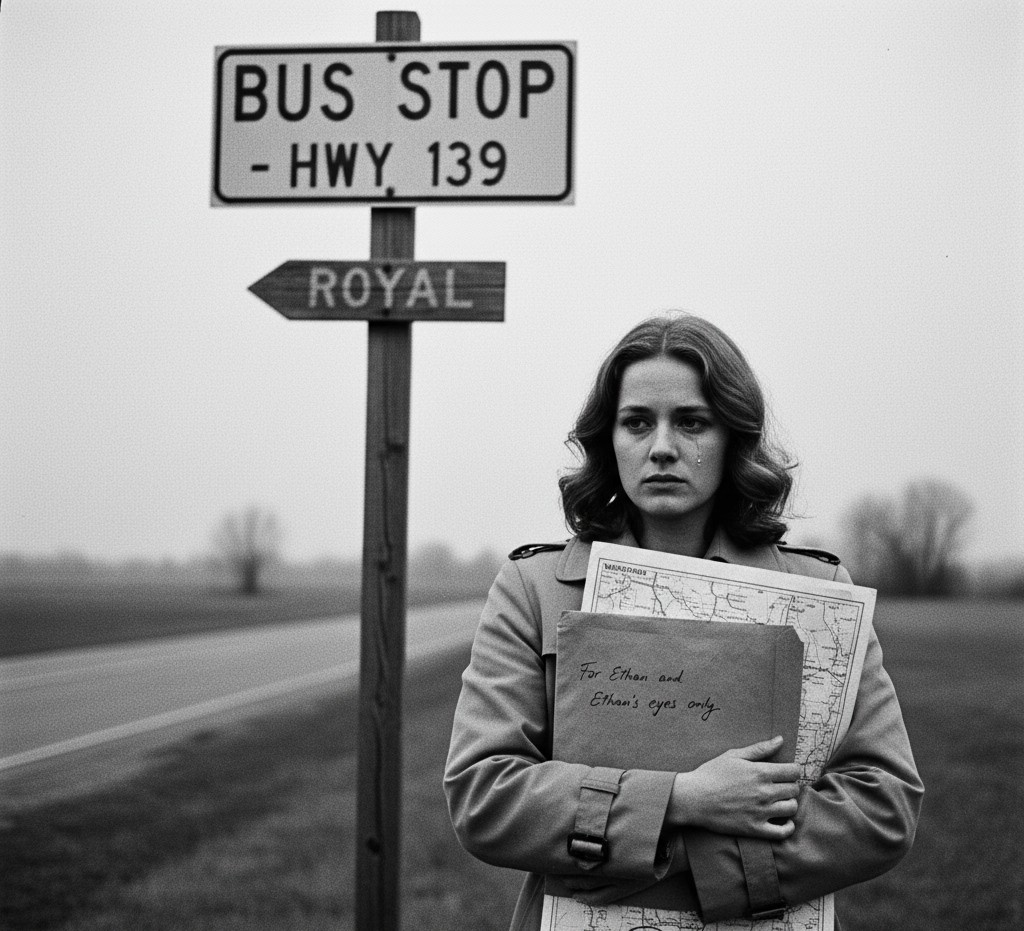
The true breakthrough, the first thread of the past she could pull, was found buried deep in the local newspaper archives. There, a stark headline jumped out: “Measles Quarantine Locks Down Entire Town Of Royal.” The accompanying photograph was grainy but clear enough to stop Peggy’s breath. It showed a county sheriff, stern-faced, positioning a wooden roadblock across a road. In the background, undeniable even through the newspaper’s poor printing, was state highway marker 139 with a sign below it saying “Royal”, with an arrow pointing to the roadblock.
Peggy snatched a current state road map, her fingers trembling as she searched for the state highway visible in the photo. She found the highway and traced it with her fingers, but the intersection and the road leading away from it—labeled in her mind as the road to Royal—were gone. The town itself was a blank space. “It’s not there”, she thought. “But there it is in the newspaper photo.”
The date on the article was Tuesday April 14,1959. Another clue! What she needed wasn’t a modern road map, but one from that year or before. The university library staff pointed her toward the Geographic Society at the University of Wisconsin, a treasure trove of historical cartography.
The appointment with the Geographic Society was a quiet, almost reverent experience. Spread out on a massive, protective table was a crisp, yellowed 1957 Wisconsin road map. Peggy’s heart was beating intensely. She was able to find state highway 139 and trace its path. And there it was. Not only the intersection, but the clear, black line of the road leading off the highway, culminating in a small, printed dot labeled Royal.
Peggy worked furiously, taking meticulous notes and securing a high-quality copy of the road map. Armed with proof of the town’s location, she began a new round of calls—county offices, local towns in the vicinity, the State Health Department to ask for any records or information related to the measles outbreak. Her life was now a relentless cycle of phone calls, library hours, and sheer exhaustion. Amy and Russel watched with mounting concern as their friend wasted away, her commitment to the search eclipsing all basic needs. The world had become flat and gray, except for that tiny, beckoning dot on the map that was Royal.
A final, desperate call to Ethan’s parents proved fruitless. They knew nothing of a town named Royal, nothing about any secret history. The silence on the other end was heavy with their own confusion and pain.
The next day, when Peggy was at her lowest, the phone rang..
“Hello?” she answered, her voice raspy.
“Peggy? It’s Helen, Ethan’s grandmother.”
A surge of adrenaline snapped Peggy alert. The grandmother sounded tentative, yet resolute. She had something, she said, something that might possibly help. Could you come over?
A couple hours later, Peggy was at the kitchen table in the grandmother’s cozy house, the scent of lavender and black tea was thick in the air. The grandmother slid a large, opened envelope across the table. Written on the front, in faded but deliberate handwriting, were the words: “For Ethan and Ethan’s eyes only.”
“Who… who opened this?” Peggy whispered, looking from the envelope to the grandmother’s tear-filled eyes.
“I did,” she confessed, her voice weary. “I found it with some of his things…Ethan’s grandfather’s things…that I was planning to give away. I couldn’t call Ethan’s father. The pain… it would break him. It would break us all.” She looked directly at Peggy, a plea in her eyes. “Promise me, Peggy. Do not say anything or show anyone the contents.”
Peggy promised. The grandmother rose silently and retreated to the living room, leaving Peggy alone with the envelope.
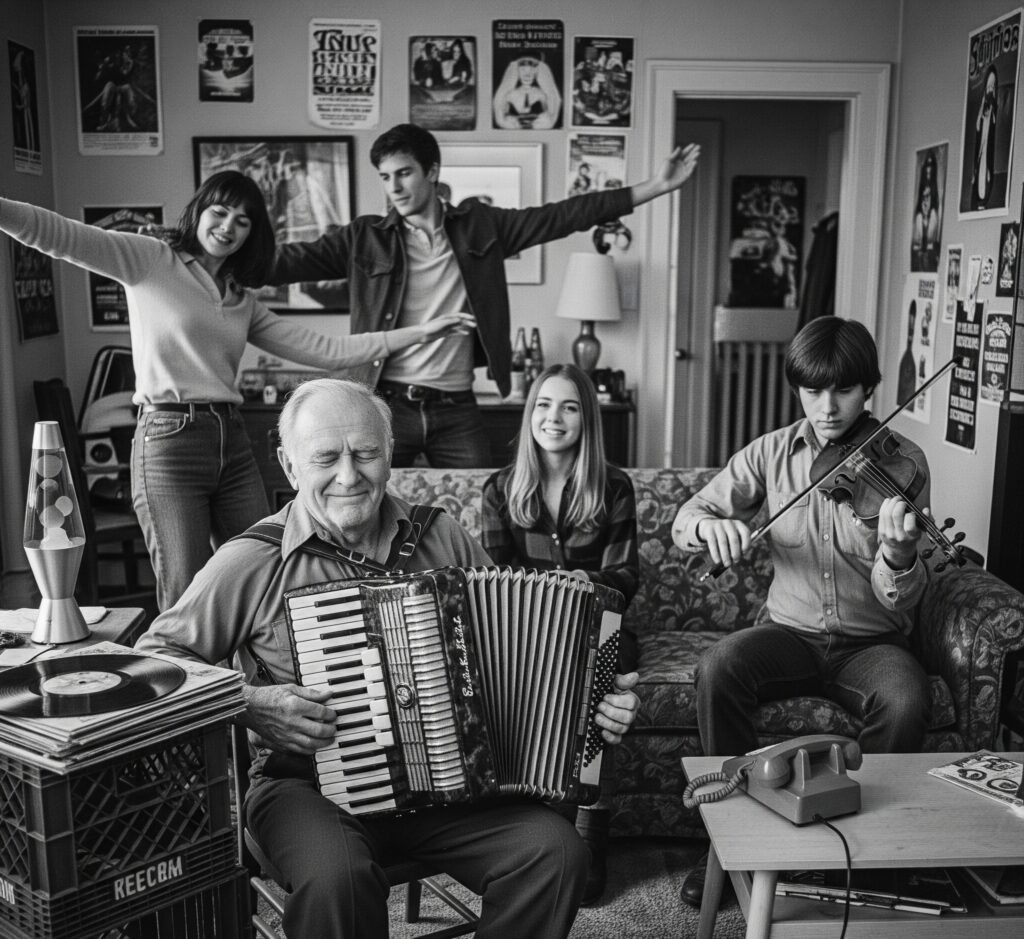
The contents were a window into a past life: letters, photos, newspaper clippings, and posters. The posters were for Tommy Melk and the Melk Duds, listing performance dates in Royal and other towns. The photos were the most striking—a younger version of Ethan’s grandfather, smiling, his accordion strapped across his chest. More photos showed him playing with Tommy Melk and the Melk Duds.
Then came the letters. They were love letters, passionate and tender, written to him from a woman named Grace. “Grace?” Peggy thought, confusion warring with a sickening realization. Grace was not Ethan’s grandmother’s name. As she continued to flip through the photos, the truth became undeniable. Ethan’s grandfather, young and vibrant, was pictured with Grace—holding hands, embracing, kissing. They were deeply in love.
Peggy had the clues to where Ethan could be—the mapped location of Royal. But the larger, more painful question now loomed: Who was Grace, and what happened to her?
Peggy gathered all the items and placed them back into the envelope. She walked into the living room. Ethan’s grandmother was sitting on the couch, openly weeping, her head in her hands. Peggy sat beside her, gently.
“You’re wondering why I’m showing you all this,” the grandmother said, wiping her eyes. “Why now?”
She took a long, shaky breath and began the story. She spoke of seeing Tommy Melk and the Melk Duds at the Eagles Club, of meeting Ethan’s grandfather, and of falling in love instantly. She spoke of his confession—that he was already in love with another woman, Grace. Then came the fateful night: drinks, dinner, passion, and shame.
“A few weeks later, I found out I was with child,” she whispered. “I contacted him through Tommy Melk. He quit the band. He moved here. We got married, and Ethan’s dad was born.”
The truth, ugly and raw, spilled out. “We were never really in love. He was still in love with Grace. He was still in love with his music.” I had dedicated my life to keeping him away from both Grace and his music, fearing the truth would destroy the family. Years later, after Ethan was born, we cornered Ethan’s grandfather, forcing him to swear he would never play the accordion or speak of music to his grandson.
“That was the second biggest mistake I ever made,” the grandmother said, her voice cracking. “He kept his promise. But I knew he snuck away to play the accordion in the attic. I knew he wasn’t happy.”
She turned, looking straight into Peggy’s eyes. “He is gone now, and so is Ethan, and it is all my fault.” She touched the envelope that was in Peggy’s hands. “Take this. You and Ethan are so much in love. I can see that. Keep it. Show it to him when he comes home. Ethan will understand. I know he will. I can see his grandfather in him, and all Ethan wants is to be happy. Ethan should know.”
The two women stood and hugged, a moment of shared, profound sorrow and sudden, fierce resolve.
“I will find Ethan,” Peggy promised, a small, solitary tear tracing a path down her cheek. “And I will bring him home.”
With the envelope clutched in her arms—containing the painful key to a family secret—Peggy headed to the bus stop. She had the final piece of the puzzle, and a destination. Royal. She knew in her heart now that she would find Ethan.
Ethan worked until the last vestiges of the gray afternoon finally bled into a deep indigo twilight. The living room, while far from perfect, now felt less like a tomb and more like a room. His muscles ached, but the fatigue was a satisfying kind—the kind earned by honest, hard labor. He paused, wiping a bead of sweat from his forehead with the back of a grime-smudged hand. A faint, tingling warmth now seemed to emanate from the old wood of the floorboards, a barely perceptible thrumming that was a strange comfort.
He moved to a small, built-in shelf near the dusty fireplace, determined to clear it. A book tumbled down as he ran his hand along a row of mildewed, forgotten objects. It wasn’t a book at all, he realized, but a thick photo album bound in faded, burgundy leather. The cover was blank, save for a few dark stains, but the weight of it in his hands felt significant.
Settling into the creaking armchair, Ethan opened the album. The pages were yellowed and brittle, yet the photos held their color with remarkable clarity. He was instantly transported. The first few pages were a collection of domestic scenes: a smiling couple on a porch swing—the very porch outside—and a woman hanging laundry in a backyard that was surprisingly lush and green. He recognized the houses near where he was residing, no longer cloaked in shadows and decay, but vibrant, their paint fresh, their lawns meticulously kept.
The album shifted to the heart of the town. There were photos of Main Street, bustling with life. Men in fedoras and women clutching their purses and shopping bags were everywhere, laughing, stopping to chat. He saw cars with the sleek, rounded bodies of the 1950s parked diagonally along the curb. He recognized the skeletal structures of the buildings he’d walked past earlier, but here they were alive—their windows bright, their shops open and welcoming. A photograph of the Royal Theatre showed a brightly lit marquee advertising “The Blob”.
Finally, he turned a page to find a picture of the WRYL broadcasting studio. It was a small, unassuming building, but the energy of the image was clear and strong. Through a large window, he could see the back of a man seated at a desk, head bent toward a microphone, the “On Air” sign glowing a triumphant red. This was Royal in its prime, a flourishing community, the very picture of the town’s life that had been so cruelly stolen by time.
Ethan leaned back, closing his eyes, letting the images swim behind his lids. He took a deep, deliberate breath and began to imagine. What was it like to live here then?
Outside the house, the spirits of the town began to gather. They were an unseen assembly of shimmering light, a host of faint, human-shaped outlines. Their individual energies didn’t clash but merged together as one, a slow, steady pulse of a communal life force. The energy focused inward, centering on the single point of light that was Ethan in the armchair.
In his mind, Ethan was no longer a solitary occupant of a ghost town. He imagined himself a part of the community. He stood on the sun-drenched sidewalk of Main Street, his clothing somehow fitting the era. The air was cleaner, filled with the faint scent of baking bread and car exhaust. He began walking down Main Street, a smile on his face. He nodded to a man polishing his sedan, exchanged a friendly “Good afternoon” with a woman carrying a shopping basket, and felt a profound sense of belonging. The townsfolk accepted him without question, a friendly face returning home.
As Ethan’s imagined reality grew sharper, the vibrational energy of the spirits grew stronger. The tingling on his skin intensified, an electric buzz of creative power. He walked into Anderson’s Hardware Store and purchased a can of paint—deep forest green, a color that would look perfect on a porch railing. He emerged and crossed the street, entering the Lunch Box Cafe, where he purchased a chocolate malt, thick and cold. He was nourishing the town with his attention, his belief.
He continued his walk, passing the Royal Theater, the marquee lights seeming to flash just for him, and turned the corner. His destination was the small building that held the power of connection for the entire community. He walked up the short steps and reached the door of the WRYL studios.
The collective glow of the spirits, a massive cloud of soft, white, human energy, had now illuminated the night sky over Royal. It pulsed once, a heartbeat of pure, concentrated hope.
Ethan didn’t hesitate. He reached out, turned the knob, and walked into the WRYL studios.
The moment the door closed behind him, the white glow in the sky didn’t fade—it exploded. A massive soundless burst of light erupted, instantly transforming into an awe-inspiring shower of gold, green, red, and blue fireworks. The spectacle was brief but magnificent, a silent proclamation of success, and as the last of the embers floated down, they scattered throughout the town of Royal, settling like glittering pollen on the rooflines and boarded windows, whispering a promise of rebirth.
A new day dawned on Royal, but the oppressive gray sky still hung heavy, threatening more rain. Ethan rose early, the dream-like vision from the night before still vivid. He ran a hand over the imagined freshly painted walls, a phantom touch of smooth, clean plaster. His bedroom, however, was as derelict as ever. The peeling wallpaper hung in strips, and a fresh ring of dampness stained the ceiling. He felt a deep sense of loss, as if the life and vibrancy from his dream had been stolen.
He was caught in a tug-of-war between two realities: the one his eyes saw and the one his heart felt. For the first time in what felt like a lifetime, the melancholy grip that had held him for days loosened its hold. A small ember of hope sparked in his chest. It was the spirit’s voice that resonated with him the most. Her words, “Your imagination is our life,” echoed in his mind, and he felt a responsibility to the spirits. With a renewed purpose, he knew he had to leave the house, to break free from the self-imposed prison he had built.
As he walked the empty streets of Royal, he felt the town’s bleakness like a physical weight. The houses, once long ago vibrant with life, now seemed to frown with neglect. The shops were boarded up and Main street, once long ago bustling with activity, was now quiet and desolate. A cold wind blew through, carrying with it the smell of wet earth and decay. The town was suffocating, and Ethan knew that if he stayed, he would be buried in its despair.
Returning to the house, Ethan ran his hand over the wood siding, and a new feeling surged through him. It was a faint, yet undeniable, hum of energy. A shiver of excitement ran down his spine. The spirits had been right. A different kind of life awaited him. It was his imagination, his willingness to believe, that held the key. He had a profound realization: Royal wasn’t just a place. It was a reflection of himself. Its decay was his decay; its despair, his despair. The town’s sorrow had resonated with his own, and in a way, he had been fueling it. He knew he had to heal himself to heal the town.
Ethan walked through the front door and took a deep breath. He needed a place to start. A spark of inspiration ignited as he looked around the desolate living room. He would start there, with a broom and a pail of soapy water. He would fight back against the grime, the decay, and the despair. He would bring back the life that had been lost. As he began to sweep, he felt a strange sense of companionship. He wasn’t alone in this. The spirits were with him, watching and waiting. He didn’t know how long it would take, but he knew what he had to do. He had to bring Royal back to life.
The night had been a blur for Peggy. She woke up on the couch, her body stiff and cold. The memory of the waltz and the visions of Ethan were still fresh in her mind, and she felt a sense of relief. Ethan was okay. Ethan was alive. The tears that came were not of sadness, but of hope. The gray despair that had shrouded her for weeks began to lift. The apartment was still dark, but she felt a new sense of purpose. She had to find Ethan. She had to know more about the gazebo, the band and who the young woman was that had been singing.
Amy and Russel found Peggy at the kitchen table, a phone book, a notebook and an old, tattered state map spread out in front of her. Her eyes, once vacant and sad, now held a spark of determination. Amy and Russel were surprised, but they knew better than to question her. They had seen Peggy at her lowest, and they were happy to see her fighting back.
Peggy spent the rest of the day in a flurry of activity. She reached out to Ethan’s family and Ethan’s old friends asking them about Ethan’s grandfather. Asking about the band he was in and where the band performed. Anything about Ethan’s grandfather would be helpful. Peggy’s search was slow, but she refused to give up. Every dead-end only fueled her resolve. As the hours passed, she realized that she was not just looking for Ethan, she was rediscovering herself. The girl who had once been so full of life was coming back.
That night, Peggy closed her eyes, not to pray, but to remember. She remembered the melody, the vision, and the feeling of love that had surged through her. She was not just waiting anymore. She was moving. And for the first time in a long time, she felt like she was heading in the right direction.
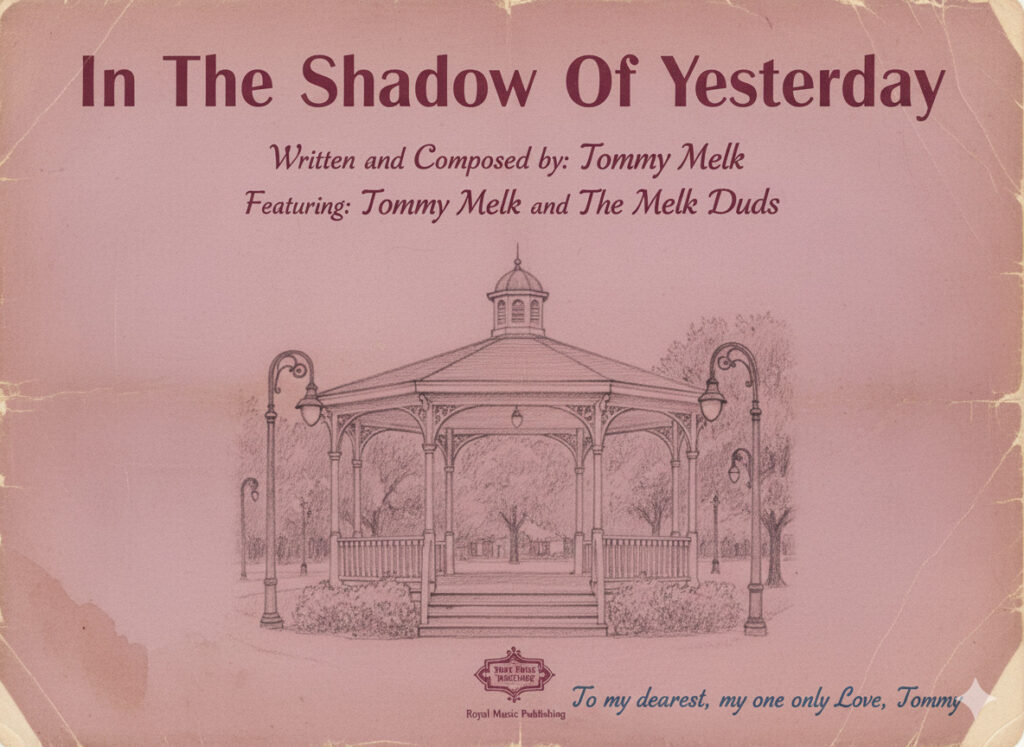
In the morning, the image of Ethan’s grandfather’s accordion case flashed into her mind. She ran to her bedroom and opened the closet door. She pulled out the accordion case and sat on the floor, gently laying the case open. Inside, the accordion was nestled in its velvet lining, but a piece of sheet music sat on top of the instrument. Peggy picked up the sheet music, her hands shaking. On the cover page, a beautiful black and white sketch of a gazebo was drawn against a backdrop of trees, and she gasped – it was the same gazebo from her dream.
Peggy’s heart pounded in her chest as she carefully examined the sheet music. The title, boldly printed on the front, read, “In the Shadow of Yesterday.” Below it, in a smaller font, was the composer’s name: Tommy Melk. Then she saw the band’s name, “Tommy Melk and the Melk Duds” printed just below the title. Below the song was the name of the publisher, Royal Music Publishing. The bottom of the sheet music held a handwritten note in a shaky hand. “To my dearest, my one only Love, Tommy.”
Peggy smiled. It had to be a sign. It was the only thing that made sense to her. Peggy looked again at the sheet music. Royal Music Publishing? It was a long shot, but it was all she had.
For days, a relentless downpour had smothered Royal, casting a gray pall over everything. Ethan felt it deeply, his own spirits as bleak as the weather. Unmotivated and melancholy, he spent hours staring out the window, mesmerized by the drumming rain. At night, he was captivated by the flashes of lightning and the resounding thunder, a natural light show that reminded him of fireworks. The wind, howling through the trees, played a somber melody that resonated with the turmoil in his soul. He sensed a profound imbalance, a deep wrongness he was powerless to correct.
His dreams became a shattered film reel of his past, forgotten childhood memories resurfacing to stir his emotions. He found himself missing his family, despite the distance he had so desperately sought. The sense of adventure that had fueled his arrival in Royal had vanished. His imagination, once a boundless well of happiness, ran dry. He had, in essence, closed the book on Royal and placed it back on the shelf. As Ethan retreated into himself, the town seemed to follow, slipping back into the bleakness of a ghost town. Despair descended like a heavy shroud, and hope dissolved entirely.
That evening, Ethan went about his routine, placing pails on the floor to catch the new leaks in the roof. The damaged windmill provided only intermittent electricity, forcing him to navigate the house by candlelight. The air was thick with the musty smell of mildew, and he couldn’t shake the feeling that the house was regressing to its derelict past. Shivering, he crawled into bed, pulling the blanket and bedspread tight against the cold as he drifted into a restless sleep.
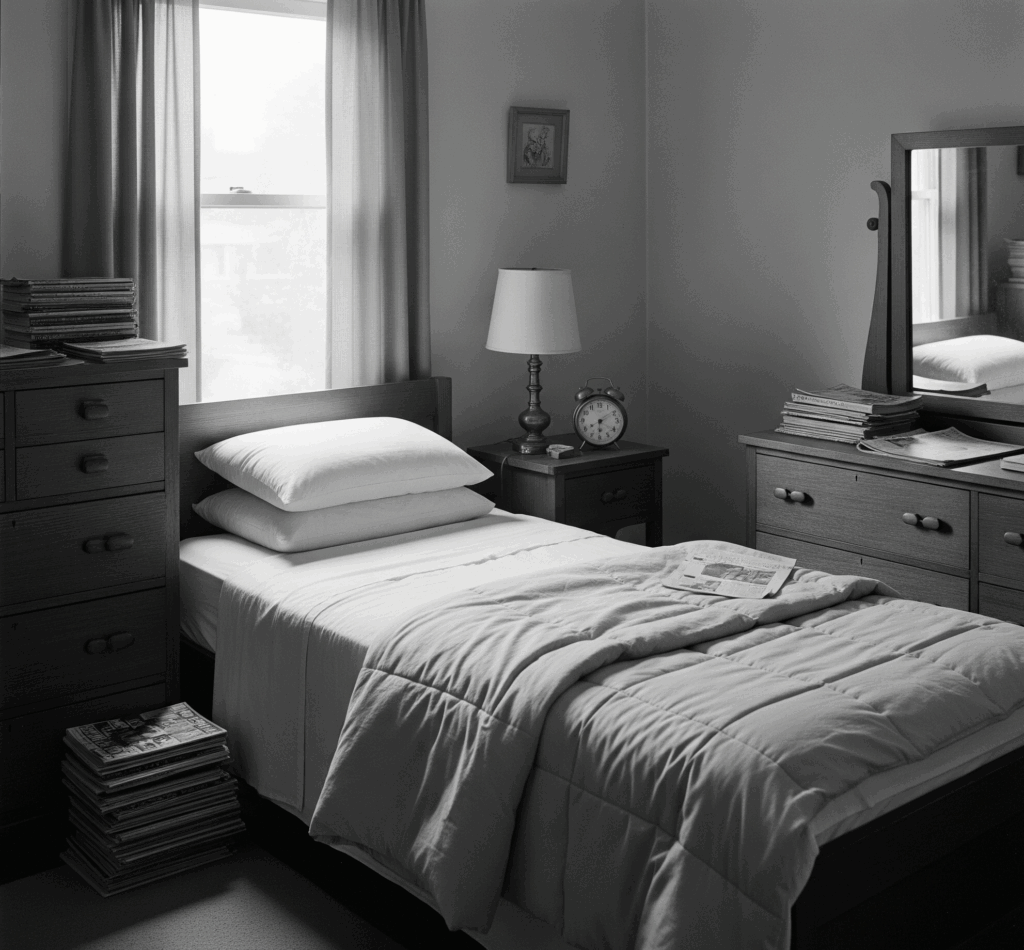
In the dead of night, a hauntingly beautiful melody stirred him awake. The sound was distant yet deeply familiar—the waltz his grandfather had written. Ethan sat up, transfixed by the accordion’s music. Its melody calmed his racing heart, easing his anxiety. A single spirit slowly materialized in his room, a woman who looked at him with a kind smile that put Ethan instantly at ease. Soon, more spirits joined her. As they drew nearer, Ethan watched his bedroom transform. The walls were no longer peeling, but clean and freshly painted. The familiar, broken furniture was replaced with new pieces. Pictures now hung on the walls and knickknacks sat on the chest and dresser. The closet door, once jammed shut, now stood open, filled with hanging shirts and pants. Books were neatly stacked on the desk. The room was not just new, it was alive, and Ethan could feel the very life of the house surging through his body.
The woman drew near, gently stroking Ethan’s hair. “Never let anyone take your imagination away from you. Your imagination is our life. I love you, Ethan, more than you can possibly know. Let your imagination take you anywhere, anytime, any place. Looking forward to seeing…” Her words trailed off as a blinding light filled the room. Ethan shielded his eyes, and when he looked again, the spirits were gone. The room had returned to its dilapidated state, leaving him sitting in the darkness, the spirit’s words echoing in his mind.
Peggy sat alone in the apartment, the silence heavy now that Amy and Russel had left for class. At the kitchen table, a cup of tea grew cold as she stared at photos from the night Ethan’s grandfather had visited. That evening felt like a lifetime ago, a memory of pure happiness now clouded by sorrow. It had been a little over two weeks since his passing, and that grief, compounded by Ethan’s month-long disappearance, was weighing on her. Tears came easily, affecting her classes, her part-time job, and her relationships with her roommates. The apartment, much like Royal, had lost its light, shrouded in a similar gray despair.
That evening, a rainstorm plunged the apartment into darkness, and the three roommates gathered in the living room, their faces illuminated by a single candle and a flashlight. Peggy was quiet, her mind elsewhere. Her responses were clipped—a “yes” or a “that’s cool”—as Amy and Russel tried to keep a conversation going. When they finally went to bed, Peggy remained on the couch, staring out the window at the storm. Just as she did every night, she closed her eyes and prayed for Ethan to be safe, healthy, and happy. She prayed that he would find what he was looking for and, most of all, that he would return home. Her final prayer was a whisper, a plea for him never to forget how much she loved him. With a sigh, she blew out the candle, curled up, and fell into a fitful sleep.
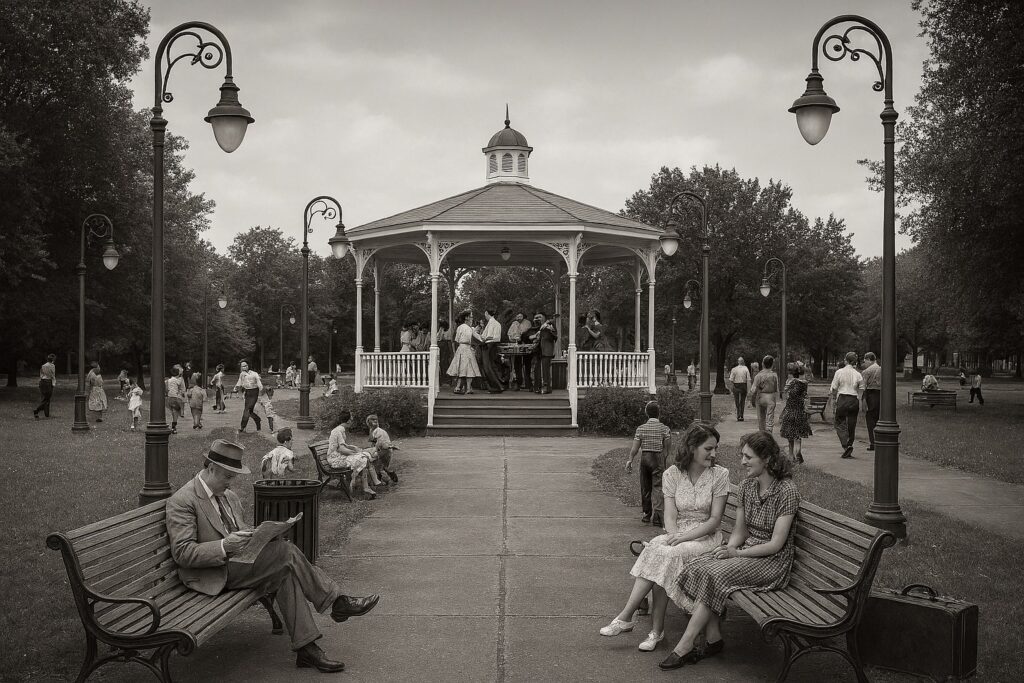
In the middle of the night, a hauntingly beautiful melody stirred Peggy awake. The sound was distant, yet so familiar—the waltz Ethan’s grandfather had written. The music filled her mind and heart, easing the emptiness she felt without Ethan by her side. She closed her eyes, concentrating on the melody, and flashes of him began to fill her mind. She saw him leaving a house, walking past stores and shops. The images came fast, from multiple angles, the faces of the people passing him blurred or turned away. She watched as he walked through a park, where a gazebo stood in the distance, and she heard the same waltz playing over and over. People were dancing, and she could see Ethan, playing his violin, joined by other musicians whose instruments added to the enchanting accordion melody.
As a young woman began to sing, people started to crowd her view of the gazebo. She pushed forward, trying to get a clearer look, but she could only make out Ethan. Then she tripped and fell. She sat up, looking at what had caused her to stumble—a suitcase that looked just like Ethan’s grandfather’s accordion case. The accordion music softened, playing alone now. The images and the music slowly faded away. Peggy was left alone on the couch, staring into the dark apartment, the memory of the music and the vision of Ethan still vivid in her mind.
Ethan did go home, but only to gather his clothes and personal belongings. His father was at work, a small mercy, but his mother was there, and the hour that followed was a living hell. She insisted he stay, telling him he’d never make it in life, that he was living in a fantasy world. She reminded him he wasn’t good enough, and that when he failed, he shouldn’t come crying back. As he walked out the door, backpack slung over his shoulder, she cried out, “The police are going to call and say they found you dead one day in a back alley! You’ll be on a slab in the morgue!” Ethan turned, met her tear-streaked gaze, and simply said, “I’m going now, Mom. I love you.” With that, he backed Bessie out of the driveway and drove towards a new life.
College, liberated from the suffocating pressure of home, became a different experience entirely. Ethan’s grades soared. He found a part-time job at an off-campus college bookstore. Ethan was able to adjust his financial aid to help cover his share of the rent and food. He even managed to keep Bessie. Life, finally, felt good. Ethan was happy. Amy and Russel, captivated by his storytelling prowess, urged him to take creative writing classes. Peggy was his unwavering support, her love for him growing stronger each day, a mirroring reflection of his own deepening affection for her.
Ethan’s curiosity pulled him into the world of theater. He discovered a passion for set design, the magic of stage lighting, the transformative power of stage makeup, and the intricate art of sound design. He thrived behind the scenes, far from the spotlight he’d never craved. He also delved into filmmaking, captivated by the tactile nature of 8mm and 16mm film. He took a class in film processing and, with his roommates’ enthusiastic help, set up a darkroom in the duplex basement.
His creative writing continued to flourish. He’d spend hours at the kitchen table, filling notebook after notebook. Peggy would bring him tea, settling in to read his latest stories, offering thoughtful insights. When writer’s block struck, he’d bounce ideas off Peggy, Amy, and Russel, sometimes staying up most of the night, exploring multiple story scenarios. He even found an old cassette recorder at Goodwill and began taping these brainstorming sessions, a living archive of their shared creativity. Ethan was at peace. He was in love with Peggy, and she with him. He had, at last, found the happiness that had eluded him for so long.
One Saturday afternoon, while Ethan was shelving books at the college bookstore, he looked up and saw his grandfather standing there. A jolt of fear shot through him. His carefully constructed world, his newfound happiness, felt poised to shatter. His grandfather walked closer, a gentle smile on his face. “Relax, son,” he said, his voice soft. “Don’t worry. I’m not going to tell your parents where you’re working. I just wanted to talk.” He asked when Ethan’s shift ended.
Just then, Peggy walked in, a bag of groceries in her arms, waiting to walk home with Ethan. Ethan, still a little shaken, introduced her. His grandfather, sensing Ethan’s apprehension, quickly reassured Peggy. “Don’t worry, dear, I won’t say a word to his parents.” Ethan’s shift ended, and his grandfather offered them a ride home. Ethan glanced at Peggy, who was staring at his grandfather, a curious expression on her face. There was something familiar about him, as if she knew him from somewhere she couldn’t quite place. Yet, she felt an instant trust.
They drove to the duplex. Inside, Ethan introduced his grandfather to Amy and Russel. The flicker of apprehension that crossed the roommates’ faces, was quickly replaced by genuine warmth when Ethan’s grandfather cheerfully suggested they order some pizza. The evening flowed beautifully. Ethan’s grandfather regaled them with stories from his past, many of which Ethan had heard before, but still loved to hear again. Then, his gaze softened as he looked at Ethan. “Many years ago, Ethan, I made a promise not to talk about certain things I did in my life. They thought it might lead you down the wrong path. But your parents were wrong to ask that. You deserve to know these stories. You deserve to know who I was and why I changed my life.”
Peggy, Amy, and Russel began to rise, thinking this was a private moment between grandfather and grandson. But Ethan’s grandfather gestured for them to stay. “You four,” he said, his voice filled with admiration, “you are all amazing individuals. Your talents are incredible. Don’t let anyone take away your dreams and aspirations. I let someone take away mine, and I’ve regretted it for many years. Never stop dreaming. Never stop loving. ” he continued, his eyes sparkling, “Ethan, I have never seen you so happy. And it’s not just about you and Peggy, though I can see how much you two are in love. It’s much more than that. And this house… this house is amazing. It’s been a long time since…” He trailed off, a quiet sadness washing over him. Then, he looked at Russel, tossing him his car keys. “Would you mind going down to my Chevy Impala and bringing up the suitcase in the trunk?”
Russel, sensing the moment’s importance, did as he was asked, returning with what appeared to be an old suitcase. Ethan’s grandfather opened it, revealing a beautifully preserved accordion. He strapped it on, a nostalgic smile touching his lips. “It’s been a while,” he said to everyone, “and I might be a bit rusty.” He began to play.
The music filled the room, a cascade of notes, vibrant and alive. Amy, Russel, Peggy, and especially Ethan were mesmerized, watching Ethan’s grandfather, this quiet man, transform into a vibrant musician. The music was pure magic. “Ethan,” his grandfather urged, “get your violin and play along!” Ethan did, his fingers finding the familiar strings, joining the melody. It wasn’t perfect, but it was wonderful, a spontaneous symphony of generations. Amy, Peggy, and Russel began to sing along to the songs they knew, their voices blending with the accordion and violin. After several more songs, the music faded.
Ethan’s grandfather looked at them all, his eyes brimming. “My life is complete,” he said, his voice soft. “I’d like to play one last number. This is a waltz I wrote many years ago, when I was young, ambitious, imaginative, and in love. I would love it to be my last dance.” He began to play. The melody was hauntingly beautiful, a bittersweet embrace of joy and longing. Ethan put his violin down and took Peggy’s hand, twirling her into a gentle dance. Amy and Russel joined in, their happiness echoing through the old house. For a moment, it seemed as if the entire world was dancing to grandfather’s music.
And then, like all songs, it had to end. A quiet sadness settled, a profound awareness that this melody, in this way, might never be played again. Ethan’s grandfather carefully placed the accordion back in its case, closing it with a finality that suggested it was truly the last time. He glanced out the window; darkness had fallen. “I better head for home,” he said, “or else your grandmother is going to give me hell.”
Russel offered to carry the accordion down to the car. “No, that won’t be necessary,” Ethan’s grandfather replied. “I won’t be playing anymore. Ethan, I want you to have it.” Ethan’s eyes welled up. “No, Grandpa,” he whispered, “I could never accept something like this.” His grandfather looked lovingly into Ethan’s eyes. “I want you to have this, and I want you to always remember.” A tear traced a path down everyone’s cheek. Ethan hugged his grandfather tightly, whispering, “I will remember.”
Ethan’s grandfather, wiping away a tear, said, “Walk with me out to my car.” They walked in comfortable silence. At the car, his grandfather turned to Ethan. “Never let anyone take your imagination away from you. Your imagination is your life. I love you, Ethan. I love you more than you can possibly know. Let your imagination take you anywhere, anytime, or any place. Looking forward to seeing…” He paused, his gaze fixed on Ethan, then got into his car. He rolled down the window, looked at Ethan one last time, and said, “Looking forward.” With that, he drove off into the night.
College life hit Ethan like a discordant chord. After twelve years of familiar faces in public school, the University of Wisconsin-Milwaukee was a lonely symphony. The first semester, he mostly kept to himself, a silent observer in a bustling hall. His refuge was the practice room, where he wrestled with private violin lessons and a beginner keyboard class. The rest of his schedule was filled with the mandatory core classes: Freshman English, College Algebra, Intro to Mass Communication, and even Folk Dancing – subjects he just wanted to get through.
A harsh truth soon emerged: Ethan wasn’t the violin virtuoso he’d imagined. The college music department was a different league, filled with talent that humbled him. He had a lot to learn and even more to practice.
Home, meanwhile, offered no respite. Though legally an adult in Wisconsin, Ethan was still treated like a child, his efforts at college met with a barrage of negativity. His father, in particular, dismissed his studies as “a waste of time and money.” UWM, a commuter school, meant Ethan drove to campus and back daily, his life resembling a joyless 9-to-5 grind. The crushing weight of loneliness and the constant barrage of disapproval at home began to take a severe toll on his mental health. Ethan was ready to quit.
One afternoon after Ethan’s classes, he was sitting on a couch in the student union trying to figure out what he could do. Staying at home was already a nightmare, and dropping out would only intensify the negative atmosphere. He had nowhere to go. An apartment was out of the question financially, and he didn’t know anyone well enough to find roommates. The stress mounted, anxiety twisting his thoughts and emotions into a suffocating knot. Tears welled up, blurring his vision.
Just then, a young woman walking by noticed his distress. She sat down beside him, a kind smile on her face. “Hi, I’m Peggy,” she offered, her voice soft and reassuring. “I’ve seen you with your violin and heard you pounding away on the piano in the practice rooms.”
Ethan, still teary, mumbled his name. Peggy asked if there was anything she could do to help. He almost said no, but something in her eyes, a genuine warmth, made him pause. He looked at her, feeling an unexpected ease, and then, the words tumbled out. He told her everything, the loneliness, the pressure, the suffocating expectations. Peggy listened, her attention unwavering, making him feel truly heard for the first time in a long time. When he finally finished, a wave of relief swept over him.
Peggy looked at him, a gentle smile returning to her face. “Are you hungry?” she asked. “I make a great mac and cheese. I’ve got some tea and a little wine if you’re interested.” She paused, her gaze steady. “You can’t do this alone, Ethan. You need some friends.” She stood up, extending her hand.
Ethan took it, and they began to walk. Then, he stopped. “Bessie,” he blurted out.
Peggy looked at him, confused. “Who’s Bessie?”
“My car,” Ethan explained, feeling a blush creep up his neck. “I know it sounds silly, but I named my car Bessie.”
Peggy stopped dead in her tracks, her eyes wide with amazement. “You have a car!?”
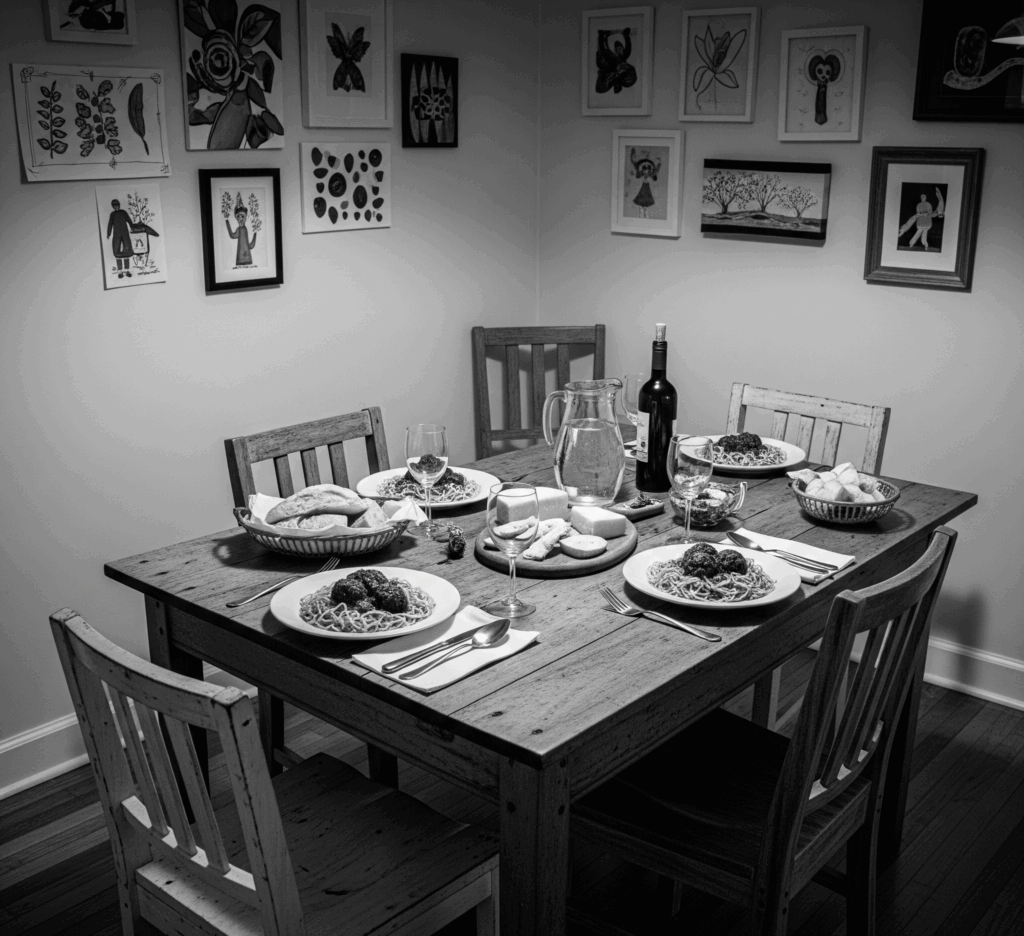
Minutes later, they were at a small, family-owned grocery store. Pooling their meager funds, they debated dinner options. “We should have something special,” Peggy declared. “I know let’s do spaghetti and meatballs…and get a loaf of Italian bread and some cheese.”
“Sounds perfect!” said Ethan.
“Maybe some gelato for dessert,” Peggy added. “I think we have enough money.”
“Gelato?” Ethan’s eyes widened. “I’ve never tried it.”
“Everyone in the house loves gelato!” Peggy exclaimed.
“Everyone?” Ethan inquired.
“My roommates,” Peggy clarified. “You’ll really like them, and they’ll definitely like you.”
“Roommates, hmmm?” Ethan murmured to himself, a flicker of something new – anticipation? – stirring within him.
Ethan pulled Bessie in front of a grand, old Victorian house, subdivided into a duplex. Peggy directed him to drive around to the alley and park behind the house. “Don’t worry,” she assured him, “this is our parking space, and now we have a reason to use it.” Peggy was in a remarkably good mood, humming a cheerful tune. Ethan watched her, captivated by her unburdened happiness, a feeling he yearned to experience.
They ascended the back steps to the upper duplex, laden with groceries, backpacks, and Ethan’s violin. At the door, they were greeted by Amy, a self-proclaimed “hippie wannabe” who dressed the part but possessed the suburban directness Ethan was accustomed to. She was polite, expressed her happiness to meet Ethan, and was visibly thrilled about Peggy bringing home dinner.
The third roommate, Russel, entered the living room. Ethan braced himself, expecting the typical jock persona he’d encountered throughout high school. But Russel, to Ethan’s surprise, was an artist. He enthusiastically showed Ethan sketches for a stage play, asking for his opinion on stage designs. Peggy, however, intervened, suggesting they give Ethan a chance to settle in first.
Amy led Ethan to the living room couch. He gazed around, marveling at the abundance of framed and unframed artwork adorning the walls – truly amazing pieces. Amy then asked about his musical preferences. When Ethan replied “most anything,” she seemed a little annoyed. “Everyone has their particular type of music that fits their personality,” she stated, “everyone is unique.” Amy stood up, studying Ethan intently. “You seem to be in pain,” she observed. She walked to a shelf filled with record albums, selected one, and placed it on the stereo. The melancholic strains of Samuel Barber’s “Adagio for Strings” filled the room. She sat back down beside him. “This is how I see you now,” she said, her voice soft but firm, “but this isn’t the real you. The real you is buried under a whole mess of unnecessary bullshit. You need to toss the bullshit.”
Peggy, stepping in from the kitchen, gently chided Amy. “Cut him some slack, Amy, don’t scare him off. He’s a nice guy.” She smiled reassuringly at Ethan before returning to her cooking.
Russel joined them in the living room, settling into a chair opposite the couch. He began asking Ethan questions, seemingly genuinely interested in his answers. Amy, too, listened intently, clearly trying to piece together who Ethan truly was.
Dinner was fantastic, the spaghetti and meatballs surprisingly delicious. Russel opened a bottle of wine, and they shared it, a sense of camaraderie blooming around the table. After the meal, Ethan helped Peggy with the dishes. He thanked her for the wonderful dinner and the great time but said he should probably head home.
Peggy turned to him, her expression firm. “Nonsense, you’re not going anywhere. Why go home? Why go back to all that stress and negativity? You can stay here.”
“But my parents will wonder where I am,” Ethan protested weakly.
Peggy looked him directly in the eyes. “Do you really want to go home, Ethan? Think before you answer.”
Ethan closed his eyes, his thoughts a chaotic whirlwind. The stress he’d tried to suppress surged back, and he felt tears beginning to fall again. Peggy gripped his arms. “Ethan!” she exclaimed.
He opened his eyes. Everyone was in the kitchen now, all eyes on him. Ethan looked at Amy and Russel, then his gaze settled on Peggy. His voice, barely a whisper, was laced with raw desperation. “I never want to go back home.”
The summer of ’77 had bled into fall, and still, Ethan remained a ghost. Three months had passed since his hurried departure from his parents’ suburban home, and the initial frenzy of the search had begun to wane. For the Milwaukee police, Ethan’s disappearance was still an open and active case, a file gathering dust on a perpetually busy desk. There had been a handful of reported Ethan sightings, each one a flicker of hope quickly extinguished by the cold reality of a false lead. News outlets, once ravenous for any scrap of information, had gradually shifted their focus to fresher tragedies and triumphs. The public, too, had moved on, their collective memory a fickle thing.
But in the meticulously kept suburban home that Ethan had fled, hope, however fragile, still flickered for his parents. The phone calls continued, the hushed inquiries to friends and acquaintances, the desperate scans of every crowd. Yet, beneath the veneer of parental concern, a bitter undercurrent of anger and resentment surged through the family. Fingers pointed, accusations flew, and much of the blame landed squarely on Ethan’s grandfather.
“He encouraged it,” his mother would lament, her voice laced with accusation. “All that talk of music and art. He filled Ethan’s head with nonsense.”
Indeed, Ethan had spent countless hours with his grandfather, lost in a world of shared melodies and profound conversations. His grandfather, a man whose own artistic spirit had been crushed by the relentless demands of survival, saw in Ethan a kindred soul. He recognized the spark, the sensitivity, the innate creativity that set Ethan apart from the pragmatic, money-driven worldview of the rest of the family. He understood, too, how Ethan was suffocating in an environment where the bottom line was the only line that mattered.
“Money equals happiness,” was the mantra drilled into Ethan’s father, a belief forged in the crucible of the Great Depression. Growing up, Ethan’s parents had known deprivation, and that experience had solidified their conviction that financial security was the sole path to contentment. His grandfather, too, had chased that security, moving from one soul-numbing job to another, but in the eyes of his wife, Ethan’s grandmother, it was never enough. The Depression had hardened her, leaving her with a cynical edge and a deep-seated distrust of anything that didn’t contribute to the household coffers. She would openly belittle her husband when he dared to take out his accordion, dismissing his music as a “waste of time” that should be spent finding another job. Eventually, the accordion, a silent casualty of her disdain, found its way to the dusty attic, where it would remain, a forgotten echo of a silenced dream.
Years later, after Ethan’s parents were married and Ethan was a young child, a family meeting was convened. It wasn’t a discussion, really, but more of an ambush. Ethan’s mother, father, and grandmother ganged up on his grandfather, extracting a solemn promise: he would not interfere in Ethan’s upbringing. No talk of his past as a musician, no tales of playing in a band and being a traveling musician, no mention of artistic expression or freedom. The past was to remain buried. The future, they decreed, was about growing up, getting a job, and making money. Happiness, they insisted, would only follow the acquisition of wealth. Money brought happiness. His grandfather, defeated, agreed.
For years, he kept his word. That was until Ethan picked up a violin. His parents, perhaps seeing it as a fleeting childhood phase, allowed it, expecting him to tire of it quickly. But Ethan didn’t quit. He excelled. He found other young musicians, and an instant camaraderie bloomed, a shared language spoken through notes and harmonies. Ethan’s grandfather, witnessing this burgeoning talent, struggled to keep his silence, the promise a heavy weight on his conscience.
As the years passed, Ethan’s passion for music deepened. He attended music camps, played in a youth orchestra, and yearned to do more. He begged his parents for piano lessons, but they flatly refused. His grandfather saw the sadness in Ethan’s eyes, the vibrant spirit dimming, but felt powerless to intervene. Ethan began to withdraw, retreating into himself, spending more time practicing his violin, reading, and dreaming. He built a vivid fantasy world, a sanctuary for his imagination, carefully guarded from the harsh realities of his home life. This was also when the lying began. So deeply did he immerse himself in his invented realities that sometimes, the line between truth and fiction blurred.
Ethan was a gifted writer, his creativity a vibrant force that spilled onto the page. Parent-teacher conferences often highlighted his exceptional talent, urging his parents to encourage his writing. But his parents, clinging to their rigid vision of a “real” career, actively repressed any artistic inclination. This repression, more than anything, fueled Ethan’s need to lie. It was his only way to rewrite the story of his life, to escape the suffocating narrative imposed upon him. This led to a cycle of yelling, lectures, and punishments. Ethan yearned to rebel, but he felt trapped, forced to endure the hostile family environment until the day he could finally escape after high school.
Ethan stood in the foyer, the cool metal of the key still warm in his palm, a tangible link between the present and the unfolding mystery. His eyes, accustomed to the dim light of his own temporary refuge, slowly adjusted to the deeper gloom of this new, silent house. Small, hesitant fingers of sunlight pierced the grimy windows, struggling to illuminate the shrouded rooms within. Dust motes, ancient and restless, danced in the faint beams.
To his left, the living room lay in disarray, a testament to a hurried departure or a prolonged abandonment. Furniture, humped beneath dusty sheets, resembled forgotten sculptures, while books and papers lay scattered like fallen leaves across the floor. The curtains, thick with age and grime, seemed too fragile to touch, sealing the room in perpetual twilight. Ethan instinctively reached for a light switch by the door, flicking it on and off in vain. No power. How then, did that light flicker on upstairs last night? The question echoed in his mind, unsettling and intriguing.
Carefully, Ethan stepped into the living room, trying not to disturb the decades of accumulated dust. His gaze fell upon the familiar glint of old newspapers and magazines among the scattered items. There were also bills, letters, and even greeting cards, each a whisper of a life once lived within these walls. He walked gingerly over the forgotten memories.
The next room, a dining room by its layout, offered a similar scene of neglect. Another light switch yielded nothing. In the corner, an old upright piano stood like a sentinel, its keys likely muted by time and disuse. Shelves, draped in sheets, lined the walls, hinting at hidden treasures beneath their dusty shrouds. A desk and chair occupied another wall, its surface buried under a fresh layer of papers. Next to the desk, metal cabinets that promised unknown contents. Several dining room chairs were scattered haphazardly, but there was no table, as if the heart of this communal space had been ripped out.
To his right, an open archway led into the kitchen. Here, the sunlight was less inhibited, reflecting off dirty white tiles on the walls, giving the room a surprisingly stark appearance. Yet, it too was a disorganized mess. Ethan tried the sink faucet, but only a musty smell and the eerie gurgle of trapped air escaping ancient lead pipes answered his attempt. In the pantry area, he found a hulking refrigerator, a relic of another era. To the left of the refrigerator, the back entrance beckoned, locked and bolted from the inside. He slid the heavy bolt, then inserted his key into the lock. With a soft click, the door opened.
He stepped outside, blinking as the sun’s bright warmth enveloped his face. As Ethan looked up at the sky, a strange sensation prickled the back of his neck – the feeling of being watched. He spun around quickly, but only the sidewalk leading to the front of the house greeted his gaze. A rustling in some nearby bushes made him jump, only for a rabbit to scurry out, disappearing into the undergrowth. Reassured, yet still slightly unnerved, Ethan went back inside, locking and bolting the door behind him.
A stairway heading down to the basement caught his eye. He tried the light switch, but again, no light. He made a mental note: next time, bring the oil lantern from the shed. The thought of exploring the depths below was both daunting and exciting.
Returning to the kitchen, Ethan made his way back through the dining room and into the living room. He cautiously pulled back the curtains on the front window, letting in a wider swath of daylight. With his shirt sleeve, he rubbed a small circle of grime off the pane, revealing the familiar outline of the house where he was living, standing silent across the street.
He closed his eyes, and the silence of this house filled his ears. He imagined. He pictured a bustling home, filled with laughter and daily routines, the sounds of life vibrant and clear. He could almost feel a love emanating from the very walls he stood within, a palpable connection that resonated deep in his heart. There was a reason for him to be here. Not just in this house, but in Royal itself. The answers he sought, the elusive pieces of his past, were here.
But with this sense of connection came a wave of sadness and disappointment. It was as if a vital link in this house, a bond between two people, had been brutally severed. The emotions rushing through Ethan were overwhelming, powerful, almost tangible. He felt dizzy, staggering and bumping into the living room couch. He sank onto its dusty cushions, the dam of his carefully guarded emotions finally breaking.
Tears streamed down his face, tears of sadness that felt like the collective sorrow of the house pouring through him. Then, the sadness curdled into anger. Why? Why did you leave? I was always here for you. Why did you shut me away for all these years? Why are you here? Why are you reopening the wounds of the past? Why? Why did you stop loving me? His emotions reached a boiling point. He stood, tears still streaking down his cheeks, and screamed into the desolate air, “What do you want from me?! What am I supposed to do?!”
A loud thud from upstairs abruptly shattered the emotional storm. Ethan froze, wiping away his tears, the raw emotion replaced by a surge of fear. Another thud. It was undeniably coming from upstairs. What was upstairs? Or who?
Then, something began rolling across the upstairs floor. It bounced down the steps, a rhythmic thump-thump-thump, coming to rest in the foyer. Ethan slowly walked towards it. The front door was still open, an escape route beckoning, but curiosity, despite his fear, held him captive. Lying on the dusty foyer floor was a red rubber ball.
He picked it up, staring at its vibrant color, so out of place in the muted tones of the old house. He bounced it once. The ball sprung right back into his hand, familiar and comforting. He began to squeeze it, the simple action surprisingly relaxing.
With the red rubber ball still in hand, Ethan walked to the foot of the stairway and looked up. Enough light filtered down from the upper floor to dimly illuminate the path. He wasn’t sure what to do, but the comforting feel of the ball seemed to instill a strange sense of confidence. Slowly, deliberately, he began to climb the stairs.
The second floor mirrored the disarray downstairs: four bedrooms and a bathroom, all in a state of disorganized chaos. Papers, clothes, and garbage littered the floors of every room. The bathroom was a disaster, the sink missing, the toilet bowl sitting in the bathtub. Ethan chuckled despite himself at the bizarre sight. He briefly looked into the other bedrooms, nothing catching his eye as out of the ordinary. He decided it was getting late; he should head home and get some food.
As he turned to leave the last bedroom, he bumped into a chest of drawers, sending a couple of books tumbling to the floor in a small cloud of dust. He bent down to retrieve them. They were scrapbooks. He gently placed them on an old bed frame and mattress. Ethan looked around the room again. Of all the upstairs rooms, this one seemed the most organized, almost as if…
His mind flashed back to last night. This was the room. Ethan walked to the window and looked out, confirming his suspicion. He opened the window, letting in a cool draft, and closed his eyes, trying to recapture the vivid image of the mysterious woman looking down at him from this very spot.
He snapped out of his dream, the red rubber ball slipping from his grasp. It bounced onto the bed and rolled to a stop. His eyes followed its path, then moved upwards. That’s when he saw it: the lamp on the nightstand. The source of the light he’d seen last night.
Curiosity overriding caution, he walked over to the lamp and stared. Could it be… He reached down, his fingers finding the light switch. He closed his eyes, took a breath, and turned the switch.
The light instantly flooded the room, making him step back in shock, trying to comprehend the how and why. His gaze fell on the two scrapbooks on the bed. He sat down and opened one, paging through it. His eyes widened with amazement and wonderment at the contents.
That night, Ethan didn’t make it back to his own house. He curled up on the old bed, the scrapbooks beside him, and finally drifted into a deep sleep after a long, stressful day.
The ethereal woman quietly entered the bedroom. She wore the same white nightgown from the night before. She walked to Ethan’s side, leaned down, and gently kissed his forehead. “Sweet dreams, my angel,” she whispered, her voice like a sigh of wind. She reached out and turned off the lamp. Her radiant glow momentarily cast shifting shadows across the room and over Ethan’s face. She smiled, a soft, knowing expression, and then, as silently as she had arrived, she disappeared.
The days in Royal began to stretch, each one mirroring the last. Routine set in, and boredom gnawed at Ethan. While his journal remained a constant, his emotions grew more intense, raw, and unfiltered on the page. Anger, boredom, and frustration began to take their toll.
Ethan would sit for hours, staring out the front window at the empty street. His mind drifted, pulling at different memories, different scenarios. He was searching for a past that made sense, but it remained elusive. His gaze often fell upon his violin case. Once a source of love and passion, it now evoked only hate and depression. “I wouldn’t be here if it wasn’t for my violin,” he’d mutter to himself. “What if I listened to my parents? Why was I so stubborn?” There were times he actually considered throwing the violin into the fireplace and burning it, but what would that accomplish? And then, visions of his grandfather playing in the park gazebo would flicker, adding to his confusion, anger, and depression.
The walks around the neighborhood offered a partial reprieve. Ethan found that the more he explored, the clearer his mind became. Sitting at home doing nothing, his thoughts would unravel, and his emotions would play relentless mind games. He discovered that writing in his journal or immersing himself in books and magazines kept those mental battles at bay. But there was only so much reading and writing one could do. Ethan needed more.
That’s when he remembered the key he’d found on the coffee table. One day, he picked it up and went around the house, trying it on every door that had a lock. Surprisingly, it worked. It worked remarkably well, in fact. He could now lock up the house, the shed, and even the utility shack housing the electric generator. “I’m now safe and secured from unwanted intruders living in this ghost town,” he said mockingly to himself, a hollow laugh escaping his lips.
That night, Ethan finished his journal and read a couple of chapters from a book. Tiredness crept in, and he headed upstairs for bed. After brushing his teeth and having one last glass of water, he unmade his bed. He switched on the bedside lamp, then turned off the ceiling light. He walked to the bedroom window, which overlooked the street. He looked at the dark, deserted houses across the way, and his imagination took flight. He started to dream of what life was like here many years ago—the families, their lives, their loves. Ethan yearned for a life like that, a life of love and acceptance.
Then, abruptly, Ethan snapped back to reality. He stared intently at one house across the street. A light flickered on in an upstairs room. Ethan froze, amazed. How could this be? Was someone there? Was he not alone in Royal? The light shone brightly, and he could make out a shadow moving within. He tried to open his bedroom window, but that pane remained stubbornly stuck. Ethan grabbed his blue jeans and shirt, pulling them on in a rush. He looked out the window again. The light was still on.
He dashed down the stairs, bursting out the front door and into the street. He stood directly in front of that house. The light was still on. He could see the curtains rustling with a gentle breeze, the window open. A shadow appeared, walking across the room. Ethan stood in the street, mouth agape, his mind spiraling between past and present. The old photos flashed vividly: his grandfather, then the unknown woman, back to his grandfather, then the unknown woman. Then, a vision he’d never seen before: the two of them together. The image solidified in his mind, growing clearer until…
“Hello!” Ethan shouted, his voice tense. “Who is there? Who are you?”
The shadowy figure came closer to the window. Ethan wanted to move, to get nearer, but his feet felt rooted to the spot. The figure lifted the window pane higher. The bedroom light created a shimmering glow as she looked out. She was dressed in an old fashion white nightgown, her long brown hair cascading over her shoulders.
“Hello!” Ethan shouted again, desperation lacing his voice.
The figure turned her head and looked directly down at Ethan, a faint smile on her lips. The vision of her, the sheer beauty of her, burned an image into Ethan’s brain. He could only stare in amazement. Then, without a word, the image receded back into the bedroom, closed the window, and turned off the light. Ethan stood there for a few more minutes, staring up at the now dark window. Then, he turned and walked back to his house. He sat on the front porch steps, still gazing at the house across the street.
Morning light filtered through his bedroom window. Ethan opened his eyes. He was in his own bedroom. He sat on the edge of the bed, looking around. Was it all a dream? Did last night really happen? He picked up the picture frame and stared at the photos, especially the one of his grandfather. Then, in a split second, the vision of Ethan’s grandfather and the unknown woman flashed before his eyes again. It startled him, and he dropped the picture frame. Luckily, it didn’t break. He picked it up and placed it back on the nightstand. Ethan got up, ready to start another day.
He went downstairs to the kitchen to grab a bite to eat and plan his day. After eating some canned fruit, Ethan walked into the living room. On the coffee table lay the key. Ethan picked it up and stared at it. Again, in a split second, the same vision of Ethan’s grandfather and the unknown woman flashed before his eyes. He slipped the key into his pocket and went out the front door.
Ethan walked across the street and stood in front of the house. He looked up at the bedroom window. It was closed, looking as if it hadn’t been opened in many years. He walked up the front sidewalk, stopping once again to stare at the house. He reached into his pocket and pulled out the key. He walked up the front porch steps and opened the screen door. With a nervous hand, Ethan put the key into the front door lock. He closed his eyes, took a deep breath, and turned the key until he heard a click. He turned the doorknob and gave the door a slight push. It opened. Ethan took a couple of steps inside the house as the screen door closed softly behind him.
The rhythmic whirl of the windmill had settled into a comforting hum, a constant testament to Ethan’s ingenuity. It had been a couple of weeks since that momentous flip of the “Power” switch, and in that time, Royal had begun to shed its shroud of desolation, thanks to Ethan’s persistent efforts. The house, once a silent monument to decay, now hummed with a growing energy, a quiet defiance against the wilderness encroaching around it.
Ethan had become a whirlwind of activity, moving through the house from top to bottom, assessing, cleaning, and mending. The tools from the shed, once alien in his hands, were now extensions of his will. He’d fixed the kitchen cabinets, their doors now closing with a satisfying click instead of a crooked groan. The incessant drip of leaky pipes in both the kitchen and the upstairs bathroom had been silenced, replaced by the steady flow of water.
Upstairs, he’d waged a relentless war against the cobwebs, sweeping away years of neglect to reveal a gleam of hardwood floors. The grimy windows, once opaque with time, now offered clear views of the outside world, letting in the filtered sunlight. A genuine find in one of the bedroom closets was an old vacuum cleaner. After some determined tinkering, it sputtered to life, its familiar hum a welcome sound. He’d meticulously set up the bedroom furniture, then dragged the mattresses he’d found outside to the back porch. There, under the vast northern sky, he’d beaten years of dust from them with the back of a shovel, creating miniature dust storms with each powerful swing. Some forgotten sheets, a blanket, and pillows, aired out for hours, transformed a dusty room into “his” bedroom. The bedroom ceiling light glowed warmly, as did the small bedside lamp. Ethan stepped back, a small smile touching his lips. No more lumpy living room couch; he had a bed now, a genuine sanctuary. It was another small success that brought a deep sense of satisfaction.
The entire interior was steadily falling into place. The pervasive grime and neglect had been systematically eradicated. He’d even managed to unstick a few more windows, allowing the crisp, clean air to circulate freely through the house. Finding some old window screens in the back of the shed had been another small victory, and he’d painstakingly fitted them to several main-level windows, keeping out the persistent swarm of insects. The fresh air, once a distant memory, now permeated every room.
But the most significant triumph, the one that truly brought a sense of normalcy back into his life, was the running water. The few initial leaks and loose pipes had been easily remedied with his newfound proficiency with wrenches and pliers. And the hot water… it was nothing short of heavenly. Ethan had spent considerable time scrubbing the bathroom, battling the years of accumulated dirt and grime until the porcelain gleamed. The first shower he’d taken in weeks was a profound experience, the hot water washing away not just the physical dust but also a layer of the lingering despair.
And then there was the food. The root cellar, a cool, dark sanctuary beneath the house, had yielded a surprising bounty. Much of the canned fruit was mushy, its texture compromised by time, but the flavor was still there, a sweet, comforting reminder of simpler days. The canned vegetables were a little more crisp, and the pickles – oh, the pickles! – were a delightful surprise. The canned beef and chicken stews were more akin to baby food in consistency, but they filled his stomach, and the taste, though bland, was undeniably present. Ethan wasn’t going hungry, and that in itself was a comfort.
With the basic necessities of shelter and sustenance now largely in hand, Ethan began to venture outside. He started taking daily walks around the neighborhood, each deserted house an enigma waiting to be explored. He would stop at each one, studying its faded paint, its broken windows, its sagging porches. He let his imagination wander, weaving elaborate stories about the families who had lived there, their laughter, their arguments, their dreams echoing in his mind as he walked the silent streets.
In the evenings, as the sun dipped below the horizon and the windmill’s rhythmic turning became a soft, hypnotic hum, Ethan would take out his notebook and journal his thoughts. He meticulously described each house he’d visited, creating narratives around the lives of its former inhabitants. He also chronicled his own daily tasks, the small victories, the lingering frustrations. And sometimes, in the quiet solitude of the house, he would allow his raw emotions to spill onto the page. He would write about the searing anger at his parents, the inexplicable circumstances that had led him to this forgotten town. He would feel a familiar pang of self-pity for being stuck here, disconnected from the world he knew. And a deep, aching sadness for missing Peggy, the woman he loved, her face a vivid, painful memory in his mind.
But one thing remained untouched, a silent testament to a grief too raw to confront: his violin. It stayed in its case in the corner of the living room, a polished, beautiful instrument that now felt like a relic from another lifetime. His profound love for playing, once an inseparable part of his identity, had simply disappeared, replaced by a heavy, unyielding silence. Maybe it was the weeks of isolation, the sheer weight of everything he’d gone through, or perhaps it was his lingering anger, the resentment and belittlement from his parents that still resonated deeply within him, preventing him from playing.
In the evenings, to fill the quiet hours, Ethan would delve into the books, magazines, and old newspapers he’d found scattered around the house. With each article or story, Ethan discovered a little bit more about the history of life in Royal, piecing together fragments of a bygone era.
One evening, while exploring one of the bedrooms, he found an old picture frame. It was empty, much to his initial disappointment. However, a thought sparked in his mind. He retrieved the photos he’d brought from home, along with the mysterious photos he’d found on the coffee table that perplexing morning a few weeks prior. He carefully arranged them in the frame, a tangible connection to his past and to the enigma that was Royal. Next to the picture frame, he placed the key he’d also found on the coffee table that same morning. Every night, before drifting off to sleep, Ethan would look at the photographs and pick up the key, turning it over in his fingers. He’d closely studied the faces in the pictures, both familiar and unknown, and the worn metal of the key. Were they clues to a mystery? Or were they answers to questions that had been stored up inside of him for years, waiting for the right moment to surface?
The summer of ’77 hung heavy and humid over Madison, Wisconsin. For Ethan, the sweltering air was a familiar blanket, much like the worn denim jacket he favored. He’d just wrapped up his sophomore year at the University of Wisconsin, his mind a vibrant canvas splashed with the hues of musical scores, theatrical sets, and the flickering images of potential screenplays. Living off-campus with Peggy and a couple of other art-minded souls, Ethan felt a contentment that hummed beneath the surface of his days. His part-time gig as a security guard at a quiet warehouse provided just enough cash for rent, records, and the occasional late-night pizza run. He was happy, genuinely so, his future a bright melody waiting to be played.
His parents, however, conducted a different symphony – one of disapproval and dire predictions. They saw his artistic pursuits as frivolous indulgences, a costly detour on the road to a “real” career. In their eyes, the security guard uniform was a prophetic glimpse into his stagnant future. His friends, with their long hair and talk of revolution and free love, were deemed a bad influence, Peggy bearing the brunt of their disdain. Her “hippie lifestyle,” as they called it with a sneer, was blamed for his supposed deviation from their narrow path. Every phone call, every visit home, was a battleground where Ethan found himself constantly defending Peggy and his choices, the chasm between him and his parents widening with each strained word.
A fragile truce existed in the form of his grandfather. The old man, a silent observer in the family drama, harbored a secret kinship with Ethan. He too had once dreamed in melodies and brushstrokes, a musician and artist in his youth. But the harsh realities of the Depression had silenced his own artistic aspirations, forcing him into a string of practical, soul-numbing jobs. His wife, Ethan’s grandmother, a pragmatist forged in the crucible of hardship, had instilled in their son the unwavering belief that money was the sole measure of success and happiness. This mantra had been relentlessly drilled into Ethan’s father, who now echoed it with fervor, seeing only poverty and disappointment in his son’s chosen path.
The air in his parents’ meticulously kept suburban home always felt thick with unspoken judgment. One stifling afternoon, while Ethan was begrudgingly visiting, the shrill ring of the phone sliced through the tense silence. His mother answered, her voice clipped and unwelcoming. “It’s Peggy,” she announced, her tone laced with disapproval before barking, “Ethan, get the kitchen phone.”
Ethan hurried into the linoleum-floored kitchen, unaware that his mother hadn’t hung up the phone in the bedroom. Peggy’s voice, usually bright and cheerful, was bubbling with an almost frantic excitement. “Ethan! Oh, Ethan, you won’t believe it! Our lives are going to change in a few months!”
Confusion furrowed Ethan’s brow. “What are you talking about, Peg?”
“I was going to wait until you got back home tomorrow,” she said, her voice trembling slightly, “but I just can’t keep it in any longer…” A small pause hung in the air. “Ethan…We’re expecting.”
That’s when Ethan heard it – a distinct click as the receiver on the other line was abruptly hung up. He shrugged it off.
A wave of disbelief washed over him. “Expecting what?”
“A litter!” Peggy exclaimed, her joy palpable. “Chloe’s pregnant! Our little Chloe is going to be a mama!”
Ethan, his mind already racing with questions about impending kittenhood. “Wow, that’s… wow! When do you think they’ll arrive? Do we need to get a little box ready? More food?” He was rambling, a nervous energy bubbling inside him.
His mother walked past him, her face a mask of shock and a cold fury he’d never witnessed before. She didn’t utter a single word, her eyes boring into him.
“Hey, Peg,” Ethan said into the phone, trying to ignore the palpable tension, “I need to grab a few things from home. I’ll be back tomorrow morning, okay?” He said goodbye, hung up, and turned to face the living room, where his mother stood frozen, her gaze unwavering and hostile. He simply shrugged, a gesture of bewildered resignation, and headed downstairs to the laundry room.
The dryer was still whirring, so Ethan wandered over to the dusty shelves lining the basement walls. A cardboard box caught his eye, labeled in faded marker: “Family Photos.” He pulled it down and lifted the lid, revealing stacks of old albums. He picked one at random and began to leaf through the brittle pages. Black and white images of his grandparents stared back at him, young and almost unfamiliar. Ethan didn’t see any children in the early photos, leading him to believe they were from before or just after their marriage.
Then he found a series of snapshots taken at a rustic lakeside cabin. His grandfather’s smile in these pictures was radiant, a stark contrast to the stoic expression he usually wore. Ethan’s curiosity deepened. He kept turning the pages, discovering more glimpses into a past he never knew existed. There were photos of his grandfather playing an accordion, his fingers dancing across the keys. Another showed him holding a violin, his head tilted in concentration. One particular photograph snagged his attention – his grandfather singing a duet with a woman Ethan didn’t recognize. It wasn’t his grandmother.
Further on, there were images of a quaint park in the center of a small town. A gazebo stood proudly in the middle, and in one photo, his grandfather was part of a small band playing within it. A sign hung next to the gazebo, but the photo was taken from a distance, the lettering blurred and illegible.
Intrigued, Ethan carried the album over to his father’s cluttered workbench. A magnifying glass lay amongst the tools. He carefully positioned it over the sign in the photograph, adjusting the focus until the blurry shapes resolved into words: “Tommy Melk and the Melk Duds.”
Tommy Melk and the Melk Duds? His grandfather, a musician in a band? Why had he never mentioned this? Why the silence, especially now, when Ethan was facing the same parental disapproval his grandfather must have known?
He turned the page, hoping for more clues and a clearer image of the woman in the duet. A folded piece of paper slipped out of the album and fluttered to the concrete floor. Ethan picked it up. It was an advertisement, faded and creased, for the “Royal Art Festival” in Central Park, Royal. Beneath the bold title, a list of featured entertainment included “Tommy Melk and the Melk Duds.”
Ethan’s heart quickened. Royal? He scanned the rest of the advertisement. It was sponsored by Anderson’s General Store, Sven’s Mortuary and Cold Storage (a peculiar combination, he thought), and The Lunchbox Cafe. The bottom of the paper was torn and discolored, but he could just make out “County Road JJ” and what looked like “Silver Lake.” That had to be the lake in the photos!
A sudden urgency gripped Ethan. He needed to know more. He went to the basement phone and dialed his grandparents’ number. His grandmother answered, her voice pleasant but guarded. After a brief exchange of pleasantries, she handed the phone to his grandfather.
“Hi, Grandpa,” Ethan began, his voice tight with anticipation. “Tommy Melk and the Melk Duds?”
A long, heavy silence stretched across the line. Then, his grandfather’s voice, low and strained, finally broke it. “Not now,” he said abruptly, and the line went dead.
Ethan stared at the receiver, a knot of confusion tightening in his stomach. Why the sudden hang-up? Ethan considered calling back but decided against it. He tucked the advertisement and a few of the photos into a thick textbook in his backpack for safekeeping, then retrieved his laundry from the dryer, folded it and packed it into his suitcase. He carried it upstairs, the silence in the house amplifying the unease he felt but couldn’t quite place.
Later, the three of them sat around the kitchen table for dinner, an unnerving stillness hanging in the air. Finally, his father cleared his throat. “Your mother and I were talking before dinner,” he began, his voice flat, “and I have just one question for you.”
“What’s the question, Dad?” Ethan replied, bracing himself.
His father looked directly at him, his eyes hard. “Did you knock Peggy up?”
The question hit Ethan like a physical blow. The click on the phone… his mother had been listening. A surge of anger coursed through him. He turned to his mother, his voice rising. “How dare you eavesdrop on my conversations! You have no right!”
“I have every right to know what’s going on in this house!” she retorted, her voice sharp.
Ethan shot back, a smugness coloring his tone, “Well, it didn’t happen in this house,” and his mother’s face crumpled, tears welling in her eyes.
His father slammed his hand on the table. “I demand to know! Did you get Peggy pregnant?”
Ethan turned to him, his own anger now burning hot. “What if I did? What business is it of yours? This is my concern, not yours.” With that, he stood up, grabbed his suitcase, his violin case, and his backpack from his room, and stormed out of the house.
Ethan shoved everything into the backseat of Bessie, his beat-up but beloved Mercury Cougar. As he slammed the car door and walked around to the driver’s side, his parents emerged from the house, their faces etched with a mixture of fury and disbelief.
“Where do you think you’re going?” his father demanded.
“What’s it to you?” Ethan shot back, his voice trembling with a mixture of rage and hurt. “Why should you care? It’s always about you and Mom. It’s always about how my actions affect your precious social circle. Well, forget it. I’m out of here. And one last thing,” Ethan added, his voice thick with bitterness, “you two could never be grandparents.”
Ethan slid into the driver’s seat, started the engine, backed out of the driveway, and drove away, never once looking back.
Miles blurred into a hazy stream of asphalt. Ethan’s anger, initially a raging fire, began to simmer down to a dull ache. He needed to clear his head. He pulled into the deserted parking lot of a roadside grocery store, killed the engine, and sat in the sudden silence.
Reaching into the backseat, Ethan grabbed his backpack and pulled out the textbook containing the photos and the festival advertisement. He opened the glove compartment and retrieved a tattered roadmap. Ethan scanned the map, searching for County Road JJ or Silver Lake, whichever appeared first. He found County Road JJ and traced it with his finger, following its winding path north. Then he located Silver Lake. But Royal… Royal wasn’t marked on the map.
Ethan knew it existed. He held the proof in his hands. Maybe if he drove up to the general area, he could find it, or at least find out what had happened to it. The thought was impulsive, reckless even. He’d lose his job, possibly his friends. And Peggy… the thought of leaving Peggy twisted in his gut.
But a persistent whisper, a feeling deep within him, urged him onward. The answers he sought weren’t here, in the familiar streets of Madison. They lay somewhere up north, shrouded in the silence of a forgotten town.
Ethan pulled out his wallet, counting the meager bills inside. It wasn’t much, but it should be enough to get him there and back, hopefully. He started Bessie, the engine sputtering to life, and pulled out of the parking lot. He stopped at a gas station convenience store, filling the tank and grabbing some groceries, soda, snacks, and a bag of ice. Ethan stopped at the payphone inside the convience store. Ethan tried calling Peggy but the line was busy. He waited a couple of minutes and tried again but the line was still busy. Ethan left the store, packed the cooler he got from the trunk of his car and put it in the passenger seat. Ethan looked at the roadmap, and traced the highways going north.
The sun was beginning its slow descent, painting the sky in hues of orange and purple. It was going to be a long drive, and Ethan had no idea what he would find at the end of it. But as Bessie rumbled steadily northward, a strange sense of anticipation, tinged with a nervous excitement, began to bloom in his chest. He was leaving one life behind, driven by a faded advertisement and the ghost of a melody he’d never heard.
Ethan awoke the next morning to the familiar quiet of the old house. His morning routine was simple: a quick wash with the remaining water in his bucket, a meager portion of peanut butter on a cracker, and a survey of his dwindling food supply. The reality was stark. Despite his careful rationing, the peanut butter and crackers were nearing their end. Two, maybe three days at most. He needed to find another source of sustenance, and soon.
Before venturing outside, Ethan decided to explore the house’s electrical system more thoroughly. The living room lamp was a beacon of hope, but he needed to know if the rest of the house was similarly functional. He rummaged through the kitchen drawers and cabinets, hoping to find spare light bulbs. His search yielded two. He tested them in the floor lamp – both worked. Tucked away in a pantry, he also discovered a small metal step ladder, surprisingly sturdy despite its age.
Armed with a bulb and the ladder, Ethan ascended the creaking stairs to the second floor. He tested the ceiling lights in the bedrooms, the bathroom, and the hallway. To his relief, the switches and fixtures all worked, casting pools of light in the dusty rooms. However, the light in the hallway closet remained stubbornly dark. The switch did nothing. The closet door stood slightly ajar, and Ethan felt a faint breeze emanating from within. Curiosity tugged at him, but the impenetrable darkness deterred him. Without a working light, venturing into the unknown depths of the closet seemed foolish. He closed the door and moved on.
In one of the bedrooms, he found a table lamp. He tested it, along with the wall outlets in each of the upstairs rooms. Most were functional. Satisfied with his initial assessment of the electricity, Ethan located some yellowed paper and a stubby pencil in a desk drawer. He sharpened the pencil with his pocketknife and began to sketch a diagram of the upper floor, meticulously noting which lights, switches, and outlets were working and which were not.
As he made his way back downstairs, a strange sensation prickled at the back of his neck. Ethan paused on the landing, listening intently. Faint footsteps, like someone walking softly through the house, drifted up from the main level. He could also hear hushed whispers, too indistinct to understand. Ethan’s heart pounded. Has someone else entered the house? He hurried down the remaining stairs and searched every room on the main floor, his senses on high alert. But he found no one. Ethan checked outside, peering around the front and back of the house. The silent town remained undisturbed.
The only anomaly was the persistent aroma that permeated the air – the unmistakable scent of freshly baked apple pie. It lingered in every room, growing stronger as Ethan moved through the house.
Ethan continued his inspection of the main level’s electrical system, drawing another diagram and noting his findings. Hunger gnawed at his stomach, a stark reminder of his dwindling supplies. He went out back to the pump, washed his face and hands in the icy water, and filled his bucket for drinking.
As dusk began to paint the sky, Ethan plugged in the living room lamp, its warm glow a comforting presence against the encroaching darkness. He sat down and slowly ate half of his last peanut butter sandwich, washing it down with a glass of the cold water. The sweet, tantalizing smell of apple pie was becoming almost unbearable, amplifying his hunger.
Where was it coming from? Ethan wandered through the main floor, trying to pinpoint the source. The aroma grew stronger as he approached the kitchen. He moved slowly around the room, his nose twitching, until he reached the basement door. The smell was significantly more potent here.
Ethan remembered the oppressive darkness that had greeted him the last time he had tentatively opened the door. Now, the lure of the apple pie was a powerful draw. Ethan opened the door and reached for the light switch at the top of the basement stairs and flipped it. A brief spark flared, and then a dim light illuminated the stairwell.
Ethan could now see the steep wooden steps descending into the gloom. He cautiously stepped onto the first tread. It creaked under his weight. The air grew cooler, carrying a stronger whiff of cinnamon and baked apples. Ethan descended slowly, his eyes adjusting to the dim light. The basement was larger than he had imagined, with rough brick foundation walls.
To his left, a sturdy workbench was cluttered with tools, an assortment of nuts, bolts, and nails scattered across its surface. Nearby, shelves were stacked high with cardboard boxes labeled with faded markers: “Christmas Decorations,” “Winter Gear,” “Towels,” “Toys,” “Clothes” and more. Ethan made a mental note of their contents. “What an adventure this will be,” he murmured to himself.
In the opposite corner, he spotted a hot water tank. Its switch was flipped to “Off”. Next to it stood a water pump, remarkably similar to the one at his grandparents’ old cabin. Its switch was in the “Off” position. Ethan flipped it on. Nothing. The pump remained silent.
His gaze then fell upon a large, gray fuse box mounted on the wall. Most of the fuses looked intact, but two were clearly blown. Ethan carefully unscrewed the damaged fuses and returned to the workbench, sifting through various small containers until he found a few spares that matched. He carefully screwed the new fuses into the fuse box.
Ethan returned to the water pump and flipped the switch again. This time, a low hum filled the air, lasting for a few seconds before the familiar chugging sound of a working pump began. He could actually hear water filling the pipes overhead. Next to the pump, there was an old-fashioned washtub. Ethan cautiously turned on the cold water tap. The pipes rattled and groaned as air escaped, followed by a few sputtering bursts before a steady stream of cold water flowed into the tub. Ethan’s eyes widened in disbelief. Running water. Indoor plumbing.
Ethan moved over to the hot water tank. He could hear the faint sound of water filling the tank. Ethan remembered his grandfather’s warning: never turn on a hot water tank until it’s full. That would have to wait.
Then, Ethan noticed a door tucked away behind the staircase. Curiosity piqued, he opened it. A rush of cool, earthy air escaped. He found a light switch inside and flipped it on, revealing a root cellar. Rows upon rows of glass jars lined the shelves, filled with preserved food. Pickles, peaches, applesauce – the labels were faded but legible. He even saw jars of what looked like canned chicken stew and various soups, the dates on the labels ranging from 1956 to 1961. Ethan was astounded. He carefully selected a jar of pickles and a jar of peaches. The seals were intact, the lids not bulging. He turned off the light and closed the root cellar door, a sense of relief washing over him.
He was about to head back upstairs when he remembered the hot water tank. He turned on the washtub’s hot water tap. After the initial rattling and sputtering, a steady stream of water flowed. He turned off the hot water tap and then turned on the hot water tank. A wave of anticipation filled Ethan’s mind. Hot water. The thought was almost luxurious.
Clutching the jars of pickles and peaches, Ethan made his way back upstairs, turning off the basement light and closing the door behind him. He placed the jars in his cooler in the living room. Just as he did, a loud buzzer went off in the kitchen, making him jump.
He rushed into the kitchen to find the stove’s timer buzzing away. The oven was on, radiating heat. He quickly turned off the timer and then the oven. On a whim, he tried the burners. They all worked. The smell of apple pie was still strong, almost mocking him.
“There’s nothing in the oven, is there?” Ethan muttered to himself, a sense of unease creeping in. Slowly, hesitantly, he opened the oven door. A wave of warm, sweet apple pie aroma filled the kitchen. And there it was. A freshly baked apple pie, golden brown and steaming gently.
Ethan stared at it in disbelief. He grabbed his towel from the living room, carefully removed the hot pie from the oven, and placed it on the stovetop. Ethan stood there, gazing at the unexpected bounty, his mind reeling.
Then, a low hum filled the kitchen, and the refrigerator came to life. Ethan froze, unsure whether to open the refrigerator door. He closed his eyes, took a deep breath, and pulled the refrigerator door open. A rush of cold air escaped, as if it had been running continuously. Ethan opened his eyes and saw a single glass bottle of milk on the top shelf. He took it out. It was ice cold, the seal intact. A knot of apprehension tightened in his stomach. This was beyond coincidence.
Ethan carefully peeled off the seal and cautiously sniffed the milk. It wasn’t sour. Taking another deep breath, he took a small sip. It was incredible – rich, creamy, and tasted like it had come straight from a farm. He set the bottle down, a mixture of relief and bewilderment swirling within him.
Ethan rummaged through the kitchen drawers and cabinets until he found a knife, fork, and plate. He wiped them clean with his towel, then carefully cut a slice of the warm apple pie and placed it on the plate. The fork slid easily through the flaky crust. He took a bite. It was heavenly. Ethan closed his eyes, a wave of nostalgia washing over him as he remembered his grandmother’s apple pie and a cold glass of milk from his childhood. The taste and smell transported him back to simpler times.
Later that evening, after savoring every last bite of the pie and the refreshing milk, Ethan lay on the couch, wrapped in the thin blanket, the soft glow of the lamp casting long shadows on the dusty walls. He reflected on the day’s unbelievable discoveries – running water, a hidden pantry of preserved food, and now, a freshly baked pie and cold milk appearing out of nowhere. Exhaustion finally claimed him, and he drifted off to sleep.
Later that night, a faint shimmer materialized in the living room. The ethereal figure of the woman floated silently towards the sleeping Ethan. She gazed down at him, a soft, almost sorrowful expression on her face. She gently placed several small, antique-looking items on the dusty coffee table. She turned off the lamp. Then, she leaned down and pressed a spectral kiss to his cheek. “I love you, Ethan,” she whispered, her voice barely audible, before fading back into the stillness of the night.
The discovery of the windmill manual ignited a spark of focused energy within Ethan. The aimless wandering and the gnawing unease of Royal receded, replaced by a singular, compelling objective. The towering structure in the backyard, once an enigmatic silhouette against the sky, now held the promise of understanding, perhaps even a means of escape.
For the next several days, Ethan’s world narrowed to the rusted metal frame of the windmill. Armed with the hedge cutter from the shed, he waged a relentless war against the tenacious vines and stubborn weeds that had choked the structure for years. He climbed rung by precarious rung, the wind whispering through the decaying metal, snipping and pulling at the tangled vegetation. The work was arduous, the sun beating down on his back, the sharp edges of the metal biting at his hands even through the gloves he’d found in the shed.
Ethan also put the toolbox to good use. He tightened loose bolts with the wrenches, the rusted metal protesting with a groan. He replaced crumbling nuts and bolts with the extra nuts and bolts from the peanut butter jars, each small repair a tangible victory against the relentless decay. Slowly, painstakingly, the skeletal frame began to feel more solid beneath his feet.
Finally, after days of sweat and effort, Ethan reached the pinnacle of the windmill. The view from the top was breathtaking, a panorama of the silent town and the surrounding wilderness stretching to the horizon. But his focus was not on the scenery. The blades, thick with matted vines, and the tail, equally obscured, were the last vestiges of the obstruction. With renewed vigor, he cleared them away, the hedge cutter making quick work of the remaining growth.
Ethan stood on the narrow platform, the wind whipping around him, and grabbed one of the massive metal blades. He pulled downwards, expecting the entire bonnet to pivot, to turn the blades into the wind. But nothing happened. A stubborn resistance held the mechanism fast. A wave of dejection washed over him, a familiar companion in Ethan’s often-frustrating life.
Ethan reached into his back pocket and pulled out the worn windmill manual. Its pages, brittle with age, held diagrams of intricate gearwork and chains. Ethan studied them intently, tracing the lines with a dirt-stained finger, then looked back into the shadowy head of the windmill. Something was clearly jammed within the complex machinery.
Climbing a few rungs higher, Ethan peered down into the heart of the mechanism. There, wedged between the large gears and a thick chain, was the culprit: a broken tree branch, its jagged edges firmly lodged. He would need to climb up to the very top of the frame and reach down to dislodge it.
The task was precarious. Balancing on the narrow metal rung, Ethan reached down, his fingers grasping the rough bark of the branch. It was stubbornly stuck, refusing to budge. He moved it back and forth, applying steady pressure, the rusted gears groaning in protest. Time seemed to stretch, each failed attempt fueling his frustration. But Ethan persisted, his muscles aching, his determination fueled by the days of effort already invested. Finally, with a loud crack, the branch yielded.
Suddenly, without warning, the massive blades began to turn. The wind, now unimpeded, caught their broad surfaces, and they started to rotate with surprising speed. Ethan instinctively ducked, narrowly avoiding the sweeping arc of the tail fin, which would have sent him plummeting to the ground far below.
Ethan descended a few feet, his heart pounding in his chest, and looked up. The windmill was alive. The blades spun in a steady rhythm, the gearwork and chains groaning and clicking as they translated the wind’s energy. A loud yell of pure, unadulterated happiness erupted from Ethan’s throat, echoing across the silent town.
Ethan climbed down the rest of the frame, his legs shaky with adrenaline and elation. He took a few steps back, his gaze fixed on the magnificent sight above. The windmill, in all its forgotten glory, had been resurrected, turning freely in the breeze.
Ethan pulled the manual from his back pocket once more. “Ok,” he muttered to himself, a new focus sharpening his gaze. “The windmill is working. What about the generator?”
Ethan looked at the small, dilapidated shack standing next to the base of the windmill. A shaft protruding from the base of the windmill frame entered the shack through the side wall. A thick electrical cable ran from the shack to the house. Ethan tried to open the door to the shack, but it was firmly stuck, swollen and warped with age.
Returning to the shed, Ethan located a sturdy crowbar amongst the tools. With a grunt of effort, he wedged the crowbar into the gap between the shack door and the frame and forced it open. A rush of stale, musty air billowed out, causing Ethan to step back, his nose wrinkling at the smell of decay and years of disuse.
Ethan cautiously entered the shack. Spiderwebs clung to every surface, and a thick layer of dust and grime coated the generator and the surrounding equipment. Ethan wiped away the debris, his eyes scanning the generator and then the windmill manual, but there was no information about its operation.
Ethan looked around the shack, his mind racing, searching for any clue. The windmill was turning, the gears meshing, but a copper spindle in the center of what looked like a giant horseshoe magnet remained stubbornly still. Then he saw it. A broken broom handle was wedged tightly between the copper spindle and the spinning gear chain of the windmill. The chain was a blur of motion, but the jammed broom handle prevented the spindle from turning.
Ethan walked over to the obstruction and gripped the splintered wood. It was wedged in tight. He pulled with all his strength, the muscles in his arms straining. The broom handle creaked and groaned, but refused to budge. He shifted his grip and pulled again, and with a sudden lurch, it came free.
The copper spindle instantly began to spin, a high-pitched whine filling the small shack. The force of the sudden movement threw Ethan back against the shack wall with a thud. He looked up, dazed, and saw a shower of sparks flying from the generator.
Ethan pushed himself up and cautiously approached a panel filled with dials and switches, wiping away the thick layer of dust. The needles on the dials were fluctuating wildly as the spindle spun faster. His eyes scanned the control panel, finally locating a large, clearly labeled “Power” switch. It was set to “Off.”
Could this be the main power switch for the house? The thought sent a jolt of both excitement and trepidation through him. Would the old wiring still work after all these years of abandonment? Or would there be a short circuit, a surge of uncontrolled electricity that could ignite the dry, aged wood of the house and send it up in flames?
Ethan closed his eyes, took a deep, steadying breath, and then, with a surge of nervous energy, he flipped the power switch to “On.”
More dials on the control panel jumped and steadied. Then, a small light bulb hanging from the shack ceiling flickered to life, glowing dimly at first, then growing brighter as the generator whirred with increasing power. A wide smile spread across Ethan’s face.
Later that evening, as the last rays of the setting sun painted the sky in hues of orange and purple, Ethan carefully unscrewed the light bulb from the stairway ceiling fixture in the house. He carried it into the living room and screwed it into the socket of the floor lamp. He plugged the lamp into a wall outlet, his heart pounding with anticipation, and flipped the switch.
The lamp glowed brightly, casting a warm, inviting light that illuminated the dusty living room. Ethan sat down on the couch, picking up a stack of old magazines he had found earlier, their pages filled with the ghosts of a bygone era. But his gaze kept returning to the lamp, to the steady, unwavering light. “Let there be light,” Ethan murmured, a sense of profound satisfaction washing over him. “And there was light.”
Ethan leaned back against the dusty cushions, a wave of exhaustion and a strange sense of accomplishment settling over him. Ethan thought back on the last several days – the struggle, the grime, the frustration, and finally, this small but significant victory. An accomplishment. It was a feeling so rare in his life that it felt almost foreign.
But as quickly as the warmth of accomplishment had spread through Ethan, it began to dissipate, replaced by a gnawing feeling of unease. His gaze drifted towards the empty doorway, towards the encroaching darkness outside. The light was a comfort, but it also highlighted his isolation. The reality of his situation crashed down on him, cold and stark. The windmill was working, the house had light, but a far more pressing concern now overshadowed his triumph.
Ethan awoke slowly, a sense of unfamiliar comfort enveloping him. He stretched, his muscles surprisingly relaxed, and his mind clearer than it had been since Bessie vanished. As his eyes fluttered open, he noticed a soft weight across his body. A blanket. A faded, slightly musty blanket lay draped over him. He stared at it, a furrow in his brow. He had no recollection of finding this blanket, let alone covering himself with it the night before.
A shiver of unease, a familiar companion in this strange town, prickled his skin. Yet, beneath the unease, there was a subtle warmth, a feeling of having slept soundly for the first time in what felt like an eternity. He sat up, the blanket sliding to his lap. He folded it carefully, the worn fabric feeling strangely familiar against his hands, and draped it over the back of the makeshift couch. This had been the first night of truly restful sleep since arriving in Royal. He felt… almost normal.
Ethan made his way into the dusty kitchen. He located the collection of old, mismatched pots and pans he had discovered the previous day. Selecting a dented pot, he carried it out to the hand-pump well in the backyard. The morning sun was bright, casting long shadows and promising a warmer day. He worked the pump handle, the familiar squeak and groan now less daunting than before. Cold, clear water gushed forth, filling the pot. He splashed some on his face, the icy shock waking him fully, and then cupped his hands for a long, satisfying drink. The sun felt good on his face, a small, simple pleasure in this desolate place.
Back inside, Ethan placed the pot of water on the kitchen counter. He retrieved his suitcase from the living room and opened it, pulling out his small travel bag. This bag held the everyday essentials he needed. Items that offered a semblance of normality in this bizarre reality. He took out a washcloth and gratefully washed his face with the cold water, scrubbing away the layers of dust and grime that had accumulated over the past few days. Next, he brushed his teeth and shaved. The familiar routine, the clean feeling, was a small but significant victory.
Leaving his travel bag in the kitchen, Ethan returned to the living room and put on a clean shirt. He opened his cooler and pulled out the remaining half of a sandwich and an apple. He ate slowly, savoring the simple meal, his gaze drifting towards the folded blanket on the couch. The question of how it had gotten there still lingered, a subtle disquiet in the otherwise peaceful morning. The blanket did look familiar, a faint echo from a distant memory. Looking at it evoked a strange sense of security, a fleeting feeling of being almost… home. Yet, the persistent feeling of not being entirely alone in this abandoned town continued to nag at him.
After breakfast, Ethan decided to continue his exploration of the house. He cautiously ascended the creaking stairs, each step groaning under his weight. It felt as though years had passed since anyone had ventured to the upper floor. Upstairs, he found three bedrooms and a small bathroom. The bedrooms were filled with dilapidated furniture, some with sagging mattresses. Dust lay thick on every surface, mingling with scattered books, yellowed papers, forgotten toys, and piles of musty clothes, pillows, and blankets. The air hung heavy with the smell of mold and decay, the stagnant atmosphere a testament to years of neglect.
The bathroom was in a similar state of disrepair. Rust stained the sink, bathtub, and shower. On a whim, Ethan turned one of the sink faucets. Nothing. He headed back downstairs, the silence of the house pressing in on him.
As he reached the bottom of the stairs, his hand brushed against a light switch on the wall. A sudden spark startled him. He looked up and saw a light bulb in the ceiling fixture flicker, emitting a faint, yellowish glow. Ethan stood frozen, amazement washing over him. Electrical power? Here? But where was the source? Just as quickly as it had appeared, the dim light extinguished. He flipped the switch repeatedly, but the light remained stubbornly dark.
Intrigued, Ethan went out the back door. He scanned the yard, his eyes searching for any sign of electrical utility poles. He didn’t see any. However, he did notice a thick electrical wire running from the house towards a tall, overgrown structure in the distance, almost completely obscured by vines and weeds. Curiosity piqued, Ethan ventured closer. He began pulling at the dense tangle of greenery, his fingers struggling against the stubborn tendrils. Beneath the vines, he encountered something solid and metallic. It felt like a tower of some kind, its true form hidden beneath years of unchecked growth.
Realizing he needed more than just his bare hands, Ethan retreated back to the house, his mind now focused on finding tools. He remembered the shed in the backyard. He made his way towards it and pulled open the door. Sunlight flooded the interior, causing a few startled mice to scurry into the shadows. The shed had two small windows, one in the back and one on the side. The air inside was dusty but dry.
Ethan’s eyes scanned the contents. A pegboard hung on one wall, adorned with a faded calendar from 1959 and a few surprisingly well-preserved pictures of Playboy playmates from 1957. A few basic tools hung haphazardly nearby. On a sturdy workbench, he spotted a toolbox. He opened it to find a hammer, pliers, wrenches, and a selection of screwdrivers. Several peanut butter jars filled with nails, screws, and various nuts and bolts sat neatly arranged. Shelves lined one wall, crammed with an assortment of forgotten items.
Ethan rummaged through the shelves, his fingers brushing against dusty objects, until he found what he was looking for: Hedge cutters. Perfect! He reached for them, and as he did, a small stack of booklets slid off the shelf and fell to the floor. He placed the hedge cutters on the workbench and picked up the booklets. He glanced at the covers. One was for an electric water heater, another for an electrical heating system. There were smaller booklets for a stove, a refrigerator, and a radio. But one booklet caught his eye. Its cover depicted a simple, yet elegant structure against a clear sky: a windmill electrical generator system. Ethan’s eyes widened. A windmill. Could that be the source of the fleeting power he had witnessed? A spark of hope, brighter than the brief flicker of the light bulb, ignited within him.