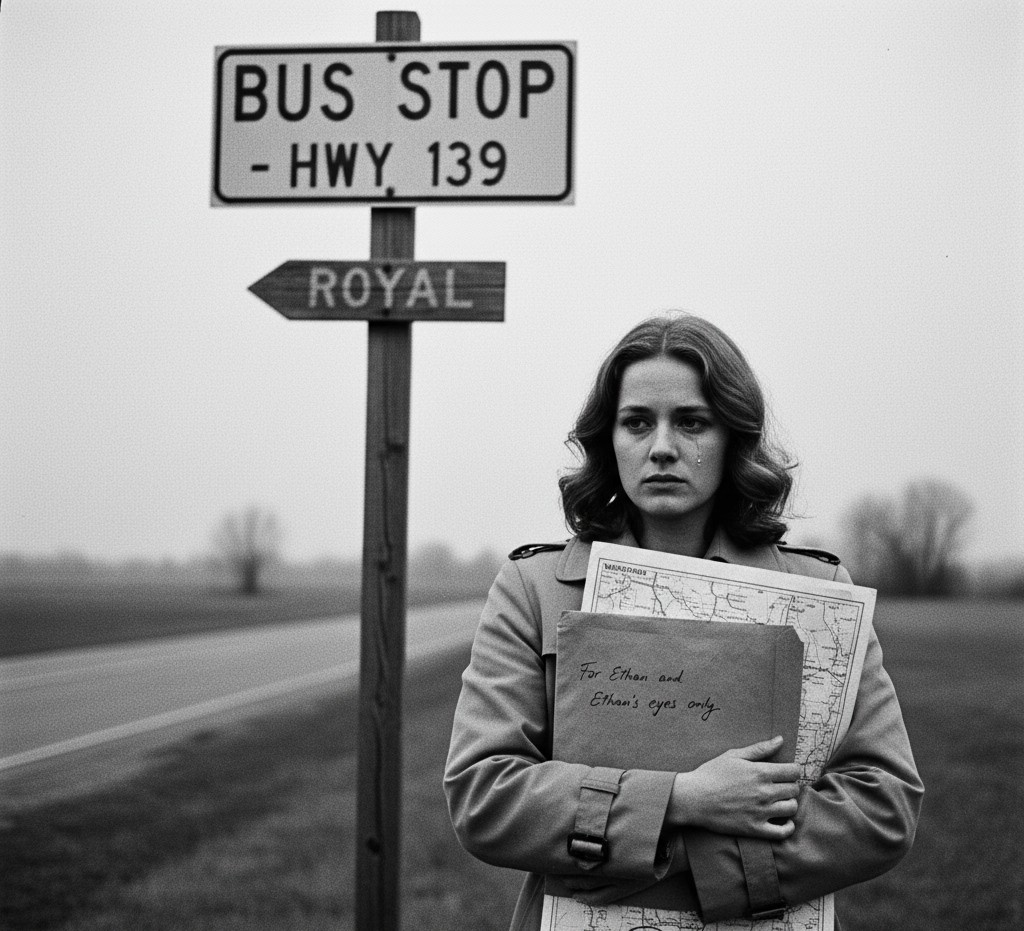
Peggy was a woman of singular focus now. The world outside her quest for Ethan had blurred into a meaningless, frustrating chaos. Her apartment, once a vibrant hub of student life, felt suffocating. Amy and Russel, were keeping her afloat—a fact that only added to the heavy guilt she carried, yet she couldn’t stop. She wouldn’t. Ethan’s face, the haunting melody from the sheet music, and the hollow ache in her heart drove her forward.
Her initial searches were methodical, a desperate grasp for anything concrete. The resources at the University Library and State Government offices yielded next to nothing on the Royal Publishing Company—it seemed to have vanished without a trace, a ghost in the corporate records. The Musician’s Union had equally frustratingly sparse files on Tommy Melk and the Melk Duds, just a few scattered, faded notations confirming their existence as a regional dance band in the late 40s and early 50s.
The true breakthrough, the first thread of the past she could pull, was found buried deep in the local newspaper archives. There, a stark headline jumped out: “Measles Quarantine Locks Down Entire Town Of Royal.” The accompanying photograph was grainy but clear enough to stop Peggy’s breath. It showed a county sheriff, stern-faced, positioning a wooden roadblock across a road. In the background, undeniable even through the newspaper’s poor printing, was state highway marker 139 with a sign below it saying “Royal”, with an arrow pointing to the roadblock.
Peggy snatched a current state road map, her fingers trembling as she searched for the state highway visible in the photo. She found the highway and traced it with her fingers, but the intersection and the road leading away from it—labeled in her mind as the road to Royal—were gone. The town itself was a blank space. “It’s not there”, she thought. “But there it is in the newspaper photo.”
The date on the article was Tuesday April 14,1959. Another clue! What she needed wasn’t a modern road map, but one from that year or before. The university library staff pointed her toward the Geographic Society at the University of Wisconsin, a treasure trove of historical cartography.
The appointment with the Geographic Society was a quiet, almost reverent experience. Spread out on a massive, protective table was a crisp, yellowed 1957 Wisconsin road map. Peggy’s heart was beating intensely. She was able to find state highway 139 and trace its path. And there it was. Not only the intersection, but the clear, black line of the road leading off the highway, culminating in a small, printed dot labeled Royal.
Peggy worked furiously, taking meticulous notes and securing a high-quality copy of the road map. Armed with proof of the town’s location, she began a new round of calls—county offices, local towns in the vicinity, the State Health Department to ask for any records or information related to the measles outbreak. Her life was now a relentless cycle of phone calls, library hours, and sheer exhaustion. Amy and Russel watched with mounting concern as their friend wasted away, her commitment to the search eclipsing all basic needs. The world had become flat and gray, except for that tiny, beckoning dot on the map that was Royal.
A final, desperate call to Ethan’s parents proved fruitless. They knew nothing of a town named Royal, nothing about any secret history. The silence on the other end was heavy with their own confusion and pain.
The next day, when Peggy was at her lowest, the phone rang..
“Hello?” she answered, her voice raspy.
“Peggy? It’s Helen, Ethan’s grandmother.”
A surge of adrenaline snapped Peggy alert. The grandmother sounded tentative, yet resolute. She had something, she said, something that might possibly help. Could you come over?
A couple hours later, Peggy was at the kitchen table in the grandmother’s cozy house, the scent of lavender and black tea was thick in the air. The grandmother slid a large, opened envelope across the table. Written on the front, in faded but deliberate handwriting, were the words: “For Ethan and Ethan’s eyes only.”
“Who… who opened this?” Peggy whispered, looking from the envelope to the grandmother’s tear-filled eyes.
“I did,” she confessed, her voice weary. “I found it with some of his things…Ethan’s grandfather’s things…that I was planning to give away. I couldn’t call Ethan’s father. The pain… it would break him. It would break us all.” She looked directly at Peggy, a plea in her eyes. “Promise me, Peggy. Do not say anything or show anyone the contents.”
Peggy promised. The grandmother rose silently and retreated to the living room, leaving Peggy alone with the envelope.
The contents were a window into a past life: letters, photos, newspaper clippings, and posters. The posters were for Tommy Melk and the Melk Duds, listing performance dates in Royal and other towns. The photos were the most striking—a younger version of Ethan’s grandfather, smiling, his accordion strapped across his chest. More photos showed him playing with Tommy Melk and the Melk Duds.
Then came the letters. They were love letters, passionate and tender, written to him from a woman named Grace. “Grace?” Peggy thought, confusion warring with a sickening realization. Grace was not Ethan’s grandmother’s name. As she continued to flip through the photos, the truth became undeniable. Ethan’s grandfather, young and vibrant, was pictured with Grace—holding hands, embracing, kissing. They were deeply in love.
Peggy had the clues to where Ethan could be—the mapped location of Royal. But the larger, more painful question now loomed: Who was Grace, and what happened to her?
Peggy gathered all the items and placed them back into the envelope. She walked into the living room. Ethan’s grandmother was sitting on the couch, openly weeping, her head in her hands. Peggy sat beside her, gently.
“You’re wondering why I’m showing you all this,” the grandmother said, wiping her eyes. “Why now?”
She took a long, shaky breath and began the story. She spoke of seeing Tommy Melk and the Melk Duds at the Eagles Club, of meeting Ethan’s grandfather, and of falling in love instantly. She spoke of his confession—that he was already in love with another woman, Grace. Then came the fateful night: drinks, dinner, passion, and shame.
“A few weeks later, I found out I was with child,” she whispered. “I contacted him through Tommy Melk. He quit the band. He moved here. We got married, and Ethan’s dad was born.”
The truth, ugly and raw, spilled out. “We were never really in love. He was still in love with Grace. He was still in love with his music.” I had dedicated my life to keeping him away from both Grace and his music, fearing the truth would destroy the family. Years later, after Ethan was born, we cornered Ethan’s grandfather, forcing him to swear he would never play the accordion or speak of music to his grandson.
“That was the second biggest mistake I ever made,” the grandmother said, her voice cracking. “He kept his promise. But I knew he snuck away to play the accordion in the attic. I knew he wasn’t happy.”
She turned, looking straight into Peggy’s eyes. “He is gone now, and so is Ethan, and it is all my fault.” She touched the envelope that was in Peggy’s hands. “Take this. You and Ethan are so much in love. I can see that. Keep it. Show it to him when he comes home. Ethan will understand. I know he will. I can see his grandfather in him, and all Ethan wants is to be happy. Ethan should know.”
The two women stood and hugged, a moment of shared, profound sorrow and sudden, fierce resolve.
“I will find Ethan,” Peggy promised, a small, solitary tear tracing a path down her cheek. “And I will bring him home.”
With the envelope clutched in her arms—containing the painful key to a family secret—Peggy headed to the bus stop. She had the final piece of the puzzle, and a destination. Royal. She knew in her heart now that she would find Ethan.