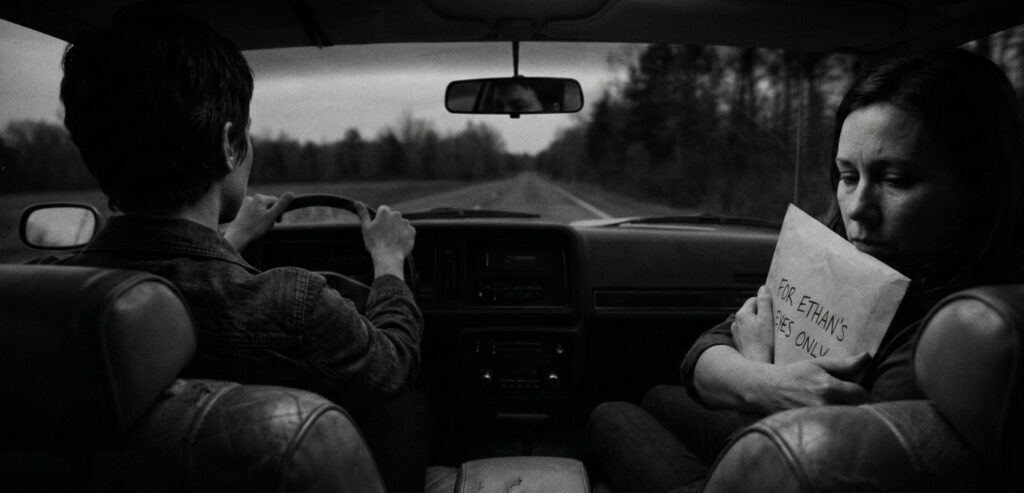
The heavy front door of the VFW groaned shut, sealing out the amber light of the late afternoon. Peggy sat in the passenger seat of Eleanor’s battered Chevy. Her mind spinning faster than the gravel under the tires. Clutched in her arms, the “For Ethan’s Eyes Only” envelope felt heavy, a physical weight of secrets and skipped heartbeats.
“You’re awfully quiet, sugar,” Eleanor said, her eyes fixed on the winding blacktop. “Those old warhorses in there can talk your ear off, but they don’t mean much harm. Mostly just bored.”
Peggy looked at Eleanor’s profile. The woman’s hands were steady on the wheel, her face a map of small-town resilience. “Harold mentioned a woman named Grace. He said she stayed in Royal after everyone else left. After the power was cut.”
Eleanor’s foot hesitated on the gas for a fraction of a second. The engine hummed a lower note. “Harold always did have a soft spot for a ghost story. But Grace… she wasn’t a story. She was real enough.”
“Did you know her?”
Eleanor sighed, a sound like dry leaves skittering across pavement. “Everyone knew the girl who waited. She lived in that little Victorian house near Royal Park. The park with the gazebo. The house was a beautiful place before the quarantine. After? It was like the world just forgot to keep turning for her.”
Peggy’s breath hitched. The gazebo. The image from the puzzle, the image on the sheet music. It wasn’t just a romantic illustration; it was a landmark of a tragedy.
“She had a child, didn’t she?” Peggy pressed.
“A boy,” Eleanor said. “Born a few years before the ’59 outbreak. Grace was… different after that. Fiercely private. When the sheriff put up the roadblocks for the measles quarantine, she didn’t complain. Some say she liked the silence. But then the quarantine lasted too long. The measles story started to smell funny to folks in Oakhaven. People stopped getting sick, but the guards stayed. And when they finally left? Royal was just a shell.”
“Why didn’t she leave with the others?” Peggy asked.
“She told my mom once that she’d promised someone she’d be there when the music started again. Can you imagine? Waiting in a town with no lights, no mail, just the wind whistling through the abandoned town.” Eleanor shook her head. “She stayed until 1964. By then, the boy was school-age. The county finally sent a social worker in to force them out. They moved her to a state facility over in Chippewa Falls. The boy… well, he went into the system.”
Peggy gripped the envelope. “What was the boy’s name?”
Eleanor turned the blinker on, the rhythmic click-clack filling the tense silence of the car. “I really don’t remember. Maybe after his father. But Grace never would say who the father was. Just that he was a traveling man. Or something like that. Some said the father was a musician. He might have played in the Tommy Melk band”
The realization hit Peggy like a physical blow. Tommy Melk and the Melk Duds? Ethan’s grandfather? The family friend she told the old men about wasn’t just a friend. Could it be…?
As they pulled into the driveway of a small, neat house in Black River Falls, Eleanor turned off the ignition. The silence was absolute.
“Peggy,” Eleanor said softly, “that puzzle those old men were working on? It’s been in that VFW hall for years. No one ever finishes it because one piece is missing. Just like the truth about Royal. Some things are better left lost in the woods.”
Peggy looked at the dark silhouette of the trees against the twilight sky. Somewhere out there, past the highway and the history books, the ghost town of Royal was waiting. And she knew, with a terrifying certainty, that she held the missing piece in her hand.