Page 2 of 11
(SCENE START)
INT. UWM FILM DEPARTMENT CLASSROOM – DAY
The classroom is brightly lit, but the atmosphere is heavy with the stale air of a hundred previous lectures. Five students sit around a large, battered seminar table. DR. SKOLLER, an older professor with a neatly trimmed, salt-and-pepper beard and the weary eyes of a man who has read too many student screenplays, stands at the head of the table.
JEFF (O.S.): Dr. Skoller had the look of a man who’d been promised cinematic poetry and instead was given a lifetime subscription to bad metaphors. His job was to strip away our artistic pretensions and teach us the cold, hard truth of storytelling. It was brutal. It was necessary. It was the moment we realized the shift from abstract imagery to three act structure was going to hurt. Our first sacrifice was our dignity, laid bare in the form of the logline.
DR. SKOLLER: Welcome. This semester, we abandon the comfort of the abstract. We trade philosophical musings for the unforgiving tyranny of narrative structure. Your task is to pitch your feature film screenplay idea to the group. Tell us the logline, the basic three act structure, and most importantly, tell us why anyone should care. Who wants to face disaster first? Stanley? Your shirt screams high concept.
STANLEY: (Springing up slightly, performing the pitch) Dr. Skoller, sir, I call this: ‘Fast Track to Fame!’ Logline: A relentlessly ambitious, but secretly inept, film student from Milwaukee bluffs his way into the highest echelon of Hollywood. Only to discover that true success means learning to direct his own life.
DR. SKOLLER: (Raises a skeptical eyebrow) That sounds suspiciously autobiographical, Mr. Stanley.
STANLEY: It is an aspirational autobiography, sir! Act One: The audacious lie. The plane ticket to LA. The coffee-running internship. Inciting Incident: He overhears a real producer complaining they need a script tonight! Act Two: He desperately fabricates a masterpiece, juggling his lies and nearly losing his soul to the Hollywood machine. Act Three: The lie collapses, but his authentic vision emerges. Resolution: He returns to Milwaukee, humbled, but with a real, marketable script. It’s a tale of triumph over… temporary setbacks.
DR. SKOLLER: (Nods slowly) So, a familiar Hollywood formula wrapped in the crushing reality of Milwaukee winters. Interesting. Next? Leonard? Please tell me you haven’t written a script about a goldfish.
LEONARD: (Adjusts his glasses, his voice shaking slightly) No, sir. This is far more potent. It is entitled: ‘The Ovoid Obsession.’ Logline: A neurotic man, desperate to impose order on a chaotic world, becomes obsessed with finding the perfectly spherical potato. Driving him to the brink of madness.
DR. SKOLLER: (Massages his temples) And the conflict? Does the potato speak?
LEONARD: The conflict is entirely internal. Act One: The search begins, fueled by philosophical need. Inciting Incident: He finds a potato that is almost perfect. A frustrating, tantalizing near-perfection of a potato. Act Two: The descent. He alienates friends, loses his job, and spends all his money on rare varieties of potatoes. Act Three: He realizes true perfection is impossible and the search itself was meaningless. Resolution: He eats the almost perfect potato, weeping gently.
DR. SKOLLER: It sounds like a ninety-minute anxiety attack, Leonard. But perhaps that’s the point. Cynthia? Let’s bring the mood down further.
CYNTHIA: (Flicking her invisible cigarette ash) My project is ‘The Algorithm of Ashes.’ Logline: A brilliant but profoundly cynical senator realizes all hope for political change is dead. So she orchestrates the most elaborate and beautiful act of political sabotage the world has ever seen.
DR. SKOLLER: Sabotage. Go on.
CYNTHIA: Act One: The slow, soul-crushing realization of futility. Inciting Incident: The senator sees definitive proof that the entire political system is rigged by a self-correcting, indifferent algorithm. Act Two: She meticulously plans the takedown, recruiting other disillusioned citizens. Act Three: The explosion. Not literal, but structural. The system is exposed and collapses. Resolution: The resulting chaos is not hope, but a more honest, profound emptiness.
DR. SKOLLER: Profound emptiness. Very UWM, Miss Cynthia. Thank you. Marvin? I assume yours involves something mundane becoming sinister.
MARVIN: (Speaks in his low, steady voice) ‘The Antique Washer.’ Logline: A quiet hardware store employee must track down a rare, stolen antique brass washer that holds the secret to a decades old crime spree. It leads him into the dangerous world of suburban organized crime.
DR. SKOLLER: Suburbia is rarely dangerous, Marvin.
MARVIN: This one is. Act One: Sorting bolts and meeting the girl. Inciting Incident: An old ledger reveals the washer’s history and the dark reasons it was originally stolen. Act Two: The hunt. He uses his knowledge of hardware inventory to track the piece across Milwaukee. He finds bullets stored in mason jars and bloodstains on galvanized pipes. Act Three: The confrontation in the back room of a rival store. Resolution: He recovers the washer, solves the crimes, and decides that focusing on the small, precise details of life, like a good relationship, is the only way to avoid the life’s larger chaos. (Deborah smiles at the last line.)
DEBORAH:(Leaning forward, genuinely excited) That leads perfectly into mine! Mine is called ‘Fasteners of the Heart.’ Logline: An earnest film student, searching for meaning in the world, finds a surprise romance with a cynical hardware store worker, forcing them both to trust in simple human connection instead of abstract philosophy.
DR. SKOLLER: And the conflict, Miss Deborah? Is it the difference between hex bolts and lag bolts?
DEBORAH: The conflict is vulnerability. Act One: They meet, drawn together by shared dismay at their other friends’ abstract ideas. Inciting Incident: They share an unexpected, deep conversation about life while sorting rusty fittings. Act Two: Their relationship blossoms, but they both fear commitment. Marvin hides behind cynicism, and I, well, my character hides behind idealism. Act Three: A crisis. A misunderstanding threatens their connection. Resolution: They choose each other, realizing that love is a practical, deliberate act, not a sweeping epic.
DR. SKOLLER: (Takes off his glasses, rubbing the bridge of his nose) Fascinating. So, Stanley gives us cliché. Leonard gives us despair. Cynthia gives us justified anarchy. And Marvin and Deborah give us… relationship goals set against a backdrop of nuts and bolts. Welcome to narrative structure. This semester is going to be painful. (DR. SKOLLER drops his glasses onto the table with a CLACK.)
JEFF (O.S.): The gloves were off. Dr. Skoller had cracked the whip of conventional storytelling, forcing us to try and fit our messy lives and wild philosophies into the neat confines of a screenplay. Stanley was already picturing the red carpet, Leonard was mentally calculating the spherical error of his protagonist’s life. Cynthia takes another drag on her imaginary cigarette. And for Marvin and Deborah. Their love story officially had a clear three act structure that they had to adhere to. Both on and off the written page.
(SCENE END)
The Wit And Wisdom Of Horace B Miesner

Keep your friends close and your snacks closer.
WRYL – The Voice of the Great Up North


In this world you will have trouble. But take heart. I have overcome the world, promising peace and courage amidst life’s inevitable difficulties by emphasizing the divine victory over worldly struggles, providing comfort and a call to be courageous. – Gospel of John
Friends, let us look at one another with clear eyes. We live in an age of remarkable progress. We have split the atom, built amazing communities, and filled our homes with wonders that would have seemed like magic to our ancestors.
Yet, if we are honest, our hearts are often heavy. The evening paper brings news of uncertainty, and our own doorsteps are not immune to the shadows of violence, sickness, financial worry, or the quiet ache of a weary lonely soul.
It is a fundamental truth of our existence. In this world we will have trouble. It is not a possibility. It is a certainty. The rain falls on every roof, and the wind blows against every shutter. To live is to encounter the friction of a world that is often harsh and unpredictable.
But listen closely. The story of our lives does not end with the word “trouble.” There is a turning point offered to us if we are willing to see it.
“But take heart.” This is a call to find your inner fortitude. This isn’t a suggestion to put on a mask of false happiness or to ignore the gravity of our situation. It is a call to summon a deep, abiding peace. A peace that the world didn’t give you and, therefore, the world cannot take away.
Human courage, and indeed all true human bravery, is not the absence of fear. It is the realization that something else is more important than fear. It is the recognition that we are anchored to something much larger than our current storm.
Here is the bedrock of our hope: The Divine has overcome the world.
When we speak of the Divine, we speak of a power that transcends the temporary struggles of our day-to-day lives. Think of the beauty that persists despite destruction, the love that endures despite hate, and the light that cannot be put out by any darkness.
This higher power has already moved through the deepest valleys of human experience and emerged victorious on the other side. The Divine does not ask you to fight a battle that hasn’t been understood or won. You are being invited to walk in a victory that has already been secured by the very source of life itself. Every struggle you face is but a small wave on an ocean that has already been calmed.
So my friends, when you go back to your work, or when you face a difficult personal trial, or when the weight of the world feels too heavy to bear, remember this:
You are not alone in the struggle.
The trouble is a temporary season.
The peace of the Divine is an eternal constant.
So lift up your heads! The path has been cleared. Let us walk today not with trembling hearts, but with the steady step of those who know that the ultimate victory belongs to the light of the Divine.
Amen.


The gentle May air of Milwaukee was bright and fresh, but Peggy barely noticed. She stood outside the intercity bus depot, the worn canvas backpack containing everything for the trip, including Ethan’s envelope, slung over her shoulder. Amy and Russel flanked her, two steadfast pillars of worry in the early morning light. Their support felt like both a lifeline and an anchor of guilt.
“Are you sure you don’t want me to drive you at least to Madison?” Amy pleaded, adjusting the lightweight cardigan she wore. “It would shave two hours off the bus ride.”
“No, Ames. I’m fine,” Peggy insisted, trying to sound more confident than she felt. “You need the gas, and you both need to focus on finals. I’ll be fine. Black River Falls is the key. Once I’m there, I’ll figure the rest out.”
Russel silently pressed a wad of bills into her hand. All their combined cash reserves, tightly folded. “This has to last, Peg. Get a room if you have to, but don’t spend it on anyone trying to fleece a college kid. Promise us you’ll call.”
Peggy’s throat tightened. She looked at their earnest, worried faces, recognizing the enormous sacrifice they were making for her singular, all consuming quest. “I promise. I will call. And I will find him.”
A moment of profound, silent sorrow passed between the three of them. They knew this was reckless, but they also understood the alternative. Watching Peggy slowly dissolve under the weight of her grief and curiosity was worse.
“Be safe. Don’t take any risks you don’t have to,” Russel finally said, giving her a brief, awkward hug.
Amy embraced her tightly. “Bring him home, Peg.”
Peggy watched them drive away, the headlights of Amy’s beat-up Honda Civic disappearing into the Milwaukee sunrise. Then, she turned, clutching the backpack and walked into the sterile, diesel-scented cavern of the depot. She was on her own now.
Peggy’s only real lead was found in the envelope marked “For Ethan’s Eyes Only.” The envelope Ethan’s grandmother opened. Looking through the contents, she found a single, garish flyer: Tommy Melk and the Melk Duds playing at the Oakhaven VFW.
Oakhaven was the clue. Spreading out her map, she located Royal. She then located Oakhaven and felt a jolt of pure adrenaline: it was the closest town to Royal she could find. The flyer was not an invitation, but a cryptic destination. Her path was clear. She would take the bus to Black River Falls, the nearest stop, and from there find transport to Oakhaven.
The bus ride was a warm, rattling blur. Peggy sat by the window, letting the bright, green landscape of Wisconsin roll past, her mind replaying the story of Ethan’s grandfather, of Grace, and the secret love the two shared. The town of Royal, the measles quarantine in 1959. It was all coming into focus, but the image was heartbreakingly tragic.
When the bus finally pulled into the Black River Falls depot, it was mid-morning. The small station smelled faintly of cigarettes and coffee. Peggy checked her watch: 10:30 AM. She had made it. But the next hurdle was upon her. How to cover the remaining twenty miles to Oakhaven, the town neighboring Royal.
She walked out to the parking area, her eyes scanning for any sign of opportunity. A couple of battered cars were parked near the entrance, drivers leaning against them, waiting for passengers. She approached the first man, who quoted a price that would take nearly half of Amy and Russel’s cash. Peggy shook her head and moved on. The second driver was equally expensive. She stood for a long minute, feeling the familiar spiral of panic begin to choke her. “Recognize what is in front of your face,” Peggy whispered to herself.
She turned back to the depot entrance and spotted a third car, an ancient, faded station wagon with a hand-painted sign duct-taped to the windshield that read, simply TAXI. The driver, a woman with kind eyes and a sensible, wool coat, was just settling behind the wheel smoking a cigarette.
Peggy walked up and leaned down to the open window. “Ma’am, I need to get to Oakhaven. It’s about twenty miles south on Highway 139. I don’t have much money.” Peggy quickly named a price she could afford, a fraction of the others’ quotes and held up the crumpled bills.
The woman, whose name tag read ‘Eleanor,’ considered her for a moment. “Oakhaven? Nothing much out there but woods and a VFW hall,” she observed. She looked at Peggy’s earnest face. “Well, you look like you’re on a mighty important mission, dear. Hop in. I can’t promise you a ride back, but I’ll take you the twenty miles for that. Just promise me you won’t stand out there alone hitchhiking.”
Peggy’s relief was immediate and overwhelming. “Thank you, Eleanor. Thank you so much.”
The ride was surprisingly pleasant. Eleanor wasn’t one for chitchat, but the silence was a welcome change from the bus ride. As they drove south, Peggy kept her eyes glued to the scenery, looking for any clue, any hint of the landscape she’d seen in the grainy 1959 newspaper photo.
“Whereabouts in Oakhaven you headed?” Eleanor asked, pulling the station wagon onto the quieter, two-lane Highway 139.
“The VFW Hall,” Peggy answered immediately. She pulled out the blurry photo of the roadblock. “Do you know anything about a town called Royal? It was just a few miles from Oakhaven, years ago.”
Eleanor squinted at the photo, then chuckled, a dry, rusty sound. “Royal, huh? That’s a name I haven’t heard in years. My folks used to drive out there for dances when I was a kid. Why, Royal’s been nothing but timberland for ages now. The road’s gone, folks moved out.”
“But it was still there in ’59?” Peggy pressed.
“Oh, sure. Just before that big measles thing,” Eleanor nodded. “Everyone in the whole county was terrified. Whole place was locked up tight as a drum. Folks just kind of… never came back after that. Not much reason to, I suppose.”
Eleanor pulled over onto a narrow, paved road. The sun was fully up now, illuminating a small, sleepy collection of utility poles, a gas station that looked half-dead, and a single, faded sign reading: Welcome to Oakhaven—Established 1898. Just ahead, a squat, concrete block structure stood: the Oakhaven VFW Hall.
“This is it, dear,” Eleanor said, pulling out a cigarette from her purse. “Good luck with your mission.”
Peggy paid her, thanked her and stepped out onto the warm asphalt. She stood for a long moment, watching the station wagon pull away, her solitude absolute. Clutched in her hands were the envelope, the map, and the faint hope that someone inside that concrete hall remembered a dance, a band, a man with an accordion, and a lost town called Royal.
The VFW Hall looked closed, dark, and utterly impenetrable. She walked toward the front door, the heavy brass knob cold beneath her fingers.“Recognize what is in front of your face,” Peggy whispered to herself.
The door was locked.
Peggy walked around the side of the building, her shoes crunching on the gravel. Beside a loading dock, a small, unmarked door was ajar, a faint line of golden light spilling out, along with the distinct aroma of coffee and tobacco.
Taking a deep breath, Peggy pulled the door open and stepped inside.
(SCENE START)
EXT. UW-MILWAUKEE STUDENT UNION MALL – DAY (FALL)
The campus mall is a vibrant mosaic of green grass, red brick, and the bustling energy of returning students. The late August sun is bright and warm, but a crisp, new-semester breeze hints at the Fall to come. Students mill about, greeting old friends and hauling backpacks.
A small, circular stone table outside the Student Union is occupied by MARVIN and DEBORAH. They are sitting close, a comfortable, shared quiet between them. Deborah smiles, resting her chin on her hand, watching Marvin as he sips from a coffee cup.
JEFF (O.S.): Junior year. The cinematic gauntlet was thrown. Abstract art house pretensions were out, and the crushing weight of narrative structure was in. We’d survived the summer, and now we had to survive the semester’s first test: The Screenplay. It felt like a betrayal of all our previous artistic manifestos. But, if the summer had taught us anything, it was that even amidst the rust and the mundane, life somehow manages to find its plot.
DEBORAH: I can’t believe we’re actually back. It feels like just yesterday I was trying to figure out the torque setting for a stripped bolt.
MARVIN: (A small, soft smile plays on his lips) You know, you got pretty good at sorting those carriage bolts from the machine bolts. That’s a valuable life skill.
DEBORAH: I blame you. You made the hardware store sound… romantic. Well, “interesting,” at least. My parents were convinced I’d lost my mind. “You’re going to a hardware store, dear? To study screws?”
MARVIN: It was a good summer. Quiet. (He reaches over, briefly squeezing her hand where it rests on the table.)
DEBORAH: It was more than quiet, Marvin. It was… a first draft. A really good first draft.
(A flash of movement catches their eyes as STANLEY bounds toward the table, his arms thrown wide, a bright Hawaiian shirt clashing with his heavy tweed backpack.)
STANLEY: My darlings! My cinematic collaborators! Behold! Stanley has returned! The prodigal son of Hollywood’s outer periphery has graced your presence!
DEBORAH: Stanley! You’re back! How was the pilgrimage to La La Land? Did you hobnob with any actual stars?
STANLEY: Hobnob? I permeated the atmosphere of cinematic greatness! I told you, I had a connection! A glorious four-week internship running coffees for an assistant who worked for a junior agent. I absorbed the creative energy! I saw an actual, working slate! And, most importantly, I learned that they value narrative! Clean lines, clear arcs, no exploding bagels unless they advance the plot! It was a revelation!
MARVIN: So, you made coffee.
STANLEY No, Marvin. I made connections. And the coffee was organic. It’s all research for the screenplay, my friends! I’m going to write a sweeping epic about a troubled but brilliant young filmmaker who conquers Hollywood with sheer, unadulterated panache!
(LEONARD walks up, carrying a textbook the size of a paving stone, looking predictably weary.)
LEONARD: Stanley, you look like a walking tropical fever dream. Did you ever find the meaning of existence amongst the palm trees? I spent my summer staring at the dust motes in my childhood bedroom. They danced in the morning sun, a beautiful, fleeting metaphor for our insignificant lives. My goldfish, Bartholomew, remains unimpressed by the dust motes.
STANLEY: The meaning of existence, Leonard, is a three-act structure! I learned that, too! You need a clear, inciting incident! We are no longer making films about philosophical goldfish, we are making films about goldfish who must overcome a personal tragedy!
LEONARD: (Sighs, sitting down) And what is your screenplay about, Marvin? The existential despair of a loose spring?
MARVIN: I’m thinking about a horror film. About a couple who falls in love working at a rusty hardware store. Things get weird. (DEBORAH playfully elbows Marvin in the ribs.)
DEBORAH: I think my script is going to be a coming-of-age story about finding your voice. A young woman obsessed with existential dread finally learns to talk to the quiet, observant boy she likes. It’s a comedy.
(CYNTHIA approaches the group, wearing all black, naturally. She places a single, wilted sunflower on the table.)
CYNTHIA: I have embraced the futility of it all. I spent my summer attempting to learn a dead language. It seemed an appropriate tribute to the inevitable decay of all human endeavor. My screenplay will be a harrowing modern tragedy. A critique of the capitalist machine that turns our dreams into meaningless, marketable commodities. It will be entirely in black and white, and the dialogue will be minimal.
STANLEY: Minimal dialogue? Cynthia! We need verbal action! We need snappy patter! We need…
CYNTHIA: Stanley, your Hollywood dreams are a bourgeois fantasy. Mine is a nightmare of societal collapse. A much more compelling narrative, wouldn’t you agree?
LEONARD: (Nodding slowly) I agree with Cynthia. The only honest screenplay is one that reflects the horror of being. Mine is about a man who spends his life searching for a perfectly spherical potato. It will be called, ‘The Ovoid Obsession.’
DEBORAH: (Leans in, her voice low and earnest) My dream for this semester is to actually finish something. Something real. Something that connects with people. Not just with abstract concepts, but with feelings. And… to keep what we started this summer going. (She glances at MARVIN. He meets her gaze, his expression warm and settled.)
MARVIN: My dream is to stop making films about exploding bagels. And to make something that sticks. Like a good weld.
STANLEY: Fasteners of the Heart lives! You see, Cynthia? Even the most dour among us yearns for a good plot! My dream is to have my screenplay optioned before the end of the semester!
CYNTHIA: My dream is that the optioned script will be a metaphor for the slow, agonizing death of the human spirit.
LEONARD: My dream is that Bartholomew will finally recognize my artistic genius.
JEFF (O.S.): So there we were. Junior year. The pressure was on to trade the abstract for the actual. The philosophical goldfish for the well-structured plot. It was a sun-drenched, optimistic start to a semester that would force us all to look a little closer at the stories we were really trying to tell and the ones we were living.
(SFX: General campus sounds, a distant bell rings.)
(SCENE END)

The Most Fun You’ll Ever Have Earning Your Crown of Knowledge!
Hear ye, hear ye! Step right up, future Kings, Queens, Dukes, and Duchesses of the Royal School System! We are absolutely thrilled to unveil our brand new educational opportunity, where learning isn’t just a duty. It’s a delightful adventure!
Forget dusty textbooks and boring lectures! At the Royal School System, we believe that education, especially at the elementary level, should be filled with laughter, curiosity, and a sprinkle of royal fun. Whether you’re learning to write a fairy tale or trying to figure out how many apples fit into a royal basket, we’re going to make it an absolute blast.
What Subjects Will We Explore?
Get ready to dive into a curriculum fit for a future ruler! We’ll be covering five core subjects, one joyful lesson at a time:
Creative Writing (The Royal Scribe): Invent your own mythical creatures, pen the next great coronation speech, master the art of the perfect royal announcement and write a story fit for a King!
Math (The Treasure Tally): Counting jewels, calculating the speed of a fleeing dragon, and mastering the arithmetic needed to manage a vast kingdom!
Chemistry (Potions, Goo & The Magic Table!): Safe, simple, and seriously fun as we discover how the world works! We’ll start with the Periodic Table of Elements, learning what these fundamental building blocks are and how they’re organized. Then, we’ll explore the real magic: discovering everyday substances. From the salt on your table to the water in your bath. We investigate compounds and chemical creations we use every single day!
U.S. History (Tales from the New World): Discovering the amazing stories and legendary figures that built the United States. History is just a collection of great true stories!
Polish Language (Dzień Dobry, Poland!): A light and simple introduction to the beautiful language and rich culture of Poland. We’ll learn greetings, basic phrases, and fun facts!
How Does It Work?
Simple Lessons: We’ll post short, easy-to-digest lessons that you can tackle in a single sitting.
Fun Assignments: Every lesson comes with a super-easy assignment. Maybe you’ll write a five-sentence story, or maybe you’ll measure the volume of a teacup!
Sharing is Caring: The best part? You get to submit your work, questions, and ideas! We’ll regularly feature student-submitted assignments, answer your most puzzling questions and celebrate your creative genius!
Our Royal Motto: Keep it Light! Keep it Fun! Keep it Easy! There are no grades here. Just applause and encouragement! This is your special place to explore the world with curiosity and confidence.
Are you ready to grab your quill and put on your thinking crown? Your first lesson in Royal Scribe (Creative Writing) arrives in January!


Dear Shirley,
I am writing this with a heavy heart that feels as cold and brittle as the December ice. My loving husband, who was the light of our little family, was taken from us recently in the terrible fighting in Korea. I am a single mother now to two sweet children—our boy is six and our little girl is four.
Christmas is nearly upon us, and instead of joy, there is only sorrow in our home. My children, who miss their daddy so terribly, have turned against everything that is Christmas. They hate Christmas carols, they hate when the neighbors decorate their houses with Christmas lights and a Christmas tree, and they absolutely despise the very idea of Santa Claus. All they want, all they ask for, is for their daddy to come home.
It is their questions that hurt me worst of all. They ask me, “If God is good, why did He take Daddy to Heaven?” and “Why can’t Santa bring Daddy back for Christmas?” I don’t know how to explain such a cruel loss to such young, innocent minds. I am ashamed to say that I, too, feel a deep resentment. Every time I turn on the radio or look at an advertisement, I see happy, complete families, and it only deepens my own misery. Shirley, how can I possibly help my babies understand this loss, and how can I bring the Christmas spirit back into their hearts, and into my own?
Heartbroken Mom
Dear Heartbroken Mom,
Please, dry those tears and know that you are not alone. The shadow of war has fallen over so many homes this year, and you are carrying a burden of sorrow and confusion that would stagger the strongest of women. There is absolutely no shame in your feelings of resentment and despair. Grief is a heavy cloak, my dear, and it is darkest during the times when the world seems determined to be bright.
First, you must understand that your children are not being naughty or hateful—they are simply hurting. A six-year-old and a four-year-old cannot yet grasp the complex ideas of life, death, and duty. To them, the magic of Christmas and the power of God should be able to solve their biggest problem, which is Daddy’s absence. When they see that Christmas cannot perform this miracle, they reject it.
Here is my sincere advice for you and your two little angels:
For Their Understanding:
Be Honest and Gentle: Do not use vague terms like “Daddy went to sleep.” Your children need to know the truth: that Daddy was a brave soldier who died, and his body can no longer be with them, but his love and spirit are still here.
Heaven is a Place of Honor: When they ask why God took him, tell them that God needed the very best, strongest, and kindest of men for a special, important job in Heaven. Your husband gave his life serving his country; you can honor that by teaching your children that he is a hero watching over them.
Create a New Tradition of Remembrance: This year, Christmas cannot be what it was, so do not try to force it. Instead, dedicate a small part of the day to their father. Perhaps you can let the children write a letter to their Daddy and attach it to a balloon to send “up to Heaven.” Or, perhaps you can hang a special, new ornament—a “Daddy’s Star”—high on the tree, and explain that it represents the star he is watching you from. Remembrance is not a rejection of joy; it is a sacred part of it.
For Your Christmas Spirit:
Do Not Retreat: You must resist the temptation to watch the happy families on television and compare your life to theirs. Their happiness is real, but so is your suffering. This year, you are not meant to be a part of the noisy joy. You are meant to be a part of the quiet, loving comfort that this season also holds.
Focus on Giving, Not Receiving: The truest spirit of Christmas is in the act of kindness and service. You cannot afford an extravagant Christmas, but you and the children can afford time. Find a simple way to help others less fortunate—bake cookies for an elderly neighbor, or donate a few old toys to the local orphanage. When your children see that they can bring a smile to someone else’s face, the healing will begin. They will feel their own importance and their own power to be a light in the darkness.
Start Small: Perhaps this year, you put away the tinsel and the big ornaments. Get a small, simple pine branch or a sprig of holly, and decorate it with only the “Daddy’s Star” and maybe a few candles. Start small, dear. The Spirit will grow back, little by little, in the quiet, and it will be stronger because it will be rooted in love and memory.
Your dear husband is at peace, and he would want you to find yours, not for his sake, but for your own and for your children. Cling to the faith that he is waiting for you all, and that the greatest gift you can give him is to raise his children in love and light.
God bless you, and may a deep peace find its way into your home this Christmas season.
Shirley

The Wit And Wisdom Of Horace B Miesner
I’m not clumsy; the floor just hates me, the tables and chairs are in on it too.
WRYL – The Voice of the Great Up North
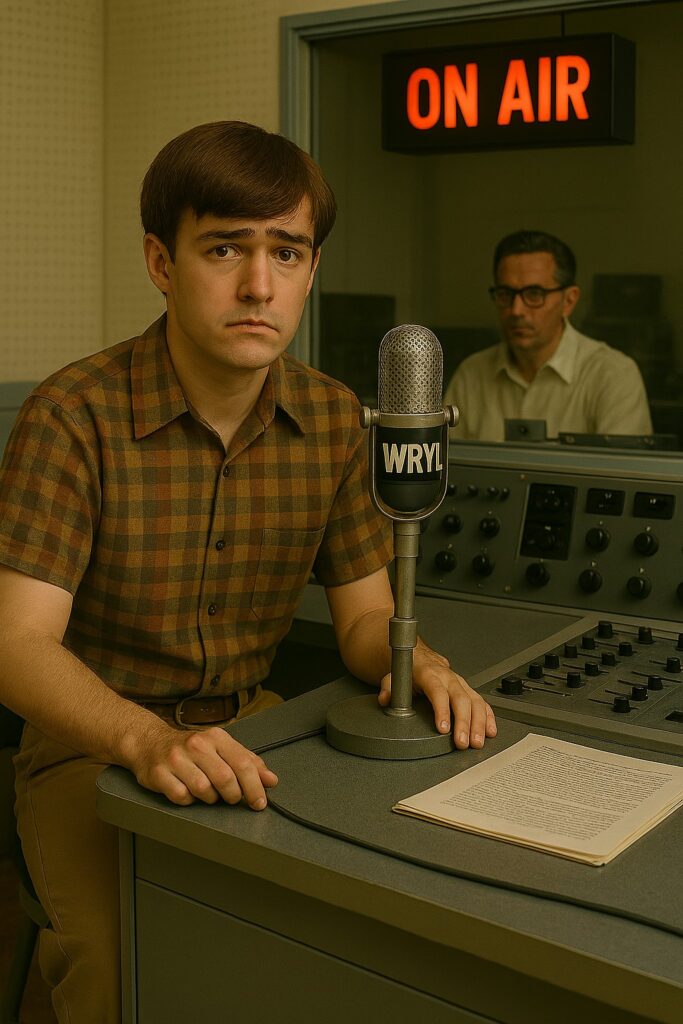
The air inside WRYL Studios was thick with the scent of dust, old electronics, and coffee. It was the smell of analog broadcasting being done on a shoestring budget. In the small, bustling reception area, a woman with a bouffant hairdo kept her gaze fixed downward, her fingers a blur on the typewriter.
“Good afternoon,” Ethan said, his voice hesitant.
Clack-clack-clack. The woman didn’t pause.
“I’m Ethan,” he tried again, taking a step closer. “I… uh… I just got a call. My show?”
The woman stopped abruptly, snatched the paper from the carriage with a rip, and looked up, her expression a mix of impatience and professionalism. Her eyes were framed by sharp cat-eye glasses.
“About time, Ethan! Mr Stoddard wants to see you right away. He’s in his office.” She pointed to a closed office door. Ethan just stood there confused, unsure of what to do. The receptionist snapped. “Try to keep up, dear.” She punctuated her statement with a shaming glance at his vintage casual wear and a finger pointing to the closed office door..
“R-right,” Ethan stammered, feeling like a high school kid late for detention. He turned and walked towards the designated door. The wall behind Ethan was lined with framed, yellowing photographs of stern-looking men and women in suits—presumably past station managers or local celebrities. The door was marked with a gold-plated sign: E. G. STODDARD, STATION MANAGER.
Ethan knocked.
“It’s open, you insufferable nitwit! Get in here!” roared the same booming voice Ethan heard on the phone.
Taking a fortifying breath, Ethan pushed the door open. Behind a massive, cluttered metal desk sat a man who filled his tweed jacket completely. He had a bristly gray crew cut and a face that looked perpetually annoyed.
“There you are,” Stoddard barked, pointing a stumpy finger at a clock on the wall. “Twenty minutes to air. You’ve been late three times this month, Ethan. Three times! You keep this up, and the sponsors will pull the plug on ‘Ethan’s Afternoon Exchange.’ You want to go back to scrubbing dishes at the Lunch Box Cafe?”
“No, sir, I don’t,” Ethan answered, swallowing the impulse to inform the man he had never scrubbed dishes in his life. Everything he was hearing felt like a line of dialogue from a play he hadn’t rehearsed.
Stoddard ignored him and shoved a typed sheet of paper across the desk. “News first. You need to hit these three headlines hard. The new community pool—it’s the biggest project since the war. Second, the missing Royal High School mascot uniform—it’s a scandal. And third, make sure you mention Mrs. Gable’s prize-winning roses again. She buys ad time. You scratch her back, she scratches ours.”
Ethan picked up the paper, his eyes scanning the impossible, anachronistic news items: “Pool construction ahead of schedule.” “Manhunt for perpetrator of mascot theft.” He was being asked to discuss current events in a town he didn’t even recognize an hour ago.
“And what is the interview?” Ethan asked, trying to sound professional and not completely insane.
Stoddard sighed, rubbing his temples. “The usual routine. Mrs. Percy from the Garden Club is coming in to discuss the annual Lilac Festival. She’s bringing her notorious triple-layered lemon cake. Be nice, nod a lot, and for heaven’s sake, don’t mention her ex-husband. Last time you did, she almost threw a vase at you.”
Ethan blinked. He had a history here. Apparently a clumsy, tactless history with Mrs. Percy.
“Alright, Ethan, listen up,” Stoddard said, leaning forward. “This station is the heartbeat of Royal. It’s a good job, a steady gig, and you’ve got a real knack for it. But you need to be professional. Get it together. Now, go warm up your voice and get into Studio A. I’ll send the engineer in shortly.”
Stoddard gestured toward another door within the office.
“Studio A?” Ethan inquired.
“Yes, Studio A! Where you host your show five days a week! Now move!”
Ethan retreated, stumbling into a small sound-proofed room. It was tiny, dominated by a large microphone and a console covered in sliders and knobs. Through a thick glass window, he could see a second room with a turntable and a reel-to-reel tape machine. The air was colder here, quieter. The world outside felt very far away.
He sat down in the upholstered chair, the smooth vinyl squeaking under his weight. He touched the heavy, chrome microphone grille, feeling a sudden, strange rush of adrenaline. He was about to go on the air as a radio host in a 1950s-era town that had materialized out of thin air.
This is it, Ethan thought, placing his hands on the worn desk.
The door opened, and a middle aged man with thick black glasses and a worried expression slipped in, clutching a stack of 45-rpm records.
“Ethan, you look pale. Did you get any sleep? Stoddard’s furious,” the man said, his eyes magnified through the thick lenses. He smelled faintly of mint and engine oil.
“I… I’m fine, just a little off,” Ethan said, studying the man’s familiar-but-unknown face. “And you are?”
The man stared, flabbergasted. “It’s me! Bobby! Your engineer! Are you still mad about that time I accidentally played the wrong ad and you had to fill four minutes with a story about a goat?”
“Oh! Bobby! Right,” Ethan mumbled, trying to connect the dots. “No, not mad, just… stressed.
Bobby, visibly relieved, flipped a switch on the console in front of Ethan, causing the words “ON AIR” to glow red..
“Theme music is cued up. Five seconds,” Bobby announced, tapping a gauge on the console. “Remember to hit the news first, and for God’s sake, say hi to Mrs. Gable! She’s listening!”
Bobby quickly retreated to the engineer’s room, giving a thumbs-up through the glass.
Ethan felt his heart hammer against his ribs. He was staring at the microphone, an inert piece of metal that was about to connect him to an entire town of strangers who thought they knew him.
The music swelled, a bright, jazzy, slightly tinny melody. A green light on the console flashed.
He cleared his throat, swallowed hard, and leaned into the microphone.
“Good afternoon, Royal! This is…” he paused for a fraction of a second, “…Ethan.”

Recognize what is in front of your face, and what is concealed will be revealed to you. For there is nothing hidden that will not be disclosed. – Gospel of Thomas
My Brothers and Sisters. We are gathered here today in our wonderful community, not to talk about what’s out there in the wide world, but what’s right here, in our very own lives. We’re going to talk about Vision. Not the kind you need to read the morning paper, but the kind you need to live a full life.
Our wisdom for today comes from a simple, yet profound passage from the Gospel of Thomas. It tells us: “Recognize what is in front of your face, and what is concealed will be revealed to you. For there is nothing hidden that will not be disclosed.”
Now, that’s a powerful idea. It sounds like something out of a detective novel, but it’s really about Good Old-Fashioned Common Sense and Plain Hard Work.
In this marvelous, modern age, we’ve got so many things competing for our attention. We’re so busy chasing the next promotion, the next big appliance, or the next vacation, that we suffer from what I call “Tunnel Vision”.
We are looking so far down the road at some grand, abstract future that we completely miss the Golden Opportunities parked right on our driveway.
You’re praying for a better job, but you haven’t taken the time to truly see the colleague next to you who could use a helping hand or a kind word.
You’re wishing for a more harmonious family, but you haven’t recognized the patience and listening ear your spouse or children need right now.
You want to be a success in this town, but you haven’t acknowledged the simple needs of your neighbor’s garden or the local school drive.
You see, the great mystery of life isn’t hidden behind some velvet curtain. It’s concealed by your own distractions. The scripture tells us to “Recognize what is in front of your face.” The solution to your problem, the path to your fulfillment, is not ahead of you, but all around you.
But recognizing isn’t passive. It requires effort. It requires you to stop, to put down the magazine, to turn off the television, and to look with honest eyes at your circumstances.
When you recognize the weariness in your own heart, that’s when the concealed secret of Rest is revealed.
When you recognize the unmet need of your community, that’s when the concealed secret of Purpose is revealed.
When you recognize the daily blessing of a clean shirt and a warm meal, that’s when the concealed secret of Gratitude—the key to true happiness—is revealed.
The passage promises us, “what is concealed will be revealed to you.” This isn’t magic. It’s a natural consequence. If you refuse to see the small, important things, the big, necessary things will forever remain a mystery. But when you honestly confront what is directly before you—the debts, the opportunities, the responsibilities—the path forward will simply appear. The fog lifts because you finally stopped staring up at the clouds and you looked down at your own two feet.
And finally, we have the great assurance: “For there is nothing hidden that will not be disclosed.”
This is a promise of integrity for the whole world. It means that whether it’s a small dishonesty in your accounts, a secret bitterness you hold against your brother, or a generous act of charity you performed in private—it will all eventually come into the light.
This shouldn’t fill us with dread. It should fill us with courage.
It means the good work you do when no one is watching. The kindness you show to an elderly neighbor. The hours you spend perfecting your craft. That effort counts. It’s an investment that will be paid back with interest in the visible realm of your life. The truth of who you are, the contents of your character—good or bad—will be revealed in the final accounting.
So let’s stop sweeping things under the rug. Let’s stop pretending everything is fine when it isn’t. Let’s start with the things we can see and touch today.
Let’s go home and recognize the dishes in the sink, the thank you note we forgot to write, and the potential we’ve been neglecting in ourselves. Let’s do the work that is in front of our face, and I promise you, that the bright, rewarding future you’ve been hoping for will suddenly unfold—it will be revealed to you.
Let us be the generation that truly sees the moment we are in, and by doing so, brings true honor and success to our families and our community.
Amen