Red Berry Workshop

I may be crazy, but it seems to me that . . .

Page 5 of 12

Chapter 15: In the Shadow of Yesterday

A new day dawned on Royal, but the oppressive gray sky still hung heavy, threatening more rain. Ethan rose early, the dream-like vision from the night before still vivid. He ran a hand over the imagined freshly painted walls, a phantom touch of smooth, clean plaster. His bedroom, however, was as derelict as ever. The peeling wallpaper hung in strips, and a fresh ring of dampness stained the ceiling. He felt a deep sense of loss, as if the life and vibrancy from his dream had been stolen.

He was caught in a tug-of-war between two realities: the one his eyes saw and the one his heart felt. For the first time in what felt like a lifetime, the melancholy grip that had held him for days loosened its hold. A small ember of hope sparked in his chest. It was the spirit’s voice that resonated with him the most. Her words, “Your imagination is our life,” echoed in his mind, and he felt a responsibility to the spirits. With a renewed purpose, he knew he had to leave the house, to break free from the self-imposed prison he had built.

As he walked the empty streets of Royal, he felt the town’s bleakness like a physical weight. The houses, once long ago vibrant with life, now seemed to frown with neglect. The shops were boarded up and Main street, once long ago bustling with activity, was now quiet and desolate. A cold wind blew through, carrying with it the smell of wet earth and decay. The town was suffocating, and Ethan knew that if he stayed, he would be buried in its despair. 

Returning to the house, Ethan ran his hand over the wood siding, and a new feeling surged through him. It was a faint, yet undeniable, hum of energy. A shiver of excitement ran down his spine. The spirits had been right. A different kind of life awaited him. It was his imagination, his willingness to believe, that held the key. He had a profound realization: Royal wasn’t just a place. It was a reflection of himself. Its decay was his decay; its despair, his despair. The town’s sorrow had resonated with his own, and in a way, he had been fueling it. He knew he had to heal himself to heal the town.

Ethan walked through the front door and took a deep breath. He needed a place to start. A spark of inspiration ignited as he looked around the desolate living room. He would start there, with a broom and a pail of soapy water. He would fight back against the grime, the decay, and the despair. He would bring back the life that had been lost. As he began to sweep, he felt a strange sense of companionship. He wasn’t alone in this. The spirits were with him, watching and waiting. He didn’t know how long it would take, but he knew what he had to do. He had to bring Royal back to life. 


The night had been a blur for Peggy. She woke up on the couch, her body stiff and cold. The memory of the waltz and the visions of Ethan were still fresh in her mind, and she felt a sense of relief. Ethan was okay. Ethan was alive. The tears that came were not of sadness, but of hope. The gray despair that had shrouded her for weeks began to lift. The apartment was still dark, but she felt a new sense of purpose. She had to find Ethan. She had to know more about the gazebo, the band and who the young woman was that had been singing.

Amy and Russel found Peggy at the kitchen table, a phone book, a notebook and an old, tattered state map spread out in front of her. Her eyes, once vacant and sad, now held a spark of determination. Amy and Russel were surprised, but they knew better than to question her. They had seen Peggy at her lowest, and they were happy to see her fighting back.

Peggy spent the rest of the day in a flurry of activity. She reached out to Ethan’s family and Ethan’s old friends asking them about Ethan’s grandfather. Asking about the band he was in and where the band performed. Anything about Ethan’s grandfather would be helpful. Peggy’s search was slow, but she refused to give up. Every dead-end only fueled her resolve. As the hours passed, she realized that she was not just looking for Ethan, she was rediscovering herself. The girl who had once been so full of life was coming back.

That night, Peggy closed her eyes, not to pray, but to remember. She remembered the melody, the vision, and the feeling of love that had surged through her. She was not just waiting anymore. She was moving. And for the first time in a long time, she felt like she was heading in the right direction.

In the morning, the image of Ethan’s grandfather’s accordion case flashed into her mind. She ran to her bedroom and opened the closet door. She pulled out the accordion case and sat on the floor, gently laying the case open. Inside, the accordion was nestled in its velvet lining, but a piece of sheet music sat on top of the instrument. Peggy picked up the sheet music, her hands shaking. On the cover page, a beautiful black and white sketch of a gazebo was drawn against a backdrop of trees, and she gasped – it was the same gazebo from her dream.

Peggy’s heart pounded in her chest as she carefully examined the sheet music. The title, boldly printed on the front, read, “In the Shadow of Yesterday.” Below it, in a smaller font, was the composer’s name: Tommy Melk. Then she saw the band’s name, “Tommy Melk and the Melk Duds” printed just below the title. Below the song was the name of the publisher, Royal Music Publishing. The bottom of the sheet music held a handwritten note in a shaky hand. “To my dearest, my one only Love, Tommy.”

Peggy smiled. It had to be a sign. It was the only thing that made sense to her. Peggy looked again at the sheet music. Royal Music Publishing? It was a long shot, but it was all she had.

Scene 6 – The Cheese Platter Metaphor

Scene: Friday Convocation – Fine Arts Building Assembly Hall

INT. BACKSTAGE – FRIDAY AFTERNOON

JEFF (O.S.):The air backstage is thick with the nervous sweat of artistic ambition and the lingering scent of cheap coffee. LEONARD, his glasses perpetually threatening to slide down his nose, fidgets with his notes, a collection of barely legible scribbles on lined paper. Across the cramped space, GWEN, a young woman with intensely dramatic eye makeup, recounts her cinematic triumph to a bored-looking STAGEHAND.

GWEN: …and the juxtaposition of the flickering Super 8 footage of the abandoned amusement park with the mournful cello solo, it’s meant to evoke the ephemeral nature of joy, the inevitable decay of memory… a commentary on the post-industrial malaise that permeates… Well, everything, really.

LEONARD: (Interjecting, adjusting his glasses with a nervous twitch) The ephemeral nature of joy. Yes. Like finding a twenty-dollar bill in an old coat pocket, only to realize it’s counterfeit. A fleeting moment of optimism cruelly snatched away by the harsh realities of… fiscal irresponsibility. Did you consider the symbolism of the rust on the carousel horses? The slow erosion of… childhood dreams?

STAGEHAND: (Without looking at her) Just try not to trip over the dolly tracks.

Across the stage, BRENDAN, a young man sporting a pretentious scarf indoors, holds court with another student.

BRENDAN: My film is a deconstruction of narrative linearity. It unfolds backwards, each scene a fragmented memory leading to a primal, unspoken trauma. The graininess of the 16mm is deliberate, a visual representation of the unreliable nature of… consciousness.

LEONARD: (Nodding thoughtfully) The unreliable nature of consciousness. Indeed. Like trying to remember why you walked into a room in the first place. A profound mystery, really. Does your protagonist grapple with the inherent subjectivity of… reality? The unsettling notion that what we perceive as truth is merely a… flawed interpretation?

BRENDAN: Mostly, we just ran out of film and had to shoot the ending first.

A frazzled STAGE MANAGER claps his hands together wearily.

STAGE MANAGER: Leonard! You’re up! Try to keep it under ten minutes. My therapist charges by the hour.

Leonard gulps, his Adam’s apple bobbing like a cork in a turbulent sea. He shuffles towards the stage entrance.

INT. ASSEMBLY HALL – CONTINUOUS

STANLEY leans forward dramatically towards MARVIN.

STANLEY: Leonard and the goldfish. This has the potential to be… Bergmanesque. Or perhaps early Fellini. Imagine! The silent suffering of a creature confined to a small, watery world! A metaphor for the human condition!

MARVIN: (Leafing through a dog-eared paperback) I’m picturing more of a wet pet.

DEBORAH: He’s actually quite bright. I’m sure he has a compelling vision. Maybe he’ll explore themes of isolation, the yearning for connection in a… well, a fish-eat-fish world. Figuratively speaking, of course.

CYNTHIA: (Exhaling an invisible cloud of smoke, a weary sigh escaping her lips) The yearning of a goldfish. Truly the stuff of epics.

STANLEY: But the exploding bagel! He mentioned it! It could be a brilliant surrealist touch! A sudden, jarring moment of… breakfast-related anarchy!

MARVIN: Maybe the fish eats it and… expands.

DEBORAH: Perhaps he’ll discuss the challenges of anthropomorphizing a creature with… limited facial expressions.

CYNTHIA: (A wry smile) The existential angst etched on a fish’s… face. I can hardly wait.

INT. BACKSTAGE – CONTINUOUS

ANOTHER STUDENT (on the verge of tears) …and then the lead actor quit halfway through filming because he said my artistic vision was “making him question his life choices.”

LEONARD: Questioning one’s life choices. A fundamental aspect of the human experience. Did you explore the actor’s… inner turmoil? The… the existential void that led to his… dramatic departure?

STAGE MANAGER: Leonard! Go! Before they all start requesting refunds.

Leonard stumbles onto the stage, blinking owlishly under the bright lights. He looks utterly alone and exposed.

INT. ASSEMBLY HALL – CONTINUOUS

LEONARD grips the microphone stand as if it’s a lifeline in a sea of expectant faces. He clears his throat, the sound echoing through the hall.

(Leonard stands on stage, blinking owlishly under the bright lights, nervously adjusting his glasses.)

Um, hello. So, the goldfish. My film. It’s… it’s about a goldfish. And, you know, they say goldfish have a memory of only three seconds. Which, if you think about it, is probably about the length of time most people will remember this presentation. Ha.

(Silence. A lone cough.)

Right. Well, the filming mostly took place in my sink. My roommate wasn’t entirely sympathetic to the artistic process involving… fish scales in the drain. But, you know, Bartholomew, the fish, he’s not just a fish. He’s a metaphor. For that feeling you get when you’re at a party and you don’t know anyone, and you just hover near the cheese platter, pretending to be deeply interested in the various textures of the brie.

(A few chuckles.)

But the real metaphor, you see, is for my crippling fear of pigeons. It’s not rational, I know. They’re just… feathered rats with tiny, dead eyes. But they’re always watching. Always. And what are they thinking? Are they plotting? Are they silently judging my inability to parallel park? Because, I have to be honest, I can’t. I’ve tried. I’ve seen people do it with such grace, like a ballet of spatial reasoning. I just end up doing this elaborate, three-point turn that ends with me on the curb, staring into the existential void that is a poorly parked Honda Civic.

(The audience is laughing now.)

And it’s all connected, you see. The fish, the pigeons, the parking. It all leads to my ongoing philosophical debate with myself about the proper way to pronounce “Nietzsche.” Is it “NEET-shuh”? “NEE-chee”? Or is it a silent “t,” like “Knee-uh-shuh”? The weight of this question… it’s an intellectual burden. It’s like trying to find the missing piece “A” when you’re assembling a bookshelf made in Sweden. It’s all just… a complete lack of intellectual curiosity. Or maybe a lot of intellectual curiosity that leads to… this.

(Leonard gestures vaguely at himself, and the audience erupts in laughter.)

I can’t quite decide.

JEFF (O.S.): And so, Leonard, the intellectual with the perpetually bewildered expression, had stumbled upon a universal truth. That sometimes, the most profound connections are made not through carefully crafted pronouncements, but through the messy, neurotic honesty of simply trying to make sense of a world that often makes no sense at all. Especially when you’re trying to make a film about a goldfish.

When Leonard finally stumbles to a conclusion, the applause is deafening. A standing ovation. Stanley, Marvin, Deborah, and Cynthia rise with the rest, clapping with a mixture of shock and genuine appreciation.

STANLEY: (Muttering) I… I don’t understand it. But I… I think I liked it?

MARVIN: (A slight shake of his head, a hint of a smile) Well. That was… something.

DEBORAH: He was… real. In a way none of us expected.

CYNTHIA: (Taking a deep, imaginary drag) Go figure.

Leonard, flushed with surprise and a dawning sense of bewildered triumph, takes a bow, his glasses askew. He spots Stanley, Marvin, Deborah, and Cynthia and waves, a goofy grin spreading across his face, before shuffling off stage. The four friends stare at each other, a silent, shared question hanging in the smoky air of the assembly hall.

STANLEY, MARVIN, DEBORAH, CYNTHIA (in unison, a bewildered whisper): What the hell just happened?

(BLACKOUT)

WRYL Presents

The Wit And Wisdom Of Horace B Miesner

The best things in life are free… mostly because nobody wants them.


WRYL – The Voice of the Great Up North

Chapter 14: The Accordion’s Echo

For days, a relentless downpour had smothered Royal, casting a gray pall over everything. Ethan felt it deeply, his own spirits as bleak as the weather. Unmotivated and melancholy, he spent hours staring out the window, mesmerized by the drumming rain. At night, he was captivated by the flashes of lightning and the resounding thunder, a natural light show that reminded him of fireworks. The wind, howling through the trees, played a somber melody that resonated with the turmoil in his soul. He sensed a profound imbalance, a deep wrongness he was powerless to correct.

His dreams became a shattered film reel of his past, forgotten childhood memories resurfacing to stir his emotions. He found himself missing his family, despite the distance he had so desperately sought. The sense of adventure that had fueled his arrival in Royal had vanished. His imagination, once a boundless well of happiness, ran dry. He had, in essence, closed the book on Royal and placed it back on the shelf. As Ethan retreated into himself, the town seemed to follow, slipping back into the bleakness of a ghost town. Despair descended like a heavy shroud, and hope dissolved entirely.

That evening, Ethan went about his routine, placing pails on the floor to catch the new leaks in the roof. The damaged windmill provided only intermittent electricity, forcing him to navigate the house by candlelight. The air was thick with the musty smell of mildew, and he couldn’t shake the feeling that the house was regressing to its derelict past. Shivering, he crawled into bed, pulling the blanket and bedspread tight against the cold as he drifted into a restless sleep.

In the dead of night, a hauntingly beautiful melody stirred him awake. The sound was distant yet deeply familiar—the waltz his grandfather had written. Ethan sat up, transfixed by the accordion’s music. Its melody calmed his racing heart, easing his anxiety. A single spirit slowly materialized in his room, a woman who looked at him with a kind smile that put Ethan instantly at ease. Soon, more spirits joined her. As they drew nearer, Ethan watched his bedroom transform. The walls were no longer peeling, but clean and freshly painted. The familiar, broken furniture was replaced with new pieces. Pictures now hung on the walls and knickknacks sat on the chest and dresser. The closet door, once jammed shut, now stood open, filled with hanging shirts and pants. Books were neatly stacked on the desk. The room was not just new, it was alive, and Ethan could feel the very life of the house surging through his body.

The woman drew near, gently stroking Ethan’s hair. “Never let anyone take your imagination away from you. Your imagination is our life. I love you, Ethan, more than you can possibly know. Let your imagination take you anywhere, anytime, any place. Looking forward to seeing…” Her words trailed off as a blinding light filled the room. Ethan shielded his eyes, and when he looked again, the spirits were gone. The room had returned to its dilapidated state, leaving him sitting in the darkness, the spirit’s words echoing in his mind.


Peggy sat alone in the apartment, the silence heavy now that Amy and Russel had left for class. At the kitchen table, a cup of tea grew cold as she stared at photos from the night Ethan’s grandfather had visited. That evening felt like a lifetime ago, a memory of pure happiness now clouded by sorrow. It had been a little over two weeks since his passing, and that grief, compounded by Ethan’s month-long disappearance, was weighing on her. Tears came easily, affecting her classes, her part-time job, and her relationships with her roommates. The apartment, much like Royal, had lost its light, shrouded in a similar gray despair.

That evening, a rainstorm plunged the apartment into darkness, and the three roommates gathered in the living room, their faces illuminated by a single candle and a flashlight. Peggy was quiet, her mind elsewhere. Her responses were clipped—a “yes” or a “that’s cool”—as Amy and Russel tried to keep a conversation going. When they finally went to bed, Peggy remained on the couch, staring out the window at the storm. Just as she did every night, she closed her eyes and prayed for Ethan to be safe, healthy, and happy. She prayed that he would find what he was looking for and, most of all, that he would return home. Her final prayer was a whisper, a plea for him never to forget how much she loved him. With a sigh, she blew out the candle, curled up, and fell into a fitful sleep.

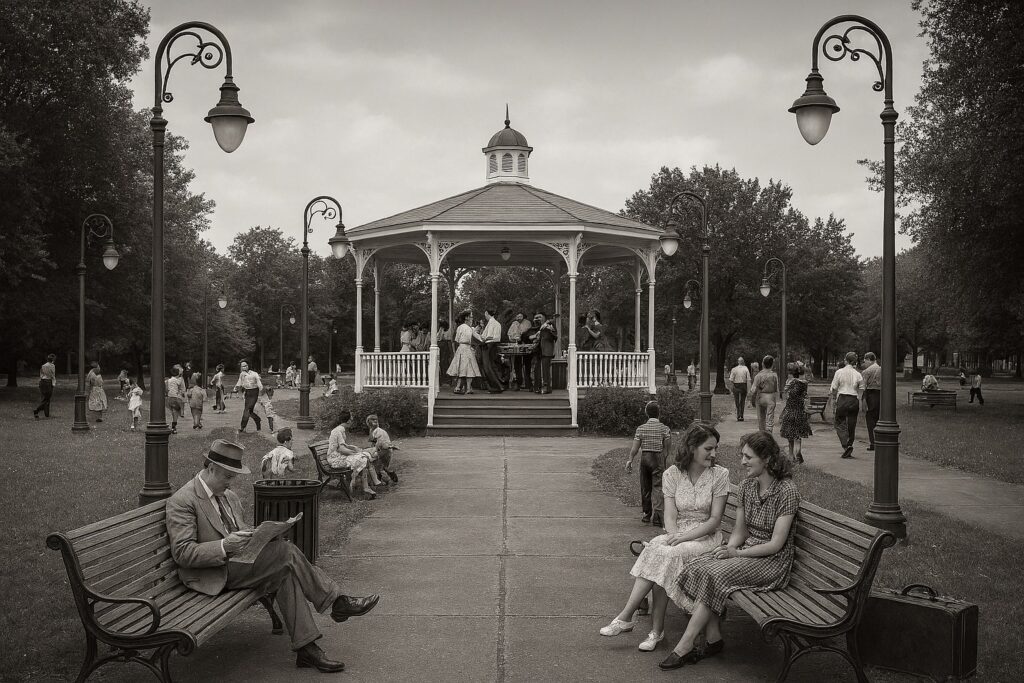
In the middle of the night, a hauntingly beautiful melody stirred Peggy awake. The sound was distant, yet so familiar—the waltz Ethan’s grandfather had written. The music filled her mind and heart, easing the emptiness she felt without Ethan by her side. She closed her eyes, concentrating on the melody, and flashes of him began to fill her mind. She saw him leaving a house, walking past stores and shops. The images came fast, from multiple angles, the faces of the people passing him blurred or turned away. She watched as he walked through a park, where a gazebo stood in the distance, and she heard the same waltz playing over and over. People were dancing, and she could see Ethan, playing his violin, joined by other musicians whose instruments added to the enchanting accordion melody.

As a young woman began to sing, people started to crowd her view of the gazebo. She pushed forward, trying to get a clearer look, but she could only make out Ethan. Then she tripped and fell. She sat up, looking at what had caused her to stumble—a suitcase that looked just like Ethan’s grandfather’s accordion case. The accordion music softened, playing alone now. The images and the music slowly faded away. Peggy was left alone on the couch, staring into the dark apartment, the memory of the music and the vision of Ethan still vivid in her mind.

Dear Shirley

Dear Shirley,
I’m writing to you today with a heavy heart and a mind full of worry. My son, Robert, is 15 and has become a stranger in his own home. He spends every waking moment locked away in his room, either with his nose in a book or scribbling away in a notebook. On the rare occasions he emerges from his room, I can hear that awful jazz music playing on his phonograph—it’s hardly fit for polite society, let alone a growing boy.

His friends call, but he just tells them he’s “busy.” Busy with what, I ask? Just yesterday, while he was at school, I went into his room and read some of his stories. It was all about the past, a time he’s never known. He wishes he could go back and live a different life. It’s all quite disturbing, to be honest.

I’m afraid he’s being sucked into this made-up world, and one day he’ll just disappear into it forever. I worry about him, about his future. How will he ever get a good job if he has no friends and no social skills? All the other boys his age are out playing baseball or going to the movies. My Robert just wants to hide away. Please, Shirley, tell me what to do. How do I save him from himself?

Sincerely,
A Concerned Mother


Dear Concerned Mother,
It seems you’ve found yourself in a rather peculiar predicament. It’s a tale as old as time, really: a mother worried her son is turning into a… well, a thinker. Oh, what a terrible fate that would be. One can only imagine the horrors of a child who prefers the company of books and his own thoughts to the rough-and-tumble world outside.

Let’s dissect this, shall we? You’re concerned he’s a “hermit.” You’ve even gone so far as to spy on him and read his private writings. A mother’s love, it seems, knows no bounds—nor does her curiosity. You’ve discovered he has a vibrant imagination, a longing for something more, and a passion for things like writing and music. And your reaction? Fear. You’re afraid he’s being “sucked into” this world, and you’re worried about his social life.

Tell me, what exactly is “normal” for a teenage boy? Is it a life spent chasing a ball, going to movies or following the crowd? And what, pray tell, is so wrong with being different? Perhaps your son is not destined to be just like all the others. Perhaps he is meant to be a creator, a dreamer, a storyteller. What is so frightening about that?

Instead of trying to “save him from himself,” perhaps you should be asking yourself what you’re trying to save him from. Are you worried about what the neighbors will think? Or are you simply uncomfortable with a son who is not a carbon copy of the boys in the other families on the street?

Instead of criticizing this “fantasy world” he has created, why don’t you try to understand it? Ask him about his stories. What inspires him? Who are his characters? Perhaps this “fantasy world” is simply a way for him to make sense of the real one. Instead of seeing his creativity as a threat, see it as a gift. He has a mind that can travel through time and create entire worlds out of thin air. How many people can say that?

Your son is not a project to be fixed. He is a young man with a unique mind and a rich inner life. The only thing you need to worry about is whether you’ll allow yourself to be a part of it.

With some common sense,
Shirley

Scene 5 – Post-Production Purgatory

Setting: Basement editing room at the University of Wisconsin – Milwaukee. A large dimly lit room with tables of various shapes and sizes randomly placed throughout the room. Each table has a 16mm film viewer and editor of various brands and conditions. Used 30 gallon fiber drum containers are scattered across the room each filled with discarded 16mm film strips. 

JEFF (O.S.): Weeks had passed, marked by lukewarm coffee, philosophical debates that circled like confused pigeons, and the persistent aroma of Marvin’s questionable snacks. The screenplay, a delicate ecosystem of neuroses and half-baked ideas, had somehow morphed into actual footage. Now, they found themselves in the dimly lit, slightly sticky confines of the college’s editing room.

(SFX: The low hum of editing equipment, the occasional click and whir)

DEBORAH: Okay, so I think if we cut from Bartholomew’s close-up – the one where he looks particularly burdened by the concept of eternal recurrence – directly to the shot of the overflowing ashtray…

CYNTHIA: (Without taking her eyes off her imaginary cigarette) It lacks a certain… despair. Maybe a slow zoom on a wilting houseplant? Symbolizing the decay of hope?

LEONARD: Or perhaps we intercut it with footage of rush hour traffic? The relentless, meaningless movement of the masses mirroring Bartholomew’s internal struggle against the tyranny of the aquarium.

STANLEY: (Gesturing dramatically) No, no, no! We need visual dynamism! What about a montage? Quick cuts! Bartholomew staring intensely, then a nuclear explosion (stock footage, of course), then a baby crying, then a close-up of a melting ice cream cone! It’ll be… Eisensteinian!

MARVIN: (Rummaging through a large, overflowing trash can filled with discarded strips of 16mm film) Has anyone seen the footage of the pigeon eating that discarded hot dog? I think it might… resonate.

DEBORAH: Marvin, we’re trying to establish Bartholomew’s profound intellectual crisis, not the culinary habits of urban wildlife.

MARVIN: But there’s a certain… existential dread in that pigeon’s relentless pursuit of processed meat. The futility of its desires mirroring… well, you know.

LEONARD: He might have a point. The base urges of the physical world juxtaposed with the lofty aspirations of the… ichthyoid intellect.

STANLEY: Absolutely not! We’re not making a documentary about vermin! This is about a Nietzschean goldfish! Think big! Think… Fellini, but with scales!

CYNTHIA: Fellini was depressing. At least the pigeon has a hot dog. A fleeting moment of greasy satisfaction in an otherwise bleak existence.

MARVIN: (Pulling out a tangled strip of film) Aha! Here it is. Look at the raw hunger in its beady little eyes. The sheer, unadulterated need.

(SFX: The whirring sound of film being pulled)

DEBORAH: Marvin, what else is in that trash can? Please tell me you’re not planning on incorporating outtakes of Stanley tripping over the microphone.

MARVIN: (Holding up another strip) Oh, this is interesting. It looks like… Mrs. Henderson’s cat chasing a wind up toy mouse. Remember that B-roll we shot for… I can’t even recall what scene.

LEONARD: The scene where the protagonist briefly considers the seductive allure of feline domesticity before reaffirming his commitment to intellectual rigor? We cut it. It felt… tangential.

STANLEY: Tangential? It was an affront to the very core of our cinematic vision! A fluffy distraction from the weighty themes of free will and… and fish philosophy!

CYNTHIA: Maybe the cat represents the protagonist’s subconscious desire for simple pleasures, a respite from the burden of existential awareness. The wind up toy mouse is the fleeting, ultimately unattainable nature of happiness.

MARVIN: (Holding up yet another strip) And this! This appears to be… static. Just pure, unadulterated visual noise.

DEBORAH: That was when the camera jammed. We lost a good ten minutes of Leonard’s intensely brooding close-up.

LEONARD: (Sighs dramatically) Perhaps it was a sign. The universe itself protesting against my attempts to convey the ineffable through the limitations of celluloid.

STANLEY: We can use the static! It represents the void! The terrifying nothingness that underlies all existence! We’ll call it… ‘Ode to the Abyss’!

CYNTHIA: Or maybe it just means someone forgot to check the film gate.

MARVIN: (Squinting at a particularly crumpled piece of film) Wait a minute… What’s this? It looks like… a close-up of an exploding bagel.

(SFX: A faint, crackly sound, like old film running through a projector)

DEBORAH: Oh, god. We filmed that? I thought we agreed that was a… a metaphor gone awry.

LEONARD: But the sheer randomness of it! The unexpected eruption of breakfast pastry! It’s almost… Beckettian!

STANLEY: We have to use it! It’s the perfect punctuation mark for Bartholomew’s descent into nihilistic despair! The bagel explodes, mirroring the shattering of his belief in… in fishy metaphysics!

CYNTHIA: It’s just an exploding bagel, Stanley. Maybe it just got too hot.

MARVIN: (Smiling faintly) You know, for a brief, chaotic moment, that bagel achieved a kind of… liberation. It transcended its bagel-ness.

DEBORAH: (Massaging her temples) We have to finish this film. We have a deadline. Can we please focus on the footage we intentionally shot?

LEONARD: But perhaps the unintentional footage holds a deeper truth. The subconscious of our cinematic endeavor revealing itself through discarded frames and exploding carbohydrates.

STANLEY: We’ll call it… ‘Bagel Ex Machina’!

CYNTHIA: I need another imaginary cigarette. This is giving me a real headache.

MARVIN: (Holding up the pigeon footage again) Just think about it. The pigeon. The bagel. Both striving, in their own way, for… something.

JEFF (O.S.): And so, amidst the discarded remnants of their artistic ambitions and the lingering scent of burnt sugar, they continued to tinker. The line between profound insight and utter nonsense blurred with each passing frame. The film, much like their collective sanity, hung precariously in the balance, a testament to the enduring power of existential angst and the surprising cinematic potential of breakfast gone wrong.

(SFX: The low hum of editing equipment continues, joined by a frustrated sigh from Deborah)

(SCENE END)

WRYL Presents

The Wit And Wisdom Of Horace B Miesner

Happiness is just sadness that hasn’t happened yet.


WRYL – The Voice of the Great Up North

Chapter 13: Goodbye Grandpa – Part 3

Ethan did go home, but only to gather his clothes and personal belongings. His father was at work, a small mercy, but his mother was there, and the hour that followed was a living hell. She insisted he stay, telling him he’d never make it in life, that he was living in a fantasy world. She reminded him he wasn’t good enough, and that when he failed, he shouldn’t come crying back. As he walked out the door, backpack slung over his shoulder, she cried out, “The police are going to call and say they found you dead one day in a back alley! You’ll be on a slab in the morgue!” Ethan turned, met her tear-streaked gaze, and simply said, “I’m going now, Mom. I love you.” With that, he backed Bessie out of the driveway and drove towards a new life.

College, liberated from the suffocating pressure of home, became a different experience entirely. Ethan’s grades soared. He found a part-time job at an off-campus college bookstore. Ethan was able to adjust his financial aid to help cover his share of the rent and food. He even managed to keep Bessie. Life, finally, felt good. Ethan was happy. Amy and Russel, captivated by his storytelling prowess, urged him to take creative writing classes. Peggy was his unwavering support, her love for him growing stronger each day, a mirroring reflection of his own deepening affection for her.

Ethan’s curiosity pulled him into the world of theater. He discovered a passion for set design, the magic of stage lighting, the transformative power of stage makeup, and the intricate art of sound design. He thrived behind the scenes, far from the spotlight he’d never craved. He also delved into filmmaking, captivated by the tactile nature of 8mm and 16mm film. He took a class in film processing and, with his roommates’ enthusiastic help, set up a darkroom in the duplex basement.

His creative writing continued to flourish. He’d spend hours at the kitchen table, filling notebook after notebook. Peggy would bring him tea, settling in to read his latest stories, offering thoughtful insights. When writer’s block struck, he’d bounce ideas off Peggy, Amy, and Russel, sometimes staying up most of the night, exploring multiple story scenarios. He even found an old cassette recorder at Goodwill and began taping these brainstorming sessions, a living archive of their shared creativity. Ethan was at peace. He was in love with Peggy, and she with him. He had, at last, found the happiness that had eluded him for so long.

One Saturday afternoon, while Ethan was shelving books at the college bookstore, he looked up and saw his grandfather standing there. A jolt of fear shot through him. His carefully constructed world, his newfound happiness, felt poised to shatter. His grandfather walked closer, a gentle smile on his face. “Relax, son,” he said, his voice soft. “Don’t worry. I’m not going to tell your parents where you’re working. I just wanted to talk.” He asked when Ethan’s shift ended.

Just then, Peggy walked in, a bag of groceries in her arms, waiting to walk home with Ethan. Ethan, still a little shaken, introduced her. His grandfather, sensing Ethan’s apprehension, quickly reassured Peggy. “Don’t worry, dear, I won’t say a word to his parents.” Ethan’s shift ended, and his grandfather offered them a ride home. Ethan glanced at Peggy, who was staring at his grandfather, a curious expression on her face. There was something familiar about him, as if she knew him from somewhere she couldn’t quite place. Yet, she felt an instant trust.

They drove to the duplex. Inside, Ethan introduced his grandfather to Amy and Russel. The flicker of apprehension that crossed the roommates’ faces, was quickly replaced by genuine warmth when Ethan’s grandfather cheerfully suggested they order some pizza. The evening flowed beautifully. Ethan’s grandfather regaled them with stories from his past, many of which Ethan had heard before, but still loved to hear again. Then, his gaze softened as he looked at Ethan. “Many years ago, Ethan, I made a promise not to talk about certain things I did in my life. They thought it might lead you down the wrong path. But your parents were wrong to ask that. You deserve to know these stories. You deserve to know who I was and why I changed my life.”

Peggy, Amy, and Russel began to rise, thinking this was a private moment between grandfather and grandson. But Ethan’s grandfather gestured for them to stay. “You four,” he said, his voice filled with admiration, “you are all amazing individuals. Your talents are incredible. Don’t let anyone take away your dreams and aspirations. I let someone take away mine, and I’ve regretted it for many years. Never stop dreaming. Never stop loving. ” he continued, his eyes sparkling, “Ethan, I have never seen you so happy. And it’s not just about you and Peggy, though I can see how much you two are in love. It’s much more than that. And this house… this house is amazing. It’s been a long time since…” He trailed off, a quiet sadness washing over him. Then, he looked at Russel, tossing him his car keys. “Would you mind going down to my Chevy Impala and bringing up the suitcase in the trunk?”

Russel, sensing the moment’s importance, did as he was asked, returning with what appeared to be an old suitcase. Ethan’s grandfather opened it, revealing a beautifully preserved accordion. He strapped it on, a nostalgic smile touching his lips. “It’s been a while,” he said to everyone, “and I might be a bit rusty.” He began to play.

The music filled the room, a cascade of notes, vibrant and alive. Amy, Russel, Peggy, and especially Ethan were mesmerized, watching Ethan’s grandfather, this quiet man, transform into a vibrant musician. The music was pure magic. “Ethan,” his grandfather urged, “get your violin and play along!” Ethan did, his fingers finding the familiar strings, joining the melody. It wasn’t perfect, but it was wonderful, a spontaneous symphony of generations. Amy, Peggy, and Russel began to sing along to the songs they knew, their voices blending with the accordion and violin. After several more songs, the music faded.

Ethan’s grandfather looked at them all, his eyes brimming. “My life is complete,” he said, his voice soft. “I’d like to play one last number. This is a waltz I wrote many years ago, when I was young, ambitious, imaginative, and in love. I would love it to be my last dance.” He began to play. The melody was hauntingly beautiful, a bittersweet embrace of joy and longing. Ethan put his violin down and took Peggy’s hand, twirling her into a gentle dance. Amy and Russel joined in, their happiness echoing through the old house. For a moment, it seemed as if the entire world was dancing to grandfather’s music.

And then, like all songs, it had to end. A quiet sadness settled, a profound awareness that this melody, in this way, might never be played again. Ethan’s grandfather carefully placed the accordion back in its case, closing it with a finality that suggested it was truly the last time. He glanced out the window; darkness had fallen. “I better head for home,” he said, “or else your grandmother is going to give me hell.”

Russel offered to carry the accordion down to the car. “No, that won’t be necessary,” Ethan’s grandfather replied. “I won’t be playing anymore. Ethan, I want you to have it.” Ethan’s eyes welled up. “No, Grandpa,” he whispered, “I could never accept something like this.” His grandfather looked lovingly into Ethan’s eyes. “I want you to have this, and I want you to always remember.” A tear traced a path down everyone’s cheek. Ethan hugged his grandfather tightly, whispering, “I will remember.”

Ethan’s grandfather, wiping away a tear, said, “Walk with me out to my car.” They walked in comfortable silence. At the car, his grandfather turned to Ethan. “Never let anyone take your imagination away from you. Your imagination is your life. I love you, Ethan. I love you more than you can possibly know. Let your imagination take you anywhere, anytime, or any place. Looking forward to seeing…” He paused, his gaze fixed on Ethan, then got into his car. He rolled down the window, looked at Ethan one last time, and said, “Looking forward.” With that, he drove off into the night.

The Uncomfortable Grace of Working Together

A House Divided

Friends, family, and fellow travelers on this journey, I want to talk to you today about a simple but profound truth. It’s about working together. About finding common ground when the earth beneath us feels shaky. It’s about a concept we all understand in our hearts, but sometimes forget in our actions: compromise.

We live in a world that often feels divided. We see it in our homes, in our communities, and on the grand stage of our society. It’s easy to believe that there are only two paths: a right one and a wrong one. My way or the highway. But life, my friends, is rarely so clear-cut. It’s not always a choice between black and white. It’s often a choice to embrace the gray—to see that the best path forward might be a new one, a path we forge together.

Think about a mighty river. A single rock in its path can cause the water to swirl and eddy, but the river eventually finds its way around. But if you fill that river with a hundred stubborn rocks, all vying for the same space, the water becomes stagnant. It stops flowing. It becomes a marsh, not a river. Our communities can be like that. When we are stubborn and resistant to change, when we insist on doing things just because “that’s the way we’ve always done them,” we stop moving forward. We stagnate.


The Uncomfortable Grace of Change

Change is uncomfortable. It’s a fact. It stretches us. It forces us to reconsider old ideas and familiar routines. Our first instinct is often to fight it, to cling to what we know. But resisting change can create bitter divides. It turns neighbors into adversaries and turns a community into a collection of factions.

The beauty, the grace, and the strength of a community come not from a lack of conflict, but from the ability to overcome it. We are not called to fight and bicker and shout each other down. We are called to listen. To respect. To seek understanding. And yes, sometimes, we are called to give in a little. To make a compromise for the good of the whole.

This doesn’t mean you must abandon your beliefs. It means you must hold them with open hands, not with clenched fists. It means understanding that your truth is not the only truth, and that a different perspective can enrich our collective vision.


The Path of Togetherness

When we work together, even when we disagree, we are living out the truest expression of community. We are building a bridge where there was once a chasm. We are planting a seed of cooperation that will one day blossom into prosperity for everyone.

You may not get your way every time. That’s okay. That doesn’t mean you should condemn others or walk away from the table. It means you’ve had the courage to participate, to listen, and to contribute to something bigger than yourself. It means you’ve chosen the path of progress over the comfort of stagnation.

Let’s commit to being a people who work together. A people who are willing to compromise, not because we are weak, but because we are strong enough to change. A people who understand that true growth comes not from winning an argument, but from building a community where everyone feels heard, valued, and loved. Let’s be a river that flows, not a pond that stands still. Amen.

Dear Shirley

Dear Shirley,
I’m at my absolute wit’s end, and I fear my thoroughly modern kitchen will soon be the scene of a rather un-modern meltdown. My husband’s parents, bless their cotton socks, have decided that our humble abode is merely an extension of their own, and my life, a delightful little play in which they are the uncredited directors.

My mother-in-law, “Agnes,” is a veritable whirlwind of unsolicited advice. She critiques my perfectly adequate casserole dishes, suggests I “dust more thoroughly” (as if I were a mere slip of a girl who just learned to keep house!), and has even dared to rearrange my linen closet, claiming my towels were not “folded with proper respect.” And don’t even get me started on her “helpful” tips for raising our children – apparently, a good smack on the bottom is still the cure-all for everything from a scraped knee to a less-than-perfect report card.

Then there’s Father-in-law, “Clarence,” who insists on “stopping by” unannounced almost daily to “check on things.” He’ll march right into the garage to inspect my husband’s tools, offer booming opinions on our lawn care, and once, he even timed how long it took me to get dinner on the table. My husband, bless his dear heart, just chuckles and says, “That’s just Ma and Pa!” I love him, Abby, but I feel like I’m living in a fishbowl, constantly under the judgmental gaze of the ” elders.”

How can I politely, yet firmly, tell them to mind their own beeswax without causing a family ruckus that would surely be the talk of the Ladies’ Aid Society for weeks? I’m afraid I’ll lose my perfectly groomed temper!

Sincerely,
A Modern Homemaker on the Brink


Dear Modern Homemaker,
My, my, it sounds as if you’ve got yourself a classic case of what we call “over-cultivated family gardens.” Agnes and Clarence, it seems, believe your life is just another plot that requires their expert pruning and fertilizing, whether you asked for it or not!

Let’s address this delicate situation before you find yourself serving burnt toast and a side of bitter resentment at Sunday dinner.

The Gentle Art of Drawing Lines

First, your dear husband. While his “that’s just Ma and Pa!” attitude is sweet, it’s about as helpful as a screen door on a submarine. Have a quiet word with him, perhaps over a perfectly brewed cup of coffee (made to your specifications, of course). Explain, gently but firmly, that while you adore his parents, a little less “help” would go a long way in preserving your sanity – and your marriage. He needs to understand that a united front is essential, even if it feels a tad disloyal. Remind him that a happy wife makes for a happy life, and frankly, a less critiqued casserole.

Now, for Agnes and Clarence. This requires the finesse of a debutante at a tea party, combined with the quiet determination of a well-behaved housewife who knows her own mind.

  • For Agnes, the Domestic Dictator: When she offers a critique on your spotless home, a cheerful yet dismissive, “Oh, Agnes, isn’t that just darling? I find this way works perfectly for our family,” should do the trick. If she starts rearranging your towels again, a polite, “Oh, please don’t trouble yourself, Agnes. I just tidied those!” delivered with a firm hand on the linen closet door, should send the message. Remember, a smile can hide a multitude of internal eye-rolls.
  • For Clarence, the Unannounced Inspector: When he pops over uninvited, greet him at the door with a beaming smile and a slight hint of business. “Clarence, how lovely to see you! We were just in the middle of [insert any legitimate (or semi-legitimate) activity here – ‘polishing the silver,’ ‘sorting stamps,’ ‘balancing the checkbook’]. Do come in for a moment, but we’ll have to get back to it shortly.” Make it clear that while you are hospitable, your schedule dictates the visit. And perhaps “forget” to hear the doorbell once or twice. Accidents do happen, you know.

The Power of a Unified Front

The key, my dear, is consistency and a subtle, unyielding refusal to engage in debates. You are not asking for permission; you are politely stating facts about your home and your life. They may huff, they may puff, they may even try to garner sympathy from the bridge club, but eventually, they will learn that their unsolicited advice is bouncing off a perfectly polished, polite, but impenetrable shield.

Remember, a little distance often makes the heart grow fonder, especially when that distance involves a respectful understanding of personal boundaries. Now, go forth, reclaim your linen closet, and enjoy your perfectly adequate casserole. You’ve earned it!

Warmly (and with a wink),
Shirley

« Older posts Newer posts »

© 2026 Red Berry Workshop

Theme by Anders NorenUp ↑

error: Content is protected !!